Oxfordshire · England
Steel security bollard installation in Didcot
Steel security bollards supplied and fitted in Didcot, Oxfordshire: surveyed, scanned for services, set in proper foundations and finished to match the ground.
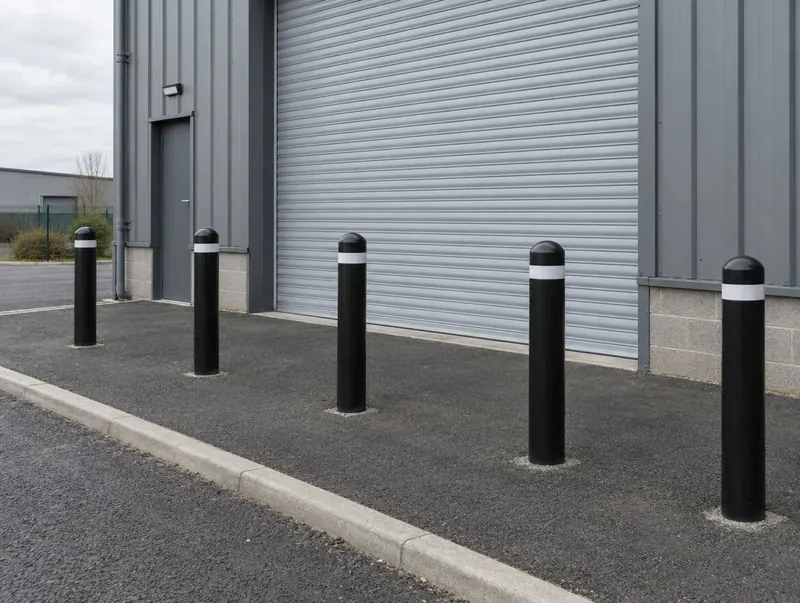 Computer-generated image
Didcot steel security bollards
Unrated steel bollards have not been crash-tested, so they deter vehicles and stop low-speed knocks and casual misuse rather than a determined attack. In Didcot, that tends to mean sites such as filling-station forecourts, schools and small industrial units.
We cover Didcot's OX11, OX14 and OX10 postcode districts, including places such as East Hagbourne, Aston Upthorpe, South Moreton and Long Wittenham. Jobs in Didcot can be combined with work in Abingdon (4.6 miles), Oxford (9.9 miles), Thatcham (14.2 miles) and Newbury (14.8 miles) (straight-line distances). Reading is around 16 miles away.
Local details
- Area
- Oxfordshire, England
- Highway authority
- Oxfordshire County Council (local roads)
- Planning authority
- the council for South Oxfordshire
- Postcodes
- OX11, OX14 and OX10
- Guide price
- Typically £205–£945 per bollard + VAT (£245–£1,145 inc VAT for homes); minimum job £625
- Survey
- Free, with a fixed written quote
Didcot: typical steel security bollard prices
| Specification | Guide price | Includes |
|---|---|---|
| Standard | £205–£515 + VAT · £245–£615 inc VAT | Standard post, foundation, reinstatement |
| Upgraded | £425–£745 + VAT · £505–£885 inc VAT | Upgraded finish or fittings, reflective band, matched keys |
| Premium | £655–£945 + VAT · £785–£1,145 inc VAT | Heavy-duty or architectural spec, premium finish |
Per bollard, supplied and installed; +6% for South East. Guide only — the fixed price follows a survey.
Typical steel security bollards jobs in Didcot
Typical reasons Didcot sites choose steel security bollards:
- Social housing estates with nuisance parking
- Lines between pedestrian routes and service yards
- Protecting meter boxes, gas kiosks, pillars and corners
Before we dig in Didcot
Oxfordshire County Council is the highway authority covering Didcot's local roads. If any post would stand on adopted highway rather than your land, that consent is the first thing we sort out.
Many private-land installations in Didcot need no planning application, but the rules don't clearly cover bollards, so listed buildings, conservation areas and prominent frontages are worth raising with the planning team at the council for South Oxfordshire before posts go in.
Reinstatement matches the surface, whether tarmac, block paving, flags or turf. Verges are often softer than they look, and the edges of car parks may be thin tarmac over hardcore, so the foundation is sized to the ground found.
- Fit contrasting or reflective bands near the top so posts are visible, as Inclusive Mobility guidance recommends.
- Check whether the land is public highway or adopted verge before installing; the highway authority's agreement is usually needed.
How the job runs
Survey and set out
A free site survey confirms positions, surfaces, buried services and whether root-fixing or base plates suit the ground. You receive a fixed written quote listing post size, finish and fixing.
Break out and excavate
For root-fixed posts, the surface is cut neatly and each hole is dug to depth, by hand near known services. For base plates, the slab is checked for thickness and soundness.
Fill and cap
Where specified, posts are filled with concrete and capped so water cannot collect inside the tube.
Choosing the right spec
| Option | Detail |
|---|---|
| Finishes | Hot-dip galvanised, then powder-coated in a RAL colour if wanted. Black, grey, yellow and green are common. |
| Caps and heads | Dome, flat, chamfered or ball tops, with welded caps to keep water out of hollow posts. |
| Tube size and wall thickness | Common diameters include 76, 114, 140, 168 and 219 mm, with heavier walls for service yards and vehicle routes. |
What affects the quote
Our South East guide prices are a starting point; the survey in Didcot firms them up. What tends to move them:
- Surface reinstatement such as block paving or tarmac
- Number of posts and length of the line
- Finish: galvanised only or powder-coated
Looking after them
Reflective bands fade and peel and are easy to renew. Powder coat chipped by vehicles should be touched up before the galvanising underneath starts to weather.
If posts in Didcot are later hit or damaged, we can repair or replace them — see bollard repairs.
Steel security bollards in Didcot: FAQs
Can you install steel security bollards anywhere in Didcot?
We cover all of Didcot (OX11, OX14 and OX10) and the rest of Oxfordshire. We also work in Abingdon, Oxford and Thatcham.
Do I need consent for steel security bollards on a public footway in Didcot?
In Didcot, work on adopted pavements and verges needs consent from Oxfordshire County Council, the local highway authority. Car parks, forecourts and other private land only need the owner's permission.
How much do steel security bollards cost in Didcot?
In Didcot, typically £205–£945 per bollard, supplied and installed, plus VAT (£245–£1,145 including VAT for homeowners), with a minimum job of £625 plus VAT, using our South East guide prices. The fixed figure comes in writing after we've seen the site.
Why fill a steel bollard with concrete?
Concrete infill adds weight and stiffness, so the post dents less and is harder to cut. It also stops water collecting inside a hollow tube. It is usual for security and impact positions.
Should I choose root-fixed or base-plated steel bollards?
Root-fixed where you can dig and want the stronger post; base-plated where there is a sound slab and you want quick installation or the option to remove posts later. Base plates are limited by the slab and anchors, so they are not the right choice where vehicles hit hard.
Steel security bollards near Didcot
- Abingdon (4.6 mi)
- Oxford (9.9 mi)
- Thatcham (14.2 mi)
- Newbury (14.8 mi)
- Reading (15.7 mi)
- Witney (15.9 mi)