Oxfordshire · England
Steel security bollard installation in Witney
Planning steel security bollards in Witney? We check ownership, consents and buried services first, then quote a fixed price.
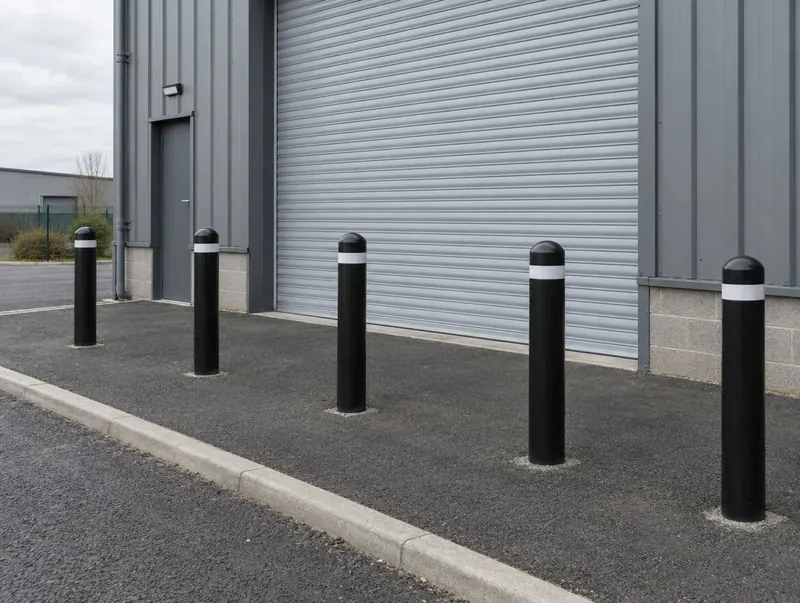 Computer-generated image
About steel security bollards in Witney
Concrete-filled steel bollards, root-fixed or base-plated, for car parks, forecourts, boundaries and nuisance vehicle control. In Witney, that tends to mean sites such as filling-station forecourts, small industrial units and schools.
We cover Witney's OX28, OX29 and OX18 postcode districts, including places such as Eynsham, Long Hanborough, Stonesfield and North Leigh. Jobs in Witney can be combined with work in Oxford (10 miles), Abingdon (11.6 miles), Didcot (15.9 miles) and Bicester (16.3 miles) (straight-line distances). Swindon is around 20 miles away.
Witney at a glance
- Area
- Oxfordshire, England
- Highway authority
- Oxfordshire County Council (local roads)
- Planning authority
- the council for West Oxfordshire
- Postcodes
- OX28, OX29 and OX18
- Guide price
- Typically £205–£945 per bollard + VAT (£245–£1,145 inc VAT for homes); minimum job £625
- Survey
- Free, with a fixed written quote
Typical steel security bollards jobs in Witney
Typical reasons Witney sites choose steel security bollards:
- Social housing estates with nuisance parking
- Protecting meter boxes, gas kiosks, pillars and corners
- Grass verges and landscaped areas that vans keep driving over
What steel security bollards cost in Witney
| Specification | Guide price | Includes |
|---|---|---|
| Standard | £205–£515 + VAT · £245–£615 inc VAT | Standard post, foundation, reinstatement |
| Upgraded | £425–£745 + VAT · £505–£885 inc VAT | Upgraded finish or fittings, reflective band, matched keys |
| Premium | £655–£945 + VAT · £785–£1,145 inc VAT | Heavy-duty or architectural spec, premium finish |
Per bollard, supplied and installed; +6% for South East. Guide only — the fixed price follows a survey.
Permissions and groundwork in Witney
Oxfordshire County Council is the highway authority covering Witney's local roads. If any post would stand on adopted highway rather than your land, that consent is the first thing we sort out.
Bollards on private land often don't need planning permission, but it depends on the council's view, the height and the location; in a conservation area, next to a listed building or under an Article 4 direction, ask the local planning authority (the council for West Oxfordshire) first — we flag this at survey.
Verges are often softer than they look, and the edges of car parks may be thin tarmac over hardcore, so the foundation is sized to the ground found. Base plates must sit on a slab thick and sound enough to hold resin anchors; cracked or thin concrete will let the anchors pull out on the first knock.
- Keep clear gaps of typically at least 1,000–1,200 mm where pedestrians, wheelchair users or buggies pass between posts.
- Check whether the land is public highway or adopted verge before installing; the highway authority's agreement is usually needed.
What happens on site
Break out and excavate
For root-fixed posts, the surface is cut neatly and each hole is dug to depth, by hand near known services. For base plates, the slab is checked for thickness and soundness.
Set the posts
Posts are set plumb and to a consistent height along the line, and concreted in. Base-plated posts are drilled, anchored with resin and torqued once cured.
Fill and cap
Where specified, posts are filled with concrete and capped so water cannot collect inside the tube.
Options to consider
| Option | Detail |
|---|---|
| Finishes | Hot-dip galvanised, then powder-coated in a RAL colour if wanted. Black, grey, yellow and green are common. |
| Visibility bands | Reflective or contrasting bands near the top for drivers at night and for partially sighted pedestrians. |
| Tube size and wall thickness | Common diameters include 76, 114, 140, 168 and 219 mm, with heavier walls for service yards and vehicle routes. |
Pricing steel security bollards in Witney
Our South East guide prices are a starting point; the survey in Witney firms them up. What tends to move them:
- Root-fixed or base-plated installation
- Number of posts and length of the line
- Ground conditions and buried services
After installation
Galvanised steel posts need little attention for years at a time. A post that leans after a knock usually means the foundation has moved or cracked; it should be re-bedded or replaced rather than left as a trip or snag hazard.
We can also service, repair or replace existing posts anywhere in Witney.
Common questions
Which parts of Witney do you cover for steel security bollards?
We cover all of Witney (OX28, OX29 and OX18) and the rest of Oxfordshire. We also work in Oxford, Abingdon and Didcot.
Who gives permission for bollards on the pavement in Witney?
In Witney, work on adopted pavements and verges needs consent from Oxfordshire County Council, the local highway authority. Car parks, forecourts and other private land only need the owner's permission.
How much do steel security bollards cost in Witney?
In Witney, typically £205–£945 per bollard, supplied and installed, plus VAT (£245–£1,145 including VAT for homeowners), with a minimum job of £625 plus VAT, using our South East guide prices. The fixed figure comes in writing after we've seen the site.
Should I choose root-fixed or base-plated steel bollards?
Root-fixed where you can dig and want the stronger post; base-plated where there is a sound slab and you want quick installation or the option to remove posts later. Base plates are limited by the slab and anchors, so they are not the right choice where vehicles hit hard.
Can new posts match our existing ones?
Usually, if we can measure the existing diameter, height, cap and colour. Galvanised steel in standard sizes is easy to match; older or unusual sections may need a close equivalent.
Steel security bollards near Witney
- Oxford (10 mi)
- Abingdon (11.6 mi)
- Didcot (15.9 mi)
- Bicester (16.3 mi)
- Swindon (20.1 mi)
- Banbury (20.3 mi)