Angus · Scotland
Telescopic bollard installation in Montrose
Telescopic bollards for sites across Montrose and the rest of Angus, from the first measurement to the last relaid paving block.
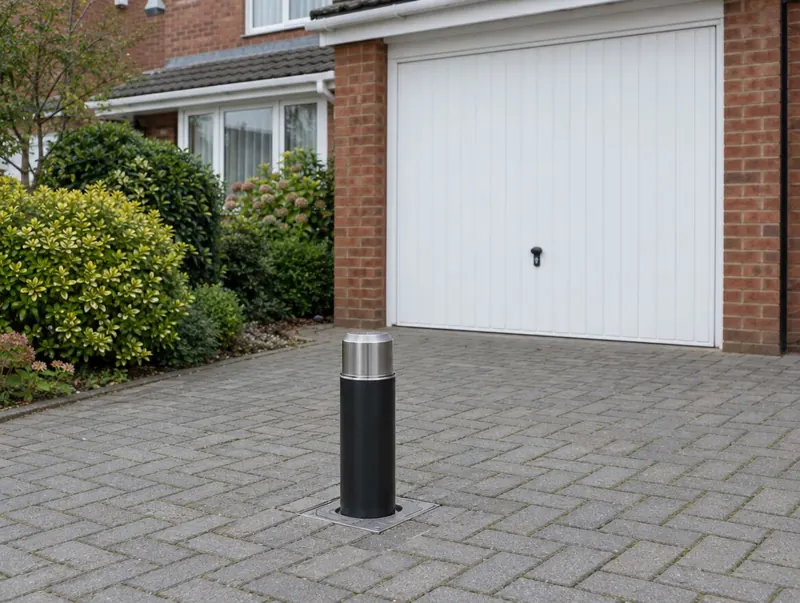 Computer-generated image
About telescopic bollards in Montrose
In the town of Montrose, telescopic bollards tend to go in at schools, residential driveways and small industrial units. Because the post stays in its cassette, there is nothing to store and nothing to lose.
We work across DD10 — Montrose itself and places including Hillside and Craigo. We also cover neighbouring Arbroath (11.6 miles), Forfar (16.8 miles), Carnoustie (17.4 miles) and Stonehaven (19.6 miles) — distances are straight-line.
Local details
- Area
- Angus, Scotland
- Roads authority
- Angus Council (local roads)
- Planning authority
- Angus Council
- Postcodes
- DD10
- Guide price
- Typically £345–£1,195 per bollard + VAT (£405–£1,445 inc VAT for homes); minimum job £645
- Survey
- Free, with a fixed written quote
- Nearby
- Arbroath (11.6 mi), Forfar (16.8 mi), Carnoustie (17.4 mi), Stonehaven (19.6 mi)
Guide prices for Montrose
| Specification | Guide price | Includes |
|---|---|---|
| Standard | £345–£705 + VAT · £405–£845 inc VAT | Standard post, foundation, reinstatement |
| Upgraded | £605–£955 + VAT · £725–£1,145 inc VAT | Upgraded finish or fittings, reflective band, matched keys |
| Premium | £855–£1,195 + VAT · £1,045–£1,445 inc VAT | Heavy-duty or architectural spec, premium finish |
Per bollard with cassette, supplied and installed; no regional adjustment. Guide only — the fixed price follows a survey.
Telescopic bollards in Montrose: common uses
Common uses in a place like Montrose:
- Shared drives that need occasional closing
- Domestic driveways where the bollard is used daily
- Access roads closed outside working hours
Permissions and groundwork in Montrose
For anything on the public footway in Montrose we check with the roads authority first — Angus Council for local roads, Transport Scotland on trunk routes. Private ground such as a car park or forecourt only needs the owner's go-ahead.
Bollards on private land often need no planning application, but listed buildings and conservation areas are different; the planning service at Angus Council can confirm before anything is ordered.
Telescopic bollards need a deeper excavation than other manual bollards, so ground and services decide where they can go. Clay soils and high water tables mean a gravel base alone will not drain the cassette; a connection to a surface water drain or a separate soakaway is then needed, and foul drains are not used.
- Connect drainage only to surface water systems or a soakaway, never to a foul drain.
- Leave access for emergency services on commercial and multi-occupancy sites, and record who holds keys.
What happens on site
Check depth and drainage
The free site survey checks how far down we can dig, where services run under the drive and how the ground drains. If water will stand, a drain connection is priced into the fixed written quote.
Form the drainage
A gravel soakaway is placed beneath the cassette, or a pipe is laid to a surface water drain or new soakaway.
Reinstate and test
The surface is made good to match. The post is raised, locked, lowered and locked several times to confirm smooth operation, and keys are handed over.
Choosing the right spec
| Option | Detail |
|---|---|
| Lock types | Keyed cylinder locks, often with a cover to keep out dirt; keyed alike for multi-bay sites where one key should open every post. |
| Finishes | Galvanised, powder-coated in common colours, or stainless steel to suit the frontage. |
| Reflective bands | Bands near the top help drivers see a raised post at night, particularly on drives shared with visitors. |
What moves the price in Montrose
When we price telescopic bollards in Montrose, these make the biggest difference:
- Stainless or powder-coated finish
- Number of posts and keyed-alike locks
- Surface type and quality of reinstatement
Keeping them working
Lubricate the lock with a suitable spray, especially before winter. Clear leaves and grit from around the lid, and a few times a year lift the post fully and look into the cassette for standing water or silt.
We can also service, repair or replace existing posts anywhere in Montrose.
Telescopic bollards in Montrose: FAQs
Do you install telescopic bollards in Montrose?
We cover all of Montrose (DD10) and the rest of Angus. We also work in Arbroath, Forfar and Carnoustie.
Do I need consent for telescopic bollards on a public footway in Montrose?
For anything on the public footway in Montrose we check with the roads authority first — Angus Council for local roads, Transport Scotland on trunk routes. Private ground such as a car park or forecourt only needs the owner's go-ahead.
How much do telescopic bollards cost in Montrose?
In Montrose, typically £345–£1,195 per bollard with cassette, supplied and installed, plus VAT (£405–£1,445 including VAT for homeowners), with a minimum job of £645 plus VAT, using our Scotland guide prices. The fixed figure comes in writing after we've seen the site.
Why does my telescopic bollard fill with water?
Because the cassette is not draining, either through a blocked base, clay ground or no drainage provision at installation. Standing water rusts the post and can freeze it in place. Fixing the drainage usually solves the problem.
How deep does a telescopic bollard go into the ground?
Usually around the exposed height of the post plus the cassette base and drainage layer, which often comes to a metre or more. The exact depth depends on the model. That depth is why we check for services under the drive first.