Belfast · Northern Ireland
Telescopic bollard installation in Belfast
Planning telescopic bollards in Belfast? We check ownership, consents and buried services first, then quote a fixed price.
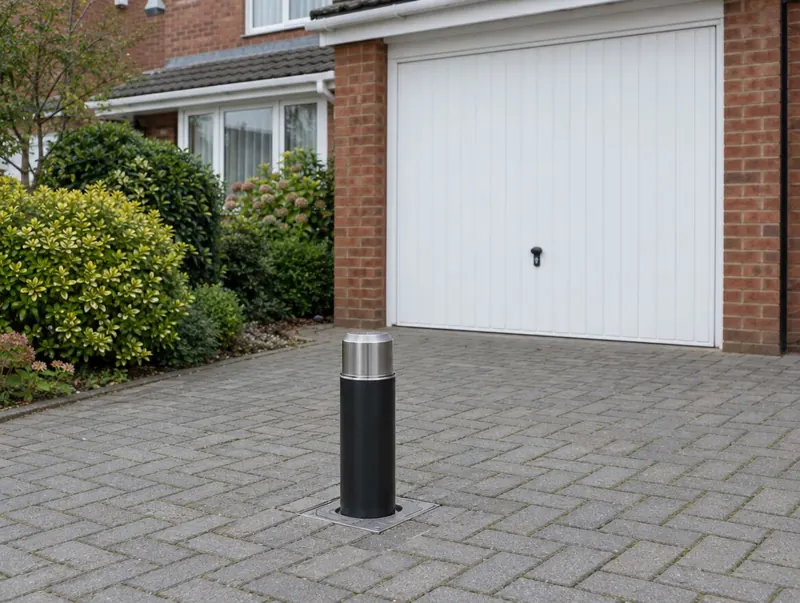 Computer-generated image
About telescopic bollards in Belfast
Because the post stays in its cassette, there is nothing to store and nothing to lose. In Belfast, that tends to mean sites such as university campuses, distribution parks and multi-storey car parks.
We cover every part of Belfast in the BT1, BT2, BT7, BT12, BT13 and BT6 postcode districts. We also cover neighbouring Holywood (5 miles), Dundonald (5.1 miles), Lisburn (6.7 miles) and Newtownards (9.4 miles) — distances are straight-line.
Key facts for this area
- Area
- Belfast, Northern Ireland
- Roads authority
- the Department for Infrastructure (DfI Roads)
- Planning authority
- Belfast City Council
- Postcodes
- BT1, BT2, BT7, BT12, BT13, BT6, BT3 and BT15
- Guide price
- Typically £335–£1,195 per bollard + VAT (£395–£1,445 inc VAT for homes); minimum job £625
- Survey
- Free, with a fixed written quote
- Nearby
- Holywood (5 mi), Dundonald (5.1 mi), Lisburn (6.7 mi), Newtownards (9.4 mi)
What telescopic bollards cost in Belfast
| Specification | Guide price | Includes |
|---|---|---|
| Standard | £335–£685 + VAT · £395–£815 inc VAT | Standard post, foundation, reinstatement |
| Upgraded | £585–£935 + VAT · £695–£1,095 inc VAT | Upgraded finish or fittings, reflective band, matched keys |
| Premium | £835–£1,195 + VAT · £995–£1,445 inc VAT | Heavy-duty or architectural spec, premium finish |
Per bollard with cassette, supplied and installed; -2% for Northern Ireland. Guide only — the fixed price follows a survey.
Where telescopic bollards go in around Belfast
Typical reasons Belfast sites choose telescopic bollards:
- Shared drives that need occasional closing
- Sites with no power for automatic bollards
- Access roads closed outside working hours
What we check first in Belfast
In Belfast, as everywhere in Northern Ireland, public roads and footways are looked after by DfI Roads rather than the council. If a post would sit on adopted footway, that consent comes first; private forecourts and car parks are a matter for the owner.
Planning in Northern Ireland sits with the councils, so for a listed building or conservation area in Belfast the planning team at Belfast City Council is the one to ask before posts go in.
Drives commonly hide the water supply pipe, gas service, electric cable and drainage runs, often at shallow depth, and they cluster near the property boundary where posts are usually wanted. Clay soils and high water tables mean a gravel base alone will not drain the cassette; a connection to a surface water drain or a separate soakaway is then needed, and foul drains are not used.
- Connect drainage only to surface water systems or a soakaway, never to a foul drain.
- Confirm the bollard is on your land; bollards on a public footway or dropped kerb need DfI Roads' agreement.
From survey to handover
Cut and excavate
The surface is cut neatly and the hole dug to the cassette's full depth plus a drainage layer, with care near any service that crosses the drive.
Form the drainage
A gravel soakaway is placed beneath the cassette, or a pipe is laid to a surface water drain or new soakaway.
Set the cassette
The cassette is set vertical and its top exactly at finished surface level and fall, then concreted in. A cassette set high or low is a common cause of tyre damage and trip edges.
Finishes and options
| Option | Detail |
|---|---|
| Diameter and height | Commonly around 90–140 mm diameter and 600–900 mm raised height, with larger posts for commercial use. |
| Lid and head designs | Flush hinged lids, removable caps or integrated heads that close the cassette top when lowered. |
| Standard or lift-assisted | Lift-assisted models use a spring or counterweight so the post rises with little effort, useful for daily domestic use. |
What affects the quote
When we price telescopic bollards in Belfast, these make the biggest difference:
- Number of posts and keyed-alike locks
- Excavation depth and the presence of services under the drive
- Drainage: simple soakaway or a connection to a drain
After installation
Clear leaves and grit from around the lid, and a few times a year lift the post fully and look into the cassette for standing water or silt. Lubricate the lock with a suitable spray, especially before winter.
If posts in Belfast are later hit or damaged, we can repair or replace them — see bollard repairs.
Common questions
Can you install telescopic bollards anywhere in Belfast?
We cover all of Belfast (BT1, BT2, BT7, BT12, BT13 and BT6). We also work in Holywood, Dundonald and Lisburn.
Who gives permission for bollards on the pavement in Belfast?
Across Northern Ireland the Department for Infrastructure's DfI Roads is the roads authority, so telescopic bollards on a public footway or road in Belfast need its agreement before anything is dug. Posts on your own land do not.
How much do telescopic bollards cost in Belfast?
In Belfast, typically £335–£1,195 per bollard with cassette, supplied and installed, plus VAT (£395–£1,445 including VAT for homeowners), with a minimum job of £625 plus VAT, using our Northern Ireland guide prices. The fixed figure comes in writing after we've seen the site.
How deep does a telescopic bollard go into the ground?
Usually around the exposed height of the post plus the cassette base and drainage layer, which often comes to a metre or more. The exact depth depends on the model. That depth is why we check for services under the drive first.
What if it freezes in winter?
Freezing usually means water is standing in the cassette. Do not force the post; pour warm, not boiling, water around the lid and lift once free. Then have the drainage checked.
Telescopic bollards near Belfast
- Holywood (5 mi)
- Dundonald (5.1 mi)
- Lisburn (6.7 mi)
- Newtownards (9.4 mi)
- Bangor, Ards and North Down (11.2 mi)
- Antrim (14.1 mi)