Lisburn and Castlereagh · Northern Ireland
Telescopic bollard installation in Dundonald
Telescopic bollards for sites across Dundonald and the rest of Lisburn and Castlereagh, from the first measurement to the last relaid paving block.
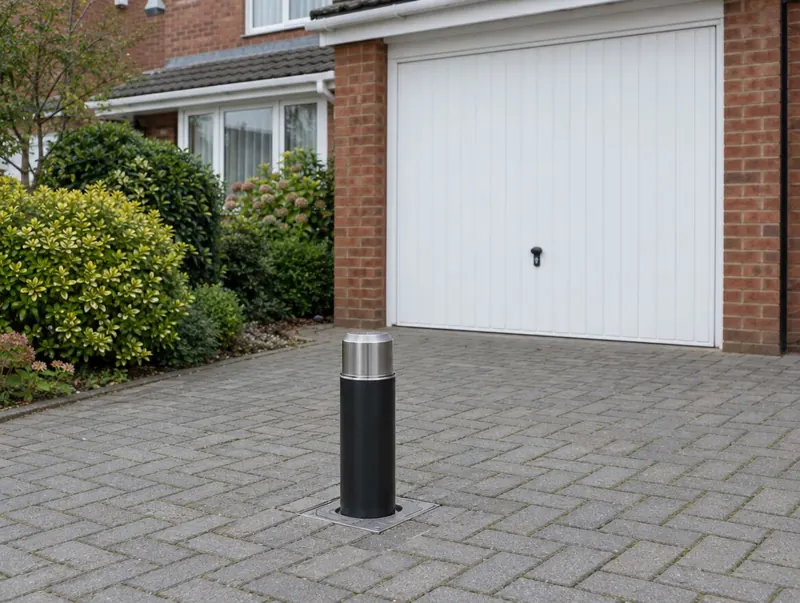 Computer-generated image
Telescopic bollards in Dundonald
In the town of Dundonald, telescopic bollards tend to go in at community buildings, schools and high street shopfronts. Key-locked telescopic bollards that retract into a ground cassette, for driveways, private bays and access roads.
We cover the BT16 postcode district in Dundonald. Nearby, we also work in Holywood (3.4 miles), Newtownards (4.3 miles), Belfast (5.1 miles) and Bangor, Ards and North Down (7 miles), measured as the crow flies. Belfast is around 5 miles away.
Local details
- Area
- Lisburn and Castlereagh, Northern Ireland
- Roads authority
- the Department for Infrastructure (DfI Roads)
- Planning authority
- Lisburn and Castlereagh City Council
- Postcodes
- BT16
- Guide price
- Typically £335–£1,195 per bollard + VAT (£395–£1,445 inc VAT for homes); minimum job £625
- Survey
- Free, with a fixed written quote
- Nearby
- Holywood (3.4 mi), Newtownards (4.3 mi), Belfast (5.1 mi), Bangor, Ards and North Down (7 mi)
Typical telescopic bollards jobs in Dundonald
Typical reasons Dundonald sites choose telescopic bollards:
- Shared drives that need occasional closing
- Sites with no power for automatic bollards
- Commercial yards where posts must not be left lying around
Dundonald: typical telescopic bollard prices
| Specification | Guide price | Includes |
|---|---|---|
| Standard | £335–£685 + VAT · £395–£815 inc VAT | Standard post, foundation, reinstatement |
| Upgraded | £585–£935 + VAT · £695–£1,095 inc VAT | Upgraded finish or fittings, reflective band, matched keys |
| Premium | £835–£1,195 + VAT · £995–£1,445 inc VAT | Heavy-duty or architectural spec, premium finish |
Per bollard with cassette, supplied and installed; -2% for Northern Ireland. Guide only — the fixed price follows a survey.
Consents, ground and services in Dundonald
Kerbside work in Dundonald is a DfI Roads question: the Department for Infrastructure is the roads authority for Northern Ireland, and its permission is needed for anything placed in the public road or footway.
If your site in Dundonald is listed or inside a conservation area, check with the local planning authority (Lisburn and Castlereagh City Council) before choosing a finish — heritage settings often favour cast iron or painted steel over stainless.
Reinstatement matches the drive, whether block paving, tarmac, resin-bound or imprinted concrete. Drives commonly hide the water supply pipe, gas service, electric cable and drainage runs, often at shallow depth, and they cluster near the property boundary where posts are usually wanted.
- Confirm the bollard is on your land; bollards on a public footway or dropped kerb need DfI Roads' agreement.
- Leave access for emergency services on commercial and multi-occupancy sites, and record who holds keys.
From survey to handover
Cut and excavate
The surface is cut neatly and the hole dug to the cassette's full depth plus a drainage layer, with care near any service that crosses the drive.
Set the cassette
The cassette is set vertical and its top exactly at finished surface level and fall, then concreted in. A cassette set high or low is a common cause of tyre damage and trip edges.
Reinstate and test
The surface is made good to match. The post is raised, locked, lowered and locked several times to confirm smooth operation, and keys are handed over.
Finishes and options
| Option | Detail |
|---|---|
| Lock types | Keyed cylinder locks, often with a cover to keep out dirt; keyed alike for multi-bay sites where one key should open every post. |
| Lid and head designs | Flush hinged lids, removable caps or integrated heads that close the cassette top when lowered. |
| Reflective bands | Bands near the top help drivers see a raised post at night, particularly on drives shared with visitors. |
What moves the price in Dundonald
Two Dundonald jobs with the same number of posts can price quite differently. The usual reasons:
- Excavation depth and the presence of services under the drive
- Stainless or powder-coated finish
- Surface type and quality of reinstatement
After installation
Clear leaves and grit from around the lid, and a few times a year lift the post fully and look into the cassette for standing water or silt. Lower and raise the bollard regularly, even if you rarely need to, so the mechanism stays free.
If posts in Dundonald are later hit or damaged, we can repair or replace them — see bollard repairs.
Common questions
Which parts of Dundonald do you cover for telescopic bollards?
We cover all of Dundonald (BT16) and the rest of Lisburn and Castlereagh. We also work in Holywood, Newtownards and Belfast.
Who gives permission for bollards on the pavement in Dundonald?
Across Northern Ireland the Department for Infrastructure's DfI Roads is the roads authority, so telescopic bollards on a public footway or road in Dundonald need its agreement before anything is dug. Posts on your own land do not.
How much do telescopic bollards cost in Dundonald?
In Dundonald, typically £335–£1,195 per bollard with cassette, supplied and installed, plus VAT (£395–£1,445 including VAT for homeowners), with a minimum job of £625 plus VAT, using our Northern Ireland guide prices. The fixed figure comes in writing after we've seen the site.
Will a telescopic bollard stop my car being stolen?
It adds a physical barrier that a thief has to defeat before driving away, which slows them down and makes the car a less attractive target. It is one layer of protection, not a complete answer to keyless car theft.
What if it freezes in winter?
Freezing usually means water is standing in the cassette. Do not force the post; pour warm, not boiling, water around the lid and lift once free. Then have the drainage checked.
Telescopic bollards near Dundonald
- Holywood (3.4 mi)
- Newtownards (4.3 mi)
- Belfast (5.1 mi)
- Bangor, Ards and North Down (7 mi)
- Lisburn (10.6 mi)
- Downpatrick (18.5 mi)