Greater Manchester · England
Timber bollard installation in Manchester
Planning timber bollards in Manchester? We check ownership, consents and buried services first, then quote a fixed price.
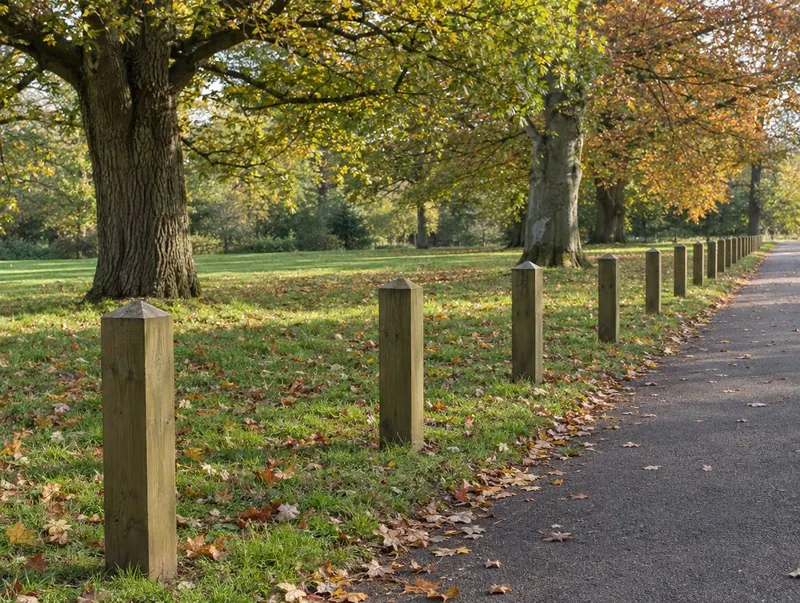 Computer-generated image
Manchester timber bollards
Across Manchester, typical sites for timber bollards include distribution parks, pedestrianised streets and office forecourts. Oak, hardwood and treated softwood bollards for parks, verges, rural sites, car parks and school frontages.
We cover the M1, M2, M4, M15, M13 and M12 postcode districts in Manchester. We also cover neighbouring Salford (2.2 miles), Failsworth (3.4 miles), Droylsden (3.8 miles) and Eccles (3.9 miles) — distances are straight-line. Oldham is around 6 miles away.
Key facts for this area
- Area
- Greater Manchester, England
- Highway authority
- Manchester City Council (local roads)
- Planning authority
- Manchester City Council
- Postcodes
- M1, M2, M4, M15, M13, M12, M8 and M14
- Guide price
- Typically £100–£335 per post + VAT (£115–£395 inc VAT for homes); minimum job £435
- Survey
- Free, with a fixed written quote
- Nearby
- Salford (2.2 mi), Failsworth (3.4 mi), Droylsden (3.8 mi), Eccles (3.9 mi)
Timber bollard prices in Manchester
| Specification | Guide price | Includes |
|---|---|---|
| Standard | £100–£195 + VAT · £115–£225 inc VAT | Standard post, foundation, reinstatement |
| Upgraded | £165–£265 + VAT · £195–£315 inc VAT | Upgraded finish or fittings, reflective band, matched keys |
| Premium | £245–£335 + VAT · £285–£395 inc VAT | Heavy-duty or architectural spec, premium finish |
Per post, supplied and installed; -2% for North West. Guide only — the fixed price follows a survey.
Timber bollards in Manchester: common uses
Around Manchester, timber bollards usually solve one of these:
- School frontages and nursery entrances
- Holiday parks, campsites and farm shops
- Village greens and recreation grounds
Consents, ground and services in Manchester
The highway authority for local roads in Manchester is Manchester City Council; motorways and trunk roads sit with National Highways. Timber bollards on the adopted footway are a matter for the highway authority, so we only install there with its written agreement.
If your site in Manchester is listed or inside a conservation area, check with the local planning authority (Manchester City Council) before choosing a finish — heritage settings often favour cast iron or painted steel over stainless.
Clay holds water against the timber and benefits from a free-draining stone base; sandy ground may need a concrete surround to stop posts loosening. Verges on rural lanes and estates often carry water mains, telecoms cables and drainage, so services are checked before augering.
- Check whether the verge is highway land; posts there usually need the highway authority's agreement.
- Leave pedestrian gaps of typically at least 1,000–1,200 mm, and wider at path entrances used by cycles, buggies and mobility scooters, referring to Inclusive Mobility guidance.
Installation, step by step
Set out the line
Posts are set out at spacings that stop cars passing between them while leaving gaps for walkers, buggies and wheelchairs.
Set the posts
Posts are set plumb and to a consistent height, backfilled with compacted stone or concreted with a shaped top. Cut softwood ends are re-treated.
Finish and tidy
Reflective bands are fitted, turf is reinstated around the posts and spoil is removed or spread as agreed.
Finishes and options
| Option | Detail |
|---|---|
| Reflective bands and studs | Reflective bands, white painted tops or inset studs so posts are visible on unlit sites. |
| Treated softwood | Pressure-treated pine for ground contact, economical for long runs on verges and rural sites. |
| Oak | Naturally durable heartwood that weathers to silver-grey. Suits parks, heritage settings and visible frontages. |
Pricing timber bollards in Manchester
Our North West guide prices are a starting point; the survey in Manchester firms them up. What tends to move them:
- Removable or hinged posts for access
- Fixing method: stone, concrete or steel shoe
- Number of posts and length of the line
Keeping them working
Inspect posts at ground level, where rot starts, by probing for soft wood. Timber naturally moves, checks and splits along its length as it dries; surface cracks in oak and hardwood are normal and rarely affect strength.
We can also service, repair or replace existing posts anywhere in Manchester.
Common questions
Which parts of Manchester do you cover for timber bollards?
We cover all of Manchester (M1, M2, M4, M15, M13 and M12) and the rest of Greater Manchester. We also work in Salford, Failsworth and Droylsden.
Who gives permission for bollards on the pavement in Manchester?
Manchester City Council is the highway authority covering Manchester's local roads. If any post would stand on adopted highway rather than your land, that consent is the first thing we sort out.
What's a typical price for timber bollards in Manchester?
In Manchester, typically £100–£335 per post, supplied and installed, plus VAT (£115–£395 including VAT for homeowners), with a minimum job of £435 plus VAT, using our North West guide prices. The fixed figure comes in writing after we've seen the site.
Should timber posts be set in concrete?
Only with care. Concrete holds the post firmly but can trap water around it at ground level, where rot starts. A free-draining base and a concrete collar shaped to shed water help, and compacted stone backfill is often better in clay.
Do timber bollards stop vehicles?
They stop most drivers deliberately mounting a verge and resist low-speed knocks, especially in dense hardwood. They are not tested barriers and should not be relied on against a vehicle driven at them deliberately.
Timber bollards in nearby towns
- Salford (2.2 mi)
- Failsworth (3.4 mi)
- Droylsden (3.8 mi)
- Eccles (3.9 mi)
- Stretford (3.9 mi)
- Prestwich (4.1 mi)