Kent · England
Timber bollard installation in Rochester
Local installation of timber bollards in Rochester — free survey, fixed written price, and posts set to the right spacing for people and vehicles.
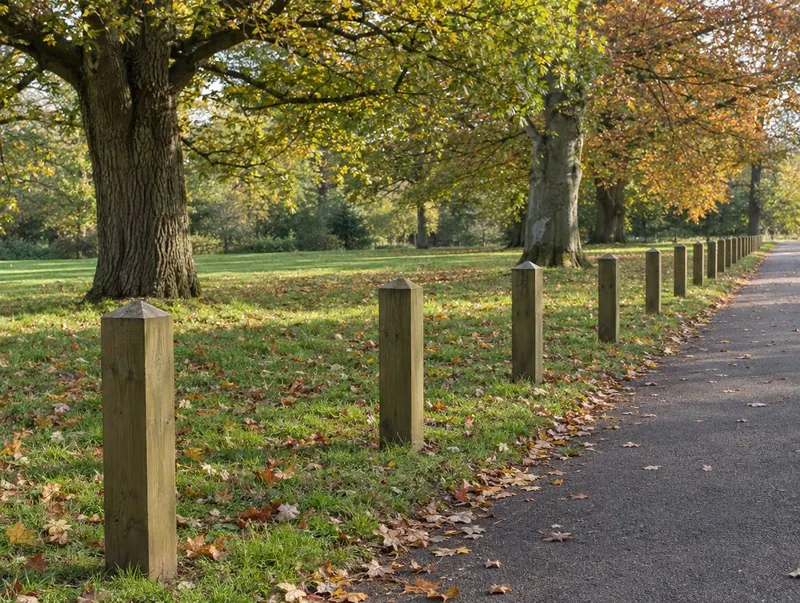 Computer-generated image
About timber bollards in Rochester
Oak, hardwood and treated softwood bollards for parks, verges, rural sites, car parks and school frontages. In Rochester, that tends to mean sites such as schools, local parades and community buildings.
We cover Rochester's ME2 and ME1 postcode districts, including places such as Lower Upnor and Upper Upnor. We also cover neighbouring Chatham (1.1 miles), Strood (1.3 miles), Gillingham (1.9 miles) and Gravesend (6.9 miles) — distances are straight-line.
Key facts for this area
- Area
- Kent, England
- Highway authority
- Medway Council (local roads)
- Planning authority
- Medway Council
- Postcodes
- ME2 and ME1
- Guide price
- Typically £105–£365 per post + VAT (£125–£435 inc VAT for homes); minimum job £465
- Survey
- Free, with a fixed written quote
- Nearby
- Chatham (1.1 mi), Strood (1.3 mi), Gillingham (1.9 mi), Gravesend (6.9 mi)
What timber bollards cost in Rochester
| Specification | Guide price | Includes |
|---|---|---|
| Standard | £105–£215 + VAT · £125–£255 inc VAT | Standard post, foundation, reinstatement |
| Upgraded | £185–£295 + VAT · £215–£345 inc VAT | Upgraded finish or fittings, reflective band, matched keys |
| Premium | £265–£365 + VAT · £315–£435 inc VAT | Heavy-duty or architectural spec, premium finish |
Per post, supplied and installed; +6% for South East. Guide only — the fixed price follows a survey.
Typical timber bollards jobs in Rochester
Typical reasons Rochester sites choose timber bollards:
- School frontages and nursery entrances
- Footpath and bridleway entrances
- Holiday parks, campsites and farm shops
Permissions and groundwork in Rochester
In Rochester, work on adopted pavements and verges needs consent from Medway Council, the local highway authority. Car parks, forecourts and other private land only need the owner's permission.
Many private-land installations in Rochester need no planning application, but the rules don't clearly cover bollards, so listed buildings, conservation areas and prominent frontages are worth raising with the planning team at Medway Council before posts go in.
Clay holds water against the timber and benefits from a free-draining stone base; sandy ground may need a concrete surround to stop posts loosening. Timber bollards usually go into soft landscape, so the ground varies more than with paved sites.
- Check whether the verge is highway land; posts there usually need the highway authority's agreement.
- Use certified sustainable sources for hardwoods, which many public bodies require.
Installation, step by step
Survey the setting
A free site survey looks at the ground, drainage, tree roots, how vehicles currently get onto the land and how the site looks. You receive a fixed written quote with species, size and fixing.
Set out the line
Posts are set out at spacings that stop cars passing between them while leaving gaps for walkers, buggies and wheelchairs.
Dig the holes
Holes are dug by hand or auger to the required depth, avoiding roots and checking for services along verges and footpaths.
Options to consider
| Option | Detail |
|---|---|
| Tropical hardwood | Very dense and long-lasting in ground contact. Specify certified sustainable sources. |
| Removable and lockable posts | Timber posts in steel sockets, or hinged timber posts, for maintenance and emergency access. |
| Fixing methods | Direct burial in compacted stone, set in concrete with a shaped collar, or mounted on a steel shoe or socket. |
Pricing timber bollards in Rochester
Our South East guide prices are a starting point; the survey in Rochester firms them up. What tends to move them:
- Removable or hinged posts for access
- Ground conditions, roots and services
- Post size and length
After installation
Timber naturally moves, checks and splits along its length as it dries; surface cracks in oak and hardwood are normal and rarely affect strength. Inspect posts at ground level, where rot starts, by probing for soft wood.
For damaged or loose posts in Rochester, repairs and replacements are priced in writing first.
Timber bollards in Rochester: FAQs
Which parts of Rochester do you cover for timber bollards?
We cover all of Rochester (ME2 and ME1) and the rest of Kent. We also work in Chatham, Strood and Gillingham.
Who gives permission for bollards on the pavement in Rochester?
The highway authority for local roads in Rochester is Medway Council; motorways and trunk roads sit with National Highways. Timber bollards on the adopted footway are a matter for the highway authority, so we only install there with its written agreement.
What's a typical price for timber bollards in Rochester?
In Rochester, typically £105–£365 per post, supplied and installed, plus VAT (£125–£435 including VAT for homeowners), with a minimum job of £465 plus VAT, using our South East guide prices. The fixed figure comes in writing after we've seen the site.
Why is my new oak bollard cracking?
Oak shrinks as it dries, and surface checks and splits are a normal part of that. They rarely affect the post's strength. Deep splits that run right through, or soft wood at the base, are a different matter.
Should timber posts be set in concrete?
Only with care. Concrete holds the post firmly but can trap water around it at ground level, where rot starts. A free-draining base and a concrete collar shaped to shed water help, and compacted stone backfill is often better in clay.
Timber bollards near Rochester
- Chatham (1.1 mi)
- Strood (1.3 mi)
- Gillingham (1.9 mi)
- Gravesend (6.9 mi)
- Maidstone (8.4 mi)
- Sittingbourne (10.3 mi)