Kent · England
Timber bollard installation in Gillingham
Timber bollards for sites across Gillingham and the rest of Kent, from the first measurement to the last relaid paving block.
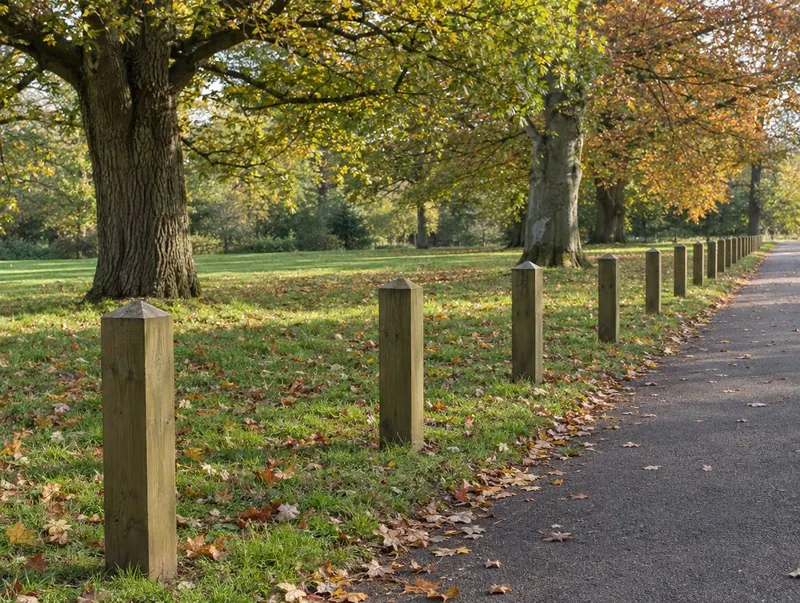 Computer-generated image
About timber bollards in Gillingham
We supply and fit timber bollards throughout Gillingham, typically for sites such as supermarket frontages, retail parks and college campuses. Oak, hardwood and treated softwood bollards for parks, verges, rural sites, car parks and school frontages.
We work across ME7, ME8 and ME3 — Gillingham itself and places including Lower Twydall, Capstone, Kemsley Street and Lower Rainham. Jobs in Gillingham can be combined with work in Chatham (1.1 miles), Rochester (1.9 miles), Strood (3.1 miles) and Gravesend (8.5 miles) (straight-line distances).
Local details
- Area
- Kent, England
- Highway authority
- Medway Council (local roads)
- Planning authority
- Medway Council
- Postcodes
- ME7, ME8 and ME3
- Guide price
- Typically £105–£365 per post + VAT (£125–£435 inc VAT for homes); minimum job £465
- Survey
- Free, with a fixed written quote
Where timber bollards go in around Gillingham
Around Gillingham, timber bollards usually solve one of these:
- School frontages and nursery entrances
- Country parks, nature reserves and woodland car parks
- Village greens and recreation grounds
Guide prices for Gillingham
| Specification | Guide price | Includes |
|---|---|---|
| Standard | £105–£215 + VAT · £125–£255 inc VAT | Standard post, foundation, reinstatement |
| Upgraded | £185–£295 + VAT · £215–£345 inc VAT | Upgraded finish or fittings, reflective band, matched keys |
| Premium | £265–£365 + VAT · £315–£435 inc VAT | Heavy-duty or architectural spec, premium finish |
Per post, supplied and installed; +6% for South East. Guide only — the fixed price follows a survey.
Consents, ground and services in Gillingham
Medway Council is the highway authority covering Gillingham's local roads. If any post would stand on adopted highway rather than your land, that consent is the first thing we sort out.
Bollards on private land often don't need planning permission, but it depends on the council's view, the height and the location; in a conservation area, next to a listed building or under an Article 4 direction, ask the local planning authority (Medway Council) first — we flag this at survey.
Verges on rural lanes and estates often carry water mains, telecoms cables and drainage, so services are checked before augering. Timber bollards usually go into soft landscape, so the ground varies more than with paved sites.
- Keep emergency vehicle access available, using a removable or hinged post where a route must open.
- Leave pedestrian gaps of typically at least 1,000–1,200 mm, and wider at path entrances used by cycles, buggies and mobility scooters, referring to Inclusive Mobility guidance.
What happens on site
Survey the setting
A free site survey looks at the ground, drainage, tree roots, how vehicles currently get onto the land and how the site looks. You receive a fixed written quote with species, size and fixing.
Set out the line
Posts are set out at spacings that stop cars passing between them while leaving gaps for walkers, buggies and wheelchairs.
Finish and tidy
Reflective bands are fitted, turf is reinstated around the posts and spoil is removed or spread as agreed.
Choosing the right spec
| Option | Detail |
|---|---|
| Oak | Naturally durable heartwood that weathers to silver-grey. Suits parks, heritage settings and visible frontages. |
| Tropical hardwood | Very dense and long-lasting in ground contact. Specify certified sustainable sources. |
| Sizes and profiles | Commonly 100–200 mm square or round, with chamfered, pyramid or domed tops to shed water. |
What affects the quote
When we price timber bollards in Gillingham, these make the biggest difference:
- Ground conditions, roots and services
- Number of posts and length of the line
- Removable or hinged posts for access
Keeping them working
Replacing individual damaged posts is straightforward if the original size and species are recorded. Timber naturally moves, checks and splits along its length as it dries; surface cracks in oak and hardwood are normal and rarely affect strength.
If posts in Gillingham are later hit or damaged, we can repair or replace them — see bollard repairs.
Questions about timber bollards in Gillingham
Which parts of Gillingham do you cover for timber bollards?
We cover all of Gillingham (ME7, ME8 and ME3) and the rest of Kent. We also work in Chatham, Rochester and Strood.
Do I need consent for timber bollards on a public footway in Gillingham?
In Gillingham, work on adopted pavements and verges needs consent from Medway Council, the local highway authority. Car parks, forecourts and other private land only need the owner's permission.
How much do timber bollards cost in Gillingham?
In Gillingham, typically £105–£365 per post, supplied and installed, plus VAT (£125–£435 including VAT for homeowners), with a minimum job of £465 plus VAT, using our South East guide prices. The fixed figure comes in writing after we've seen the site.
Should timber posts be set in concrete?
Only with care. Concrete holds the post firmly but can trap water around it at ground level, where rot starts. A free-draining base and a concrete collar shaped to shed water help, and compacted stone backfill is often better in clay.
Is tropical hardwood a sustainable choice?
It can be, if it comes from certified sustainable sources. Ask for certification with the order. Oak and treated softwood from managed forests are alternatives.
Timber bollards in nearby towns
- Chatham (1.1 mi)
- Rochester (1.9 mi)
- Strood (3.1 mi)
- Gravesend (8.5 mi)
- Maidstone (8.6 mi)
- Sittingbourne (8.6 mi)