Lisburn and Castlereagh · Northern Ireland
Timber bollard installation in Dundonald
Planning timber bollards in Dundonald? We check ownership, consents and buried services first, then quote a fixed price.
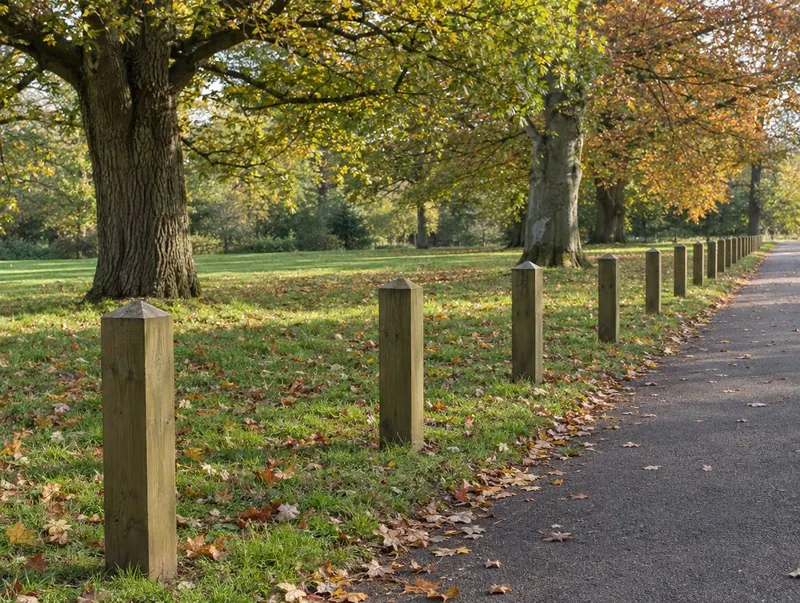 Computer-generated image
Dundonald timber bollards
In the town of Dundonald, timber bollards tend to go in at schools, filling-station forecourts and community car parks. Oak, hardwood and treated softwood bollards for parks, verges, rural sites, car parks and school frontages.
We cover every part of Dundonald in the BT16 postcode district. Jobs in Dundonald can be combined with work in Holywood (3.4 miles), Newtownards (4.3 miles), Belfast (5.1 miles) and Bangor, Ards and North Down (7 miles) (straight-line distances). It sits roughly 5 miles from Belfast as the crow flies.
Dundonald at a glance
- Area
- Lisburn and Castlereagh, Northern Ireland
- Roads authority
- the Department for Infrastructure (DfI Roads)
- Planning authority
- Lisburn and Castlereagh City Council
- Postcodes
- BT16
- Guide price
- Typically £100–£335 per post + VAT (£115–£395 inc VAT for homes); minimum job £435
- Survey
- Free, with a fixed written quote
- Nearby
- Holywood (3.4 mi), Newtownards (4.3 mi), Belfast (5.1 mi), Bangor, Ards and North Down (7 mi)
What timber bollards cost in Dundonald
| Specification | Guide price | Includes |
|---|---|---|
| Standard | £100–£195 + VAT · £115–£225 inc VAT | Standard post, foundation, reinstatement |
| Upgraded | £165–£265 + VAT · £195–£315 inc VAT | Upgraded finish or fittings, reflective band, matched keys |
| Premium | £245–£335 + VAT · £285–£395 inc VAT | Heavy-duty or architectural spec, premium finish |
Per post, supplied and installed; -2% for Northern Ireland. Guide only — the fixed price follows a survey.
Timber bollards in Dundonald: common uses
Common uses in a place like Dundonald:
- Verges on estates and rural lanes
- School frontages and nursery entrances
- Holiday parks, campsites and farm shops
Before we dig in Dundonald
In Dundonald, as everywhere in Northern Ireland, public roads and footways are looked after by DfI Roads rather than the council. If a post would sit on adopted footway, that consent comes first; private forecourts and car parks are a matter for the owner.
Planning in Northern Ireland sits with the councils, so for a listed building or conservation area in Dundonald the planning team at Lisburn and Castlereagh City Council is the one to ask before posts go in.
Clay holds water against the timber and benefits from a free-draining stone base; sandy ground may need a concrete surround to stop posts loosening. Turf around new posts is reinstated and, on sites used by mowers, posts are spaced so equipment can pass.
- Leave pedestrian gaps of typically at least 1,000–1,200 mm, and wider at path entrances used by cycles, buggies and mobility scooters, referring to Inclusive Mobility guidance.
- Check whether the verge is highway land; posts there usually need DfI Roads' agreement.
How the job runs
Survey the setting
A free site survey looks at the ground, drainage, tree roots, how vehicles currently get onto the land and how the site looks. You receive a fixed written quote with species, size and fixing.
Dig the holes
Holes are dug by hand or auger to the required depth, avoiding roots and checking for services along verges and footpaths.
Set the posts
Posts are set plumb and to a consistent height, backfilled with compacted stone or concreted with a shaped top. Cut softwood ends are re-treated.
Choosing the right spec
| Option | Detail |
|---|---|
| Fixing methods | Direct burial in compacted stone, set in concrete with a shaped collar, or mounted on a steel shoe or socket. |
| Removable and lockable posts | Timber posts in steel sockets, or hinged timber posts, for maintenance and emergency access. |
| Treated softwood | Pressure-treated pine for ground contact, economical for long runs on verges and rural sites. |
What affects the quote
When we price timber bollards in Dundonald, these make the biggest difference:
- Ground conditions, roots and services
- Fixing method: stone, concrete or steel shoe
- Species: treated softwood, oak or tropical hardwood
Looking after them
Timber naturally moves, checks and splits along its length as it dries; surface cracks in oak and hardwood are normal and rarely affect strength. New oak can release tannin that stains nearby paving for the first season; this weathers away.
For damaged or loose posts in Dundonald, repairs and replacements are priced in writing first.
Questions about timber bollards in Dundonald
Which parts of Dundonald do you cover for timber bollards?
We cover all of Dundonald (BT16) and the rest of Lisburn and Castlereagh. We also work in Holywood, Newtownards and Belfast.
Do I need consent for timber bollards on a public footway in Dundonald?
In Dundonald, as everywhere in Northern Ireland, public roads and footways are looked after by DfI Roads rather than the council. If a post would sit on adopted footway, that consent comes first; private forecourts and car parks are a matter for the owner.
What's a typical price for timber bollards in Dundonald?
In Dundonald, typically £100–£335 per post, supplied and installed, plus VAT (£115–£395 including VAT for homeowners), with a minimum job of £435 plus VAT, using our Northern Ireland guide prices. The fixed figure comes in writing after we've seen the site.
Do timber bollards stop vehicles?
They stop most drivers deliberately mounting a verge and resist low-speed knocks, especially in dense hardwood. They are not tested barriers and should not be relied on against a vehicle driven at them deliberately.
Why is my new oak bollard cracking?
Oak shrinks as it dries, and surface checks and splits are a normal part of that. They rarely affect the post's strength. Deep splits that run right through, or soft wood at the base, are a different matter.
Timber bollards in nearby towns
- Holywood (3.4 mi)
- Newtownards (4.3 mi)
- Belfast (5.1 mi)
- Bangor, Ards and North Down (7 mi)
- Lisburn (10.6 mi)
- Downpatrick (18.5 mi)