Merseyside · England
Timber bollard installation in Prescot
Planning timber bollards in Prescot? We check ownership, consents and buried services first, then quote a fixed price.
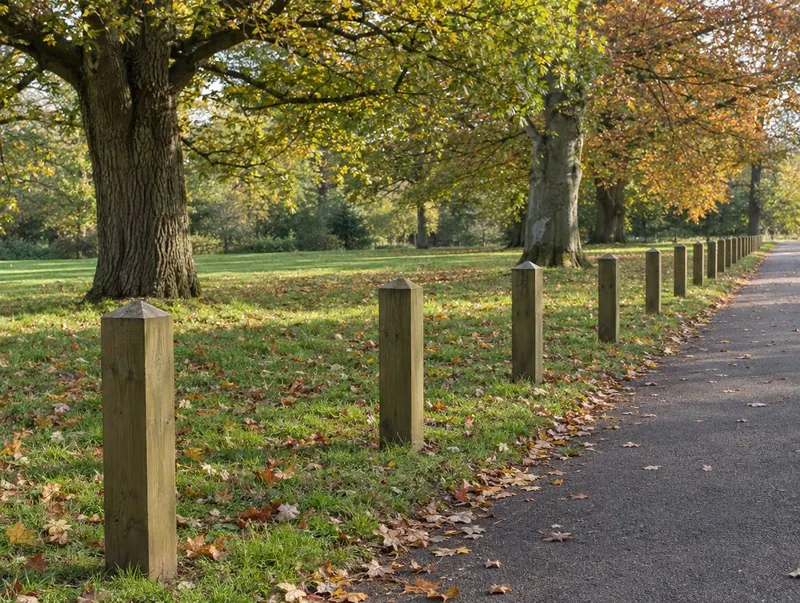 Computer-generated image
About timber bollards in Prescot
In the town of Prescot, timber bollards tend to go in at filling-station forecourts, residential driveways and community car parks. Timber bollards deter and guide vehicles; they are not tested barriers.
We work across L34 and L35 — Prescot itself and places including Huyton with Roby and Tarbock Green. Nearby, we also work in Huyton (2 miles), St Helens (3.1 miles), Halewood (5 miles) and Kirkby (5.2 miles), measured as the crow flies. Prescot is about 7 miles from Liverpool.
Local details
- Area
- Merseyside, England
- Highway authority
- Knowsley Council (local roads)
- Planning authority
- Knowsley Council
- Postcodes
- L34 and L35
- Guide price
- Typically £100–£335 per post + VAT (£115–£395 inc VAT for homes); minimum job £435
- Survey
- Free, with a fixed written quote
Typical timber bollards jobs in Prescot
Around Prescot, timber bollards usually solve one of these:
- School frontages and nursery entrances
- Country parks, nature reserves and woodland car parks
- Holiday parks, campsites and farm shops
Timber bollard prices in Prescot
| Specification | Guide price | Includes |
|---|---|---|
| Standard | £100–£195 + VAT · £115–£225 inc VAT | Standard post, foundation, reinstatement |
| Upgraded | £165–£265 + VAT · £195–£315 inc VAT | Upgraded finish or fittings, reflective band, matched keys |
| Premium | £245–£335 + VAT · £285–£395 inc VAT | Heavy-duty or architectural spec, premium finish |
Per post, supplied and installed; -2% for North West. Guide only — the fixed price follows a survey.
Permissions and groundwork in Prescot
In Prescot, work on adopted pavements and verges needs consent from Knowsley Council, the local highway authority. Car parks, forecourts and other private land only need the owner's permission.
Bollards on private land often don't need planning permission, but it depends on the council's view, the height and the location; in a conservation area, next to a listed building or under an Article 4 direction, ask the local planning authority (Knowsley Council) first — we flag this at survey.
Verges on rural lanes and estates often carry water mains, telecoms cables and drainage, so services are checked before augering. Clay holds water against the timber and benefits from a free-draining stone base; sandy ground may need a concrete surround to stop posts loosening.
- Check whether the verge is highway land; posts there usually need the highway authority's agreement.
- Use certified sustainable sources for hardwoods, which many public bodies require.
Installation, step by step
Set out the line
Posts are set out at spacings that stop cars passing between them while leaving gaps for walkers, buggies and wheelchairs.
Set the posts
Posts are set plumb and to a consistent height, backfilled with compacted stone or concreted with a shaped top. Cut softwood ends are re-treated.
Finish and tidy
Reflective bands are fitted, turf is reinstated around the posts and spoil is removed or spread as agreed.
Finishes and options
| Option | Detail |
|---|---|
| Tropical hardwood | Very dense and long-lasting in ground contact. Specify certified sustainable sources. |
| Oak | Naturally durable heartwood that weathers to silver-grey. Suits parks, heritage settings and visible frontages. |
| Removable and lockable posts | Timber posts in steel sockets, or hinged timber posts, for maintenance and emergency access. |
Pricing timber bollards in Prescot
Our North West guide prices are a starting point; the survey in Prescot firms them up. What tends to move them:
- Removable or hinged posts for access
- Ground conditions, roots and services
- Species: treated softwood, oak or tropical hardwood
Looking after them
Timber naturally moves, checks and splits along its length as it dries; surface cracks in oak and hardwood are normal and rarely affect strength. New oak can release tannin that stains nearby paving for the first season; this weathers away.
If posts in Prescot are later hit or damaged, we can repair or replace them — see bollard repairs.
Timber bollards in Prescot: FAQs
Which parts of Prescot do you cover for timber bollards?
We cover all of Prescot (L34 and L35) and the rest of Merseyside. We also work in Huyton, St Helens and Halewood.
Who gives permission for bollards on the pavement in Prescot?
In Prescot, work on adopted pavements and verges needs consent from Knowsley Council, the local highway authority. Car parks, forecourts and other private land only need the owner's permission.
What's a typical price for timber bollards in Prescot?
In Prescot, typically £100–£335 per post, supplied and installed, plus VAT (£115–£395 including VAT for homeowners), with a minimum job of £435 plus VAT, using our North West guide prices. The fixed figure comes in writing after we've seen the site.
Why is my new oak bollard cracking?
Oak shrinks as it dries, and surface checks and splits are a normal part of that. They rarely affect the post's strength. Deep splits that run right through, or soft wood at the base, are a different matter.
How long will a timber bollard last in the ground?
It depends on species, treatment and how the post is set. Dense hardwoods and oak heartwood last much longer than softwood, and posts that are kept out of standing water last longer than those sitting in wet concrete. A steel shoe that keeps timber off the ground extends life considerably.