Norfolk · England
Timber bollard installation in Thetford
Timber bollards for sites across Thetford and the rest of Norfolk, from the first measurement to the last relaid paving block.
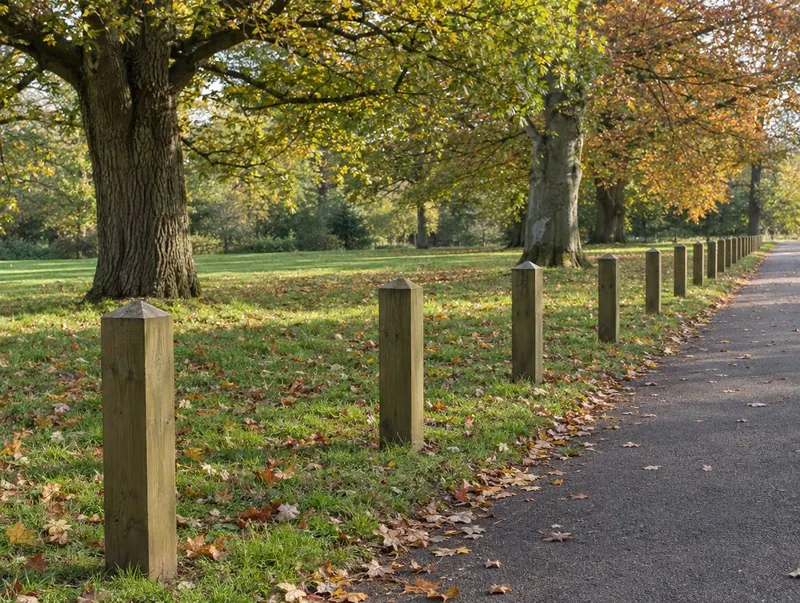 Computer-generated image
Thetford timber bollards
From community buildings, filling-station forecourts and local parades, Thetford has plenty of places where timber bollards earn their keep. Oak, hardwood and treated softwood bollards for parks, verges, rural sites, car parks and school frontages.
We cover Thetford's IP24 postcode district, including places such as Thompson, Great Hockham and East Wretham. We also cover neighbouring Bury St Edmunds (11.9 miles), Newmarket (18.8 miles), Stowmarket (18.9 miles) and Ely (20.6 miles) — distances are straight-line.
Local details
- Area
- Norfolk, England
- Highway authority
- Norfolk County Council (local roads)
- Planning authority
- the council for Breckland
- Postcodes
- IP24
- Guide price
- Typically £95–£355 per post + VAT (£105–£425 inc VAT for homes); minimum job £455
- Survey
- Free, with a fixed written quote
- Nearby
- Bury St Edmunds (11.9 mi), Newmarket (18.8 mi), Stowmarket (18.9 mi), Ely (20.6 mi)
Timber bollard prices in Thetford
| Specification | Guide price | Includes |
|---|---|---|
| Standard | £95–£205 + VAT · £105–£245 inc VAT | Standard post, foundation, reinstatement |
| Upgraded | £175–£285 + VAT · £205–£335 inc VAT | Upgraded finish or fittings, reflective band, matched keys |
| Premium | £255–£355 + VAT · £305–£425 inc VAT | Heavy-duty or architectural spec, premium finish |
Per post, supplied and installed; +3% for East of England. Guide only — the fixed price follows a survey.
Timber bollards in Thetford: common uses
Around Thetford, timber bollards usually solve one of these:
- School frontages and nursery entrances
- Footpath and bridleway entrances
- Landscaped car parks and picnic areas
Permissions and groundwork in Thetford
In Thetford, work on adopted pavements and verges needs consent from Norfolk County Council, the local highway authority. Car parks, forecourts and other private land only need the owner's permission.
Bollards on private land often don't need planning permission, but it depends on the council's view, the height and the location; in a conservation area, next to a listed building or under an Article 4 direction, ask the local planning authority (the council for Breckland) first — we flag this at survey.
Clay holds water against the timber and benefits from a free-draining stone base; sandy ground may need a concrete surround to stop posts loosening. Tree roots are common along verges and parks, and digging close to mature trees can harm them, so positions are adjusted to stay outside root areas where possible.
- Check whether the verge is highway land; posts there usually need the highway authority's agreement.
- Leave pedestrian gaps of typically at least 1,000–1,200 mm, and wider at path entrances used by cycles, buggies and mobility scooters, referring to Inclusive Mobility guidance.
Installation, step by step
Survey the setting
A free site survey looks at the ground, drainage, tree roots, how vehicles currently get onto the land and how the site looks. You receive a fixed written quote with species, size and fixing.
Dig the holes
Holes are dug by hand or auger to the required depth, avoiding roots and checking for services along verges and footpaths.
Set the posts
Posts are set plumb and to a consistent height, backfilled with compacted stone or concreted with a shaped top. Cut softwood ends are re-treated.
Finishes and options
| Option | Detail |
|---|---|
| Removable and lockable posts | Timber posts in steel sockets, or hinged timber posts, for maintenance and emergency access. |
| Fixing methods | Direct burial in compacted stone, set in concrete with a shaped collar, or mounted on a steel shoe or socket. |
| Reflective bands and studs | Reflective bands, white painted tops or inset studs so posts are visible on unlit sites. |
What moves the price in Thetford
Two Thetford jobs with the same number of posts can price quite differently. The usual reasons:
- Post size and length
- Removable or hinged posts for access
- Ground conditions, roots and services
Keeping them working
Re-treat cut or damaged softwood, keep grass and soil from building up around the base, and replace posts that are soft at the ground line before they snap. Inspect posts at ground level, where rot starts, by probing for soft wood.
We can also service, repair or replace existing posts anywhere in Thetford.
Timber bollards in Thetford: FAQs
Do you install timber bollards in Thetford?
We cover all of Thetford (IP24) and the rest of Norfolk. We also work in Bury St Edmunds, Newmarket and Stowmarket.
Who gives permission for bollards on the pavement in Thetford?
The highway authority for local roads in Thetford is Norfolk County Council; motorways and trunk roads sit with National Highways. Timber bollards on the adopted footway are a matter for the highway authority, so we only install there with its written agreement.
What's a typical price for timber bollards in Thetford?
In Thetford, typically £95–£355 per post, supplied and installed, plus VAT (£105–£425 including VAT for homeowners), with a minimum job of £455 plus VAT, using our East of England guide prices. The fixed figure comes in writing after we've seen the site.
How long will a timber bollard last in the ground?
It depends on species, treatment and how the post is set. Dense hardwoods and oak heartwood last much longer than softwood, and posts that are kept out of standing water last longer than those sitting in wet concrete. A steel shoe that keeps timber off the ground extends life considerably.
Is tropical hardwood a sustainable choice?
It can be, if it comes from certified sustainable sources. Ask for certification with the order. Oak and treated softwood from managed forests are alternatives.