Suffolk · England
Timber bollard installation in Newmarket
Planning timber bollards in Newmarket? We check ownership, consents and buried services first, then quote a fixed price.
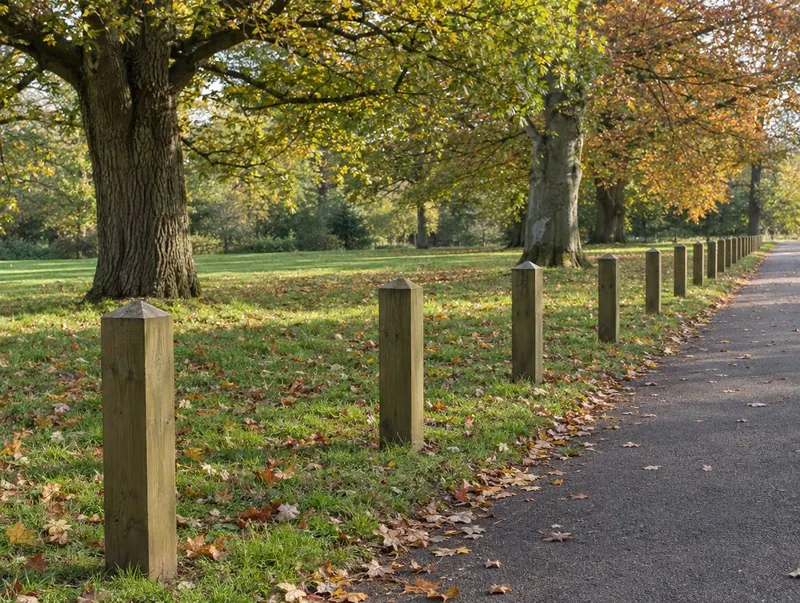 Computer-generated image
Newmarket timber bollards
We supply and fit timber bollards throughout Newmarket, typically for sites such as small industrial units, residential driveways and community car parks. Oak, hardwood and treated softwood bollards for parks, verges, rural sites, car parks and school frontages.
We work across CB8 — Newmarket itself and places including Exning, Kentford and Gazeley. Nearby, we also work in Haverhill (11.3 miles), Ely (12.3 miles), Cambridge (12.6 miles) and Bury St Edmunds (13 miles), measured as the crow flies.
Key facts for this area
- Area
- Suffolk, England
- Highway authority
- Suffolk County Council (local roads)
- Planning authority
- the council for West Suffolk
- Postcodes
- CB8
- Guide price
- Typically £95–£355 per post + VAT (£105–£425 inc VAT for homes); minimum job £455
- Survey
- Free, with a fixed written quote
- Nearby
- Haverhill (11.3 mi), Ely (12.3 mi), Cambridge (12.6 mi), Bury St Edmunds (13 mi)
Guide prices for Newmarket
| Specification | Guide price | Includes |
|---|---|---|
| Standard | £95–£205 + VAT · £105–£245 inc VAT | Standard post, foundation, reinstatement |
| Upgraded | £175–£285 + VAT · £205–£335 inc VAT | Upgraded finish or fittings, reflective band, matched keys |
| Premium | £255–£355 + VAT · £305–£425 inc VAT | Heavy-duty or architectural spec, premium finish |
Per post, supplied and installed; +3% for East of England. Guide only — the fixed price follows a survey.
Typical timber bollards jobs in Newmarket
Typical reasons Newmarket sites choose timber bollards:
- Landscaped car parks and picnic areas
- Verges on estates and rural lanes
- School frontages and nursery entrances
Permissions and groundwork in Newmarket
The highway authority for local roads in Newmarket is Suffolk County Council; motorways and trunk roads sit with National Highways. Timber bollards on the adopted footway are a matter for the highway authority, so we only install there with its written agreement.
If your site in Newmarket is listed or inside a conservation area, check with the local planning authority (the council for West Suffolk) before choosing a finish — heritage settings often favour cast iron or painted steel over stainless.
Clay holds water against the timber and benefits from a free-draining stone base; sandy ground may need a concrete surround to stop posts loosening. Verges on rural lanes and estates often carry water mains, telecoms cables and drainage, so services are checked before augering.
- Check whether the verge is highway land; posts there usually need the highway authority's agreement.
- Use certified sustainable sources for hardwoods, which many public bodies require.
What happens on site
Set out the line
Posts are set out at spacings that stop cars passing between them while leaving gaps for walkers, buggies and wheelchairs.
Set the posts
Posts are set plumb and to a consistent height, backfilled with compacted stone or concreted with a shaped top. Cut softwood ends are re-treated.
Finish and tidy
Reflective bands are fitted, turf is reinstated around the posts and spoil is removed or spread as agreed.
Choosing the right spec
| Option | Detail |
|---|---|
| Tropical hardwood | Very dense and long-lasting in ground contact. Specify certified sustainable sources. |
| Removable and lockable posts | Timber posts in steel sockets, or hinged timber posts, for maintenance and emergency access. |
| Sizes and profiles | Commonly 100–200 mm square or round, with chamfered, pyramid or domed tops to shed water. |
What affects the quote
Our East of England guide prices are a starting point; the survey in Newmarket firms them up. What tends to move them:
- Number of posts and length of the line
- Post size and length
- Removable or hinged posts for access
After installation
Timber naturally moves, checks and splits along its length as it dries; surface cracks in oak and hardwood are normal and rarely affect strength. Inspect posts at ground level, where rot starts, by probing for soft wood.
We can also service, repair or replace existing posts anywhere in Newmarket.
Common questions
Which parts of Newmarket do you cover for timber bollards?
We cover all of Newmarket (CB8) and the rest of Suffolk. We also work in Haverhill, Ely and Cambridge.
Who gives permission for bollards on the pavement in Newmarket?
Suffolk County Council is the highway authority covering Newmarket's local roads. If any post would stand on adopted highway rather than your land, that consent is the first thing we sort out.
How much do timber bollards cost in Newmarket?
In Newmarket, typically £95–£355 per post, supplied and installed, plus VAT (£105–£425 including VAT for homeowners), with a minimum job of £455 plus VAT, using our East of England guide prices. The fixed figure comes in writing after we've seen the site.
How long will a timber bollard last in the ground?
It depends on species, treatment and how the post is set. Dense hardwoods and oak heartwood last much longer than softwood, and posts that are kept out of standing water last longer than those sitting in wet concrete. A steel shoe that keeps timber off the ground extends life considerably.
Do timber bollards stop vehicles?
They stop most drivers deliberately mounting a verge and resist low-speed knocks, especially in dense hardwood. They are not tested barriers and should not be relied on against a vehicle driven at them deliberately.
Timber bollards near Newmarket
- Haverhill (11.3 mi)
- Ely (12.3 mi)
- Cambridge (12.6 mi)
- Bury St Edmunds (13 mi)
- Thetford (18.8 mi)
- Sudbury (19.9 mi)