Cambridgeshire · England
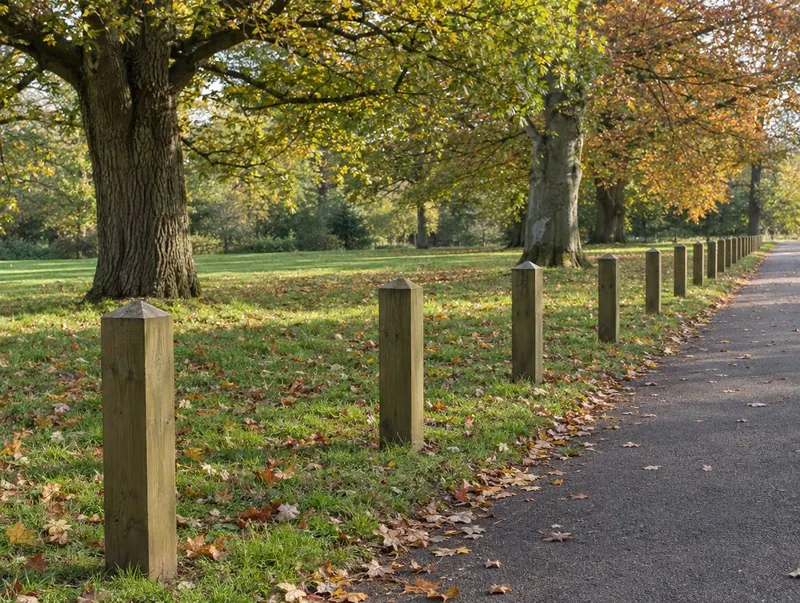
Timber bollard installation in Cambridge
Timber bollards for sites across Cambridge and the rest of Cambridgeshire, from the first measurement to the last relaid paving block.
 Computer-generated image
Timber bollards in Cambridge
Timber bollards suit plenty of Cambridge sites, high streets, supermarket frontages and housing association car parks among them. Oak, hardwood and treated softwood bollards for parks, verges, rural sites, car parks and school frontages.
Coverage in Cambridge takes in the CB2, CB1, CB3, CB4 and CB5 postcode districts and nearby places like Fen Ditton. We also cover neighbouring Newmarket (12.6 miles), Ely (15.1 miles), Huntingdon (15.7 miles) and Haverhill (15.9 miles) — distances are straight-line. Cambridge is about 32 miles from Luton.
Local details
- Area
- Cambridgeshire, England
- Highway authority
- Cambridgeshire County Council (local roads)
- Planning authority
- Cambridgeshire County Council
- Postcodes
- CB2, CB1, CB3, CB4 and CB5
- Guide price
- Typically £95–£355 per post + VAT (£105–£425 inc VAT for homes); minimum job £455
- Survey
- Free, with a fixed written quote
- Nearby
- Newmarket (12.6 mi), Ely (15.1 mi), Huntingdon (15.7 mi), Haverhill (15.9 mi)
Timber bollard prices in Cambridge
| Specification | Guide price | Includes |
|---|---|---|
| Standard | £95–£205 + VAT · £105–£245 inc VAT | Standard post, foundation, reinstatement |
| Upgraded | £175–£285 + VAT · £205–£335 inc VAT | Upgraded finish or fittings, reflective band, matched keys |
| Premium | £255–£355 + VAT · £305–£425 inc VAT | Heavy-duty or architectural spec, premium finish |
Per post, supplied and installed; +3% for East of England. Guide only — the fixed price follows a survey.
Where timber bollards go in around Cambridge
Typical reasons Cambridge sites choose timber bollards:
- Landscaped car parks and picnic areas
- Footpath and bridleway entrances
- Holiday parks, campsites and farm shops
Before we dig in Cambridge
In Cambridge, work on adopted pavements and verges needs consent from Cambridgeshire County Council, the local highway authority. Car parks, forecourts and other private land only need the owner's permission.
Bollards on private land often don't need planning permission, but it depends on the council's view, the height and the location; in a conservation area, next to a listed building or under an Article 4 direction, ask the local planning authority (Cambridgeshire County Council) first — we flag this at survey.
Clay holds water against the timber and benefits from a free-draining stone base; sandy ground may need a concrete surround to stop posts loosening. Verges on rural lanes and estates often carry water mains, telecoms cables and drainage, so services are checked before augering.
- Fit reflective bands or white tops where posts stand beside roads or in unlit car parks.
- Check whether the verge is highway land; posts there usually need the highway authority's agreement.
How the job runs
Survey the setting
A free site survey looks at the ground, drainage, tree roots, how vehicles currently get onto the land and how the site looks. You receive a fixed written quote with species, size and fixing.
Set the posts
Posts are set plumb and to a consistent height, backfilled with compacted stone or concreted with a shaped top. Cut softwood ends are re-treated.
Finish and tidy
Reflective bands are fitted, turf is reinstated around the posts and spoil is removed or spread as agreed.
Options to consider
| Option | Detail |
|---|---|
| Reflective bands and studs | Reflective bands, white painted tops or inset studs so posts are visible on unlit sites. |
| Tropical hardwood | Very dense and long-lasting in ground contact. Specify certified sustainable sources. |
| Treated softwood | Pressure-treated pine for ground contact, economical for long runs on verges and rural sites. |
Pricing timber bollards in Cambridge
When we price timber bollards in Cambridge, these make the biggest difference:
- Species: treated softwood, oak or tropical hardwood
- Removable or hinged posts for access
- Post size and length
Looking after them
Inspect posts at ground level, where rot starts, by probing for soft wood. Re-treat cut or damaged softwood, keep grass and soil from building up around the base, and replace posts that are soft at the ground line before they snap.
If posts in Cambridge are later hit or damaged, we can repair or replace them — see bollard repairs.
Questions about timber bollards in Cambridge
Can you install timber bollards anywhere in Cambridge?
We cover all of Cambridge (CB2, CB1, CB3, CB4 and CB5) and the rest of Cambridgeshire. We also work in Newmarket, Ely and Huntingdon.
Who gives permission for bollards on the pavement in Cambridge?
The highway authority for local roads in Cambridge is Cambridgeshire County Council; motorways and trunk roads sit with National Highways. Timber bollards on the adopted footway are a matter for the highway authority, so we only install there with its written agreement.
What's a typical price for timber bollards in Cambridge?
In Cambridge, typically £95–£355 per post, supplied and installed, plus VAT (£105–£425 including VAT for homeowners), with a minimum job of £455 plus VAT, using our East of England guide prices. The fixed figure comes in writing after we've seen the site.
Can timber bollards be removable?
Yes. Timber posts can be fitted into steel ground sockets with a lock, or mounted on a hinged base. That allows maintenance vehicles or emergency services through without a permanent gap.
Why is my new oak bollard cracking?
Oak shrinks as it dries, and surface checks and splits are a normal part of that. They rarely affect the post's strength. Deep splits that run right through, or soft wood at the base, are a different matter.
Timber bollards near Cambridge
- Newmarket (12.6 mi)
- Ely (15.1 mi)
- Huntingdon (15.7 mi)
- Haverhill (15.9 mi)
- St Neots (16.3 mi)
- Letchworth Garden City (21.1 mi)