Surrey · England
Timber bollard installation in Caterham
Local installation of timber bollards in Caterham — free survey, fixed written price, and posts set to the right spacing for people and vehicles.
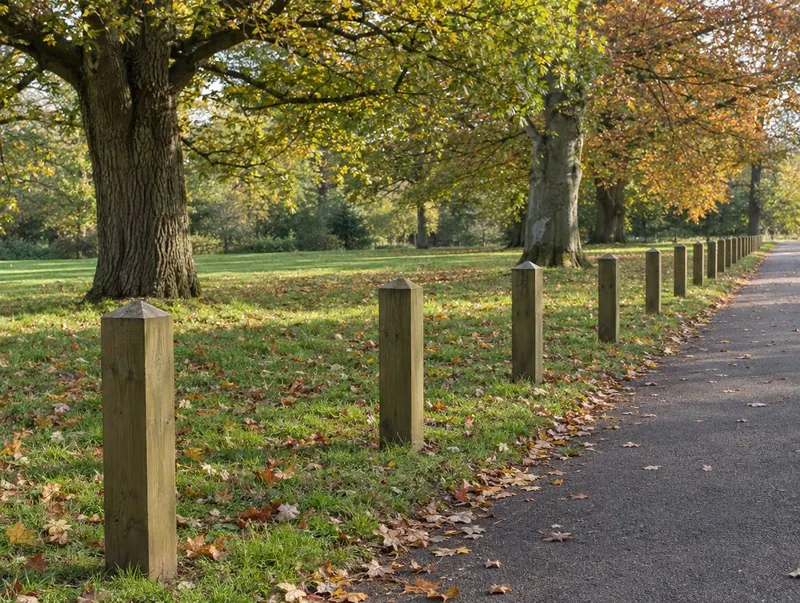 Computer-generated image
Caterham timber bollards
We supply and fit timber bollards throughout Caterham, typically for sites such as filling-station forecourts, community buildings and local parades. Timber bollards deter and guide vehicles; they are not tested barriers.
We work across CR3, CR6, RH9 and RH8 — Caterham itself and places including Whyteleafe, Chaldon, Woldingham and Woldingham Garden Village. Nearby, we also work in Redhill (4.9 miles), Croydon (5 miles), Banstead (6.2 miles) and Reigate (6.3 miles), measured as the crow flies. It sits roughly 31 miles from Brighton as the crow flies.
Local details
- Area
- Surrey, England
- Highway authority
- Surrey County Council (local roads)
- Planning authority
- the council for Tandridge
- Postcodes
- CR3, CR6, RH9 and RH8
- Guide price
- Typically £105–£395 per post + VAT (£125–£465 inc VAT for homes); minimum job £505
- Survey
- Free, with a fixed written quote
Where timber bollards go in around Caterham
Around Caterham, timber bollards usually solve one of these:
- Village greens and recreation grounds
- Country parks, nature reserves and woodland car parks
- Verges on estates and rural lanes
Caterham: typical timber bollard prices
| Specification | Guide price | Includes |
|---|---|---|
| Standard | £105–£235 + VAT · £125–£275 inc VAT | Standard post, foundation, reinstatement |
| Upgraded | £195–£315 + VAT · £225–£375 inc VAT | Upgraded finish or fittings, reflective band, matched keys |
| Premium | £285–£395 + VAT · £335–£465 inc VAT | Heavy-duty or architectural spec, premium finish |
Per post, supplied and installed; +15% for London. Guide only — the fixed price follows a survey.
Permissions and groundwork in Caterham
In Caterham, work on adopted pavements and verges needs consent from Surrey County Council, the local highway authority. Car parks, forecourts and other private land only need the owner's permission.
Bollards on private land often don't need planning permission, but it depends on the council's view, the height and the location; in a conservation area, next to a listed building or under an Article 4 direction, ask the local planning authority (the council for Tandridge) first — we flag this at survey.
Tree roots are common along verges and parks, and digging close to mature trees can harm them, so positions are adjusted to stay outside root areas where possible. Timber bollards usually go into soft landscape, so the ground varies more than with paved sites.
- Keep emergency vehicle access available, using a removable or hinged post where a route must open.
- Fit reflective bands or white tops where posts stand beside roads or in unlit car parks.
From survey to handover
Survey the setting
A free site survey looks at the ground, drainage, tree roots, how vehicles currently get onto the land and how the site looks. You receive a fixed written quote with species, size and fixing.
Dig the holes
Holes are dug by hand or auger to the required depth, avoiding roots and checking for services along verges and footpaths.
Finish and tidy
Reflective bands are fitted, turf is reinstated around the posts and spoil is removed or spread as agreed.
Options to consider
| Option | Detail |
|---|---|
| Fixing methods | Direct burial in compacted stone, set in concrete with a shaped collar, or mounted on a steel shoe or socket. |
| Oak | Naturally durable heartwood that weathers to silver-grey. Suits parks, heritage settings and visible frontages. |
| Treated softwood | Pressure-treated pine for ground contact, economical for long runs on verges and rural sites. |
What moves the price in Caterham
Two Caterham jobs with the same number of posts can price quite differently. The usual reasons:
- Removable or hinged posts for access
- Post size and length
- Number of posts and length of the line
Looking after them
New oak can release tannin that stains nearby paving for the first season; this weathers away. Replacing individual damaged posts is straightforward if the original size and species are recorded.
We can also service, repair or replace existing posts anywhere in Caterham.
Questions about timber bollards in Caterham
Which parts of Caterham do you cover for timber bollards?
We cover all of Caterham (CR3, CR6, RH9 and RH8) and the rest of Surrey. We also work in Redhill, Croydon and Banstead.
Do I need consent for timber bollards on a public footway in Caterham?
The highway authority for local roads in Caterham is Surrey County Council; motorways and trunk roads sit with National Highways. Timber bollards on the adopted footway are a matter for the highway authority, so we only install there with its written agreement.
How much do timber bollards cost in Caterham?
In Caterham, typically £105–£395 per post, supplied and installed, plus VAT (£125–£465 including VAT for homeowners), with a minimum job of £505 plus VAT, using our London guide prices. The fixed figure comes in writing after we've seen the site.
How long will a timber bollard last in the ground?
It depends on species, treatment and how the post is set. Dense hardwoods and oak heartwood last much longer than softwood, and posts that are kept out of standing water last longer than those sitting in wet concrete. A steel shoe that keeps timber off the ground extends life considerably.
Do timber bollards stop vehicles?
They stop most drivers deliberately mounting a verge and resist low-speed knocks, especially in dense hardwood. They are not tested barriers and should not be relied on against a vehicle driven at them deliberately.