London · England
Warehouse and loading-bay bollards in Croydon
Local installation of warehouse impact bollards in Croydon — free survey, fixed written price, and posts set to the right spacing for people and vehicles.
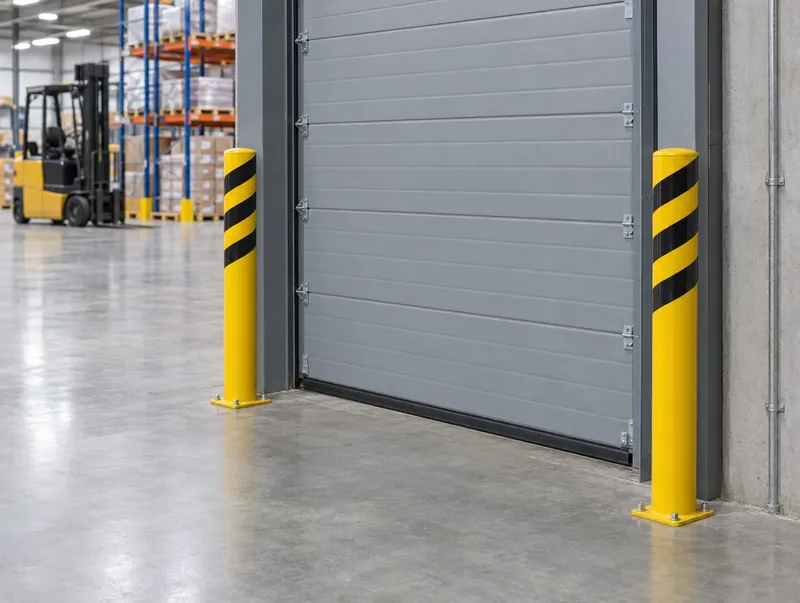 Computer-generated image
Croydon warehouse impact bollards
Yellow steel and polymer impact bollards for forklift zones, loading bays, doors, columns and racking inside warehouses. In Croydon, that tends to mean sites such as hospital approaches, station forecourts and school gates.
We cover Croydon's CR2, CR0, CR8, SE25, CR7 and SE19 postcode districts, including places such as Purley and Coulsdon. We also cover neighbouring Sutton (4.7 miles), Caterham (5 miles), Bromley (5.5 miles) and Banstead (6.6 miles) — distances are straight-line.
Croydon at a glance
- Area
- London, England
- Highway authority
- Croydon Council (local roads)
- Planning authority
- Croydon Council
- Postcodes
- CR2, CR0, CR8, SE25, CR7, SE19 and CR5
- Guide price
- Typically £205–£1,395 per bollard + VAT; minimum job £505
- Survey
- Free, with a fixed written quote
Guide prices for Croydon
| Specification | Guide price | Includes |
|---|---|---|
| Standard | £205–£695 + VAT | Standard post, foundation, reinstatement |
| Upgraded | £555–£1,045 + VAT | Upgraded finish or fittings, reflective band, matched keys |
| Premium | £905–£1,395 + VAT | Heavy-duty or architectural spec, premium finish |
Per bollard, supplied and fixed; +15% for London. Guide only — the fixed price follows a survey.
Typical warehouse impact bollards jobs in Croydon
Typical reasons Croydon sites choose warehouse impact bollards:
- Fire exit doors and emergency routes
- Loading dock doors, shutter guides and dock levellers
- Charging stations for forklifts and pallet trucks
Consents, ground and services in Croydon
Croydon Council is the highway authority covering Croydon's local roads. Red routes are managed by Transport for London. If any post would stand on adopted highway rather than your land, that consent is the first thing we sort out.
Bollards on private land often don't need planning permission, but it depends on the council's view, the height and the location; in a conservation area, next to a listed building or under an Article 4 direction, ask the local planning authority (Croydon Council) first — we flag this at survey.
Anchors need enough edge distance from slab joints and cracks or they will split the concrete on first impact. The slab is the foundation, and it decides what can be fixed where.
- Keep fire exits, escape routes and fire equipment accessible; bollards must not narrow escape routes below their required width.
- Where impact performance matters, ask for products tested to PAS 13 and match the stated performance to your vehicles.
How the job runs
Check the slab
Slab thickness, joints, cracks and any underfloor services or heating are checked, and anchors are chosen for the floor rather than taken from a standard list.
Plan around operations
Work is phased by aisle or zone, or done out of hours, with each area barriered off while drilling. Dust is controlled with extraction where products are stored nearby.
Fix, torque and mark
Bollards and guards are fixed and torqued, then any associated floor markings are applied so drivers can see protected zones.
Specification choices
| Option | Detail |
|---|---|
| Steel bollards | Yellow-coated steel tube on a base plate, often concrete-filled. Robust and economical, but they pass impact loads straight into the slab. |
| Diameters and heights | Commonly 114–273 mm diameter and around 600–1,200 mm high, chosen for vehicle type and mast or fork height. |
| Column and rack end guards | Wrap-around or corner protectors for columns and racking uprights where a single post will not fit. |
What affects the quote
Two Croydon jobs with the same number of posts can price quite differently. The usual reasons:
- Removal of damaged existing protection
- Number of positions and types of guard
- Out-of-hours or phased working around operations
After installation
On steel bollards look for bending, cracked welds, loose or sheared anchors and cracked concrete around the base plate. Polymer bollards should return to their original shape; one that stays deformed or has split needs replacing.
If posts in Croydon are later hit or damaged, we can repair or replace them — see bollard repairs.
Questions about warehouse impact bollards in Croydon
Can you install warehouse impact bollards anywhere in Croydon?
We cover all of Croydon (CR2, CR0, CR8, SE25, CR7 and SE19) and the rest of London. We also work in Sutton, Caterham and Bromley.
Who gives permission for bollards on the pavement in Croydon?
In Croydon, work on adopted pavements and verges needs consent from Croydon Council, the local highway authority. Red routes are managed by Transport for London. Car parks, forecourts and other private land only need the owner's permission.
What's a typical price for warehouse impact bollards in Croydon?
In Croydon, typically £205–£1,395 per bollard, supplied and fixed, plus VAT, with a minimum job of £505 plus VAT, using our London guide prices. The fixed figure comes in writing after we've seen the site.
How close to a column should a bollard sit?
Close enough that a vehicle cannot reach the column around it, but with enough gap that the bollard does not hit the column when struck. Polymer bollards need more clearance than steel because they deflect. The gap is set from the product data.
Should we choose steel or polymer warehouse bollards?
Steel suits lighter traffic and sound, thick slabs where cost matters most. Polymer suits busy forklift areas where repeated impacts would destroy anchors and floors. Polymer often costs more to buy but less to keep in service.