North Ayrshire · Scotland
Warehouse and loading-bay bollards in Saltcoats
Warehouse impact bollards for sites across Saltcoats and the rest of North Ayrshire, from the first measurement to the last relaid paving block.
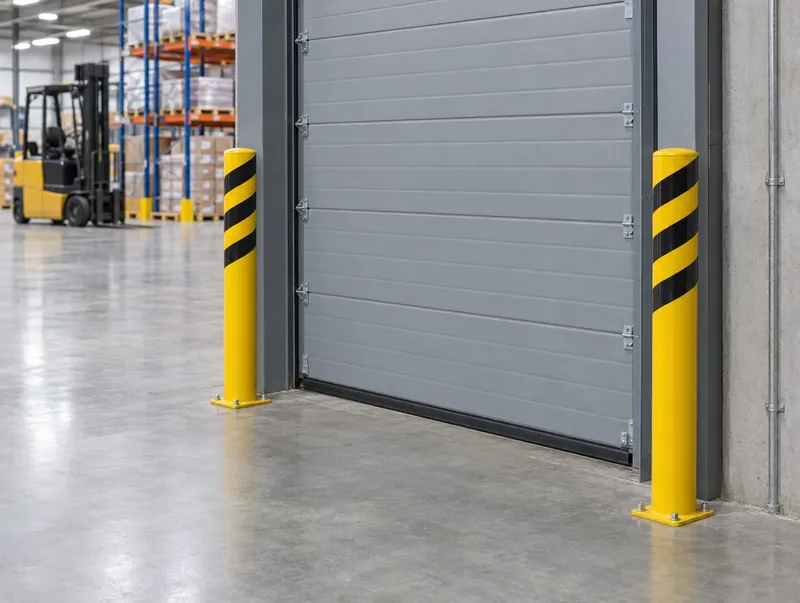 Computer-generated image
About warehouse impact bollards in Saltcoats
Warehouse impact bollards suit plenty of Saltcoats sites, schools, local parades and small industrial units among them. Yellow steel and polymer impact bollards for forklift zones, loading bays, doors, columns and racking inside warehouses.
We work across KA21 and KA20 — Saltcoats itself and places including Stevenston. Nearby, we also work in Ardrossan (1.3 miles), Kilwinning (3.3 miles), Irvine (5.2 miles) and Troon (8 miles), measured as the crow flies. Glasgow is around 26 miles away.
Key facts for this area
- Area
- North Ayrshire, Scotland
- Roads authority
- North Ayrshire Council (local roads)
- Planning authority
- North Ayrshire Council
- Postcodes
- KA21 and KA20
- Guide price
- Typically £175–£1,195 per bollard + VAT; minimum job £445
- Survey
- Free, with a fixed written quote
- Nearby
- Ardrossan (1.3 mi), Kilwinning (3.3 mi), Irvine (5.2 mi), Troon (8 mi)
Where warehouse impact bollards go in around Saltcoats
Common uses in a place like Saltcoats:
- Building columns in forklift aisles and turning areas
- Sprinkler risers, electrical panels and gas meters
- Racking ends and corners in busy aisles
What warehouse impact bollards cost in Saltcoats
| Specification | Guide price | Includes |
|---|---|---|
| Standard | £175–£605 + VAT | Standard post, foundation, reinstatement |
| Upgraded | £485–£905 + VAT | Upgraded finish or fittings, reflective band, matched keys |
| Premium | £785–£1,195 + VAT | Heavy-duty or architectural spec, premium finish |
Per bollard, supplied and fixed; no regional adjustment. Guide only — the fixed price follows a survey.
What we check first in Saltcoats
In Scotland the council is the roads authority for local roads, which in Saltcoats means North Ayrshire Council. Warehouse impact bollards on an adopted footway need its consent; trunk roads sit with Transport Scotland.
Many private-land installations in Saltcoats need no planning application, but the rules don't clearly cover bollards, so listed buildings, conservation areas and prominent frontages are worth raising with the planning team at North Ayrshire Council before posts go in.
The slab is the foundation, and it decides what can be fixed where. Warehouse floors vary from thick reinforced slabs to thin toppings over older concrete, and some contain underfloor heating, ducting or wire-guidance systems for automated trucks that must not be cut.
- Use your workplace transport risk assessment to decide where protection is needed, in line with HSE guidance on workplace transport.
- Check with the building owner before drilling into slabs with underfloor heating, guidance wires or post-tensioned reinforcement.
Installation, step by step
Plan around operations
Work is phased by aisle or zone, or done out of hours, with each area barriered off while drilling. Dust is controlled with extraction where products are stored nearby.
Drill and anchor
Holes are drilled, cleaned and anchors installed to the maker's instructions. Chemical anchors are left to cure before the bollard is loaded.
Fix, torque and mark
Bollards and guards are fixed and torqued, then any associated floor markings are applied so drivers can see protected zones.
Specification choices
| Option | Detail |
|---|---|
| Cast-in or base-plated | Base plates suit existing slabs. External yard posts can be cast into concrete foundations for heavier duty. |
| Diameters and heights | Commonly 114–273 mm diameter and around 600–1,200 mm high, chosen for vehicle type and mast or fork height. |
| Column and rack end guards | Wrap-around or corner protectors for columns and racking uprights where a single post will not fit. |
What affects the quote
Two Saltcoats jobs with the same number of posts can price quite differently. The usual reasons:
- Number of positions and types of guard
- Steel or polymer bollards and the impact performance needed
- Slab condition and the anchors or foundations it needs
Keeping them working
Polymer bollards should return to their original shape; one that stays deformed or has split needs replacing. Inspect warehouse bollards regularly as part of routine site checks, and after any reported impact.
For damaged or loose posts in Saltcoats, repairs and replacements are priced in writing first.
Questions about warehouse impact bollards in Saltcoats
Can you install warehouse impact bollards anywhere in Saltcoats?
We cover all of Saltcoats (KA21 and KA20) and the rest of North Ayrshire. We also work in Ardrossan, Kilwinning and Irvine.
Do I need consent for warehouse impact bollards on a public footway in Saltcoats?
In Scotland the council is the roads authority for local roads, which in Saltcoats means North Ayrshire Council. Warehouse impact bollards on an adopted footway need its consent; trunk roads sit with Transport Scotland.
How much do warehouse impact bollards cost in Saltcoats?
In Saltcoats, typically £175–£1,195 per bollard, supplied and fixed, plus VAT, with a minimum job of £445 plus VAT, using our Scotland guide prices. The fixed figure comes in writing after we've seen the site.
Should we choose steel or polymer warehouse bollards?
Steel suits lighter traffic and sound, thick slabs where cost matters most. Polymer suits busy forklift areas where repeated impacts would destroy anchors and floors. Polymer often costs more to buy but less to keep in service.
Can bollards be fixed to a thin warehouse floor?
Sometimes, using larger base plates, through-bolts or polymer bollards that reduce anchor loads. If the slab is too thin or damaged, a new local foundation may be needed. We check the slab before recommending a fixing.