Guide
Can I put bollards on the pavement outside my property?
Private land or adopted highway: who can install bollards on pavements and verges in England, Wales, Scotland and Northern Ireland, and how to check.
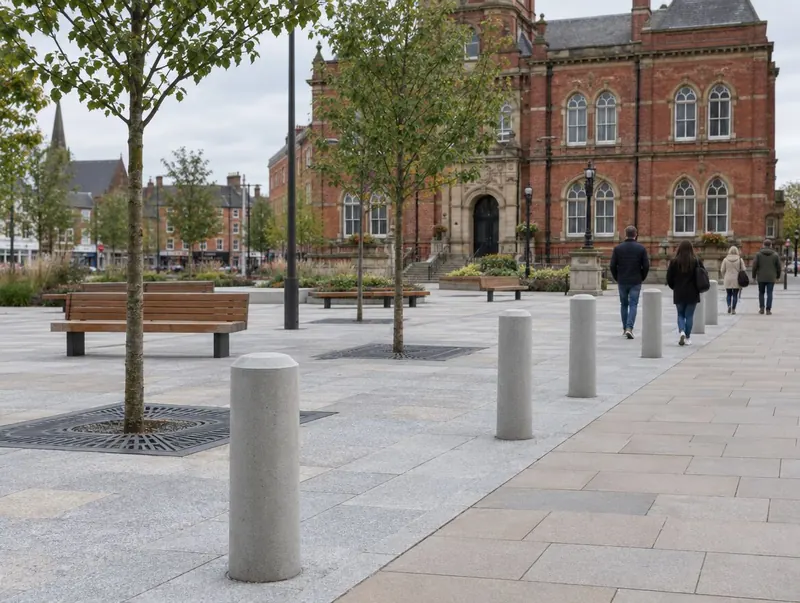 Computer-generated image
Not without the highway authority's written agreement. Pavements, verges and roads are usually adopted highway, and in England and Wales the power to put posts there sits with the highway authority under the Highways Act 1980; in Scotland the roads authority's written consent is needed, and in Northern Ireland the Department for Infrastructure's. Land wholly within your own boundary is private, so bollards there are your decision, subject to planning and access checks.
How do I know if the land is private or adopted highway?
Check two records: the title plan shows what you own, and the council's adopted highways register shows what is highway. Land wholly within your boundary is private. Pavements and verges are usually adopted highway, and supplier guidance from Bison Products notes that grass verges are usually part of the highway even when they look private.
Title plans come from HM Land Registry in England and Wales and from the land registers in Scotland and Northern Ireland, and the council's highways team can confirm what is on its register. Check both before ordering, because a post a metre in the wrong direction turns a simple job into a highway matter.
Who can install bollards on the highway in England and Wales?
The highway authority. Under section 80 of the Highways Act 1980, a highway authority can erect and maintain fences or posts to prevent access to a highway, and section 66 lets it provide pillars, posts, barriers, rails or fences to safeguard people using it. Under section 66 it may not obstruct private access to premises, and it must pay compensation for damage.
Department for Transport guidance on street works licences lists bollard installation among works that should not go through a section 50 licence, which covers pipes, cables, ducts and similar apparatus, and points to section 80 instead. Some authorities use a section 171 licence for private street furniture in the footway. Practice varies, so ask your authority which route it uses.
Is it an offence to put bollards on the pavement without permission?
It can be. Under section 137 of the Highways Act 1980, wilfully obstructing free passage along a highway without lawful authority or excuse is an offence in England and Wales, punishable by up to 51 weeks' imprisonment, a fine or both. A bollard, planter or boulder placed on the footway without the authority's agreement risks exactly that, and it cuts across the authority's own powers to decide what goes on its land.
What are the rules in Scotland?
In Scotland you need the roads authority's written consent. Under section 56 of the Roads (Scotland) Act 1984, no works may be carried out in, or excavation made under, a public road without it, and breach is an offence. Under section 59, nothing may be placed or deposited in a road so as to cause an obstruction without written consent; breach is an offence, and the authority can remove the item and recover its costs. Ask the council's roads team whether the footway outside your property forms part of the public road.
What are the rules in Northern Ireland?
In Northern Ireland the Department for Infrastructure (DfI) decides. Under Article 71 of the Roads (Northern Ireland) Order 1993, erecting a structure on a road, including any object that could obstruct it, is an offence unless it is done under a statutory power, with the Department's consent or under certain licences, and the Department can require its removal. Article 78 makes excavating or breaking up a road surface an offence without the Department's consent or a street works licence. Licences for apparatus in the street are granted under Article 11 of the Street Works (Northern Ireland) Order 1995, the equivalent of section 50 in Great Britain.
How can I stop people parking on the pavement outside my property?
Put bollards on your own side of the boundary, or ask the highway authority to act. Posts set just inside your boundary, at the back edge of the footway, can stop vehicles mounting a forecourt or verge you own without any highway consent, although planning may still need checking (see our planning guide). For posts on the footway itself, write to the highway authority with photos, a plan and a description of the problem. It can install posts under its own powers or agree a scheme with conditions, and posts it installs under section 66 cannot block access to your premises.
How do we handle bollards near the highway?
We install on private land, or on the highway only with the authority's written agreement. At the free survey we check the title plan and adoption status with you and mark positions inside the boundary where that works. Where the authority agrees to bollards on its land, we work to its conditions, including any licence, traffic management and reinstatement standard. As a guide, a licence or permit with its application runs at £395–£1,895 and traffic management at £245–£895 per day, both plus VAT, and each appears as its own line in the fixed written quote. National detail is on our rules pages for England, Wales, Scotland and Northern Ireland.
Prepared by the Bollard Installers team · Last reviewed 01 November 2026 · Prices and rules change; check the rules pages and your written quote.
Questions
Is the grass verge outside my house mine?
Often not. Grass verges are usually part of the highway even when they look private and you mow them, so check your title plan and the council's adopted highways register before fixing anything there.
Can I use a planter or boulder instead of a bollard?
The same rules apply. The obstruction offences in England and Wales, Scotland and Northern Ireland cover objects placed on the highway, not only bollards.
Can the council remove bollards put on the highway without consent?
In Scotland the roads authority can remove an obstruction and recover its costs, and in Northern Ireland the Department can require removal. In England and Wales, an unauthorised obstruction can be an offence under section 137 of the Highways Act 1980.
Do I need a licence to dig in the pavement for my own bollards?
You need the authority's agreement first. In England and Wales some councils issue a section 171 licence for private street furniture; in Scotland it is roads authority consent under section 56, and in Northern Ireland Department consent under Article 78.
Does this apply to security bollards outside offices and venues?
Yes. Hostile vehicle mitigation on the footway still needs the highway authority's agreement, and TAL 1/11 says such barriers should be recorded on the authority's asset register so later street works don't damage the foundation.
Related services

Pedestrian and shopfront protection bollards
Bollards that separate people from vehicles at car parks, forecourts, walkways, drive-thrus and shop entrances.
Learn more →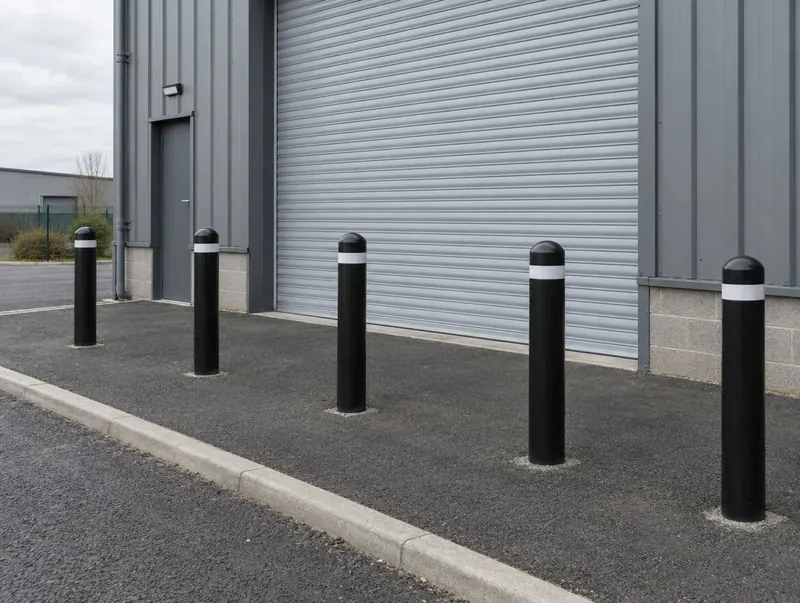
Steel security bollards (unrated)
Concrete-filled steel bollards, root-fixed or base-plated, for car parks, forecourts, boundaries and nuisance vehicle control.
Learn more →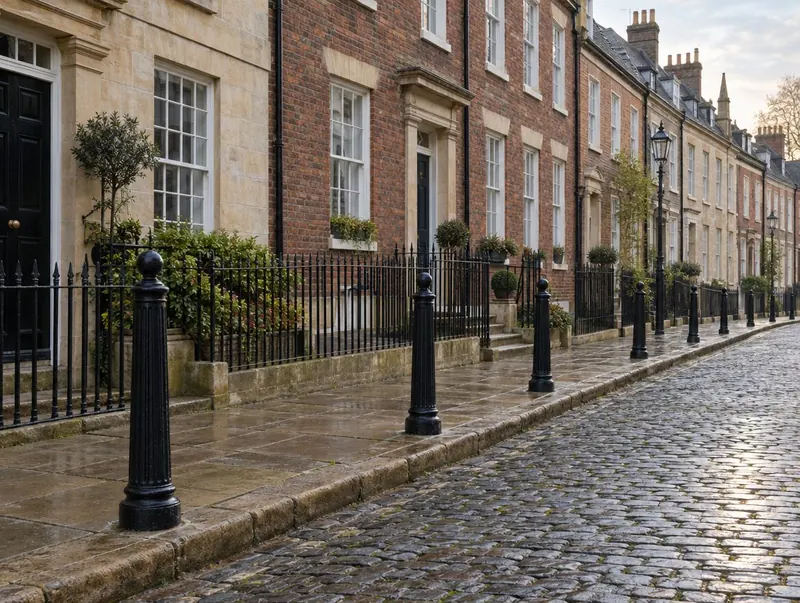
Cast iron and heritage bollards
Traditional cast and ductile iron bollards for conservation areas, period streets and historic estates, installed and reset.
Learn more →Concrete bollards
Precast concrete and reconstituted stone bollards for public realm, parks, boundaries and estates, dowelled or bedded in place.
Learn more →