Devon · England
Automatic rising bollard installation in Paignton
Automatic bollards supplied and fitted in Paignton, Devon: surveyed, scanned for services, set in proper foundations and finished to match the ground.
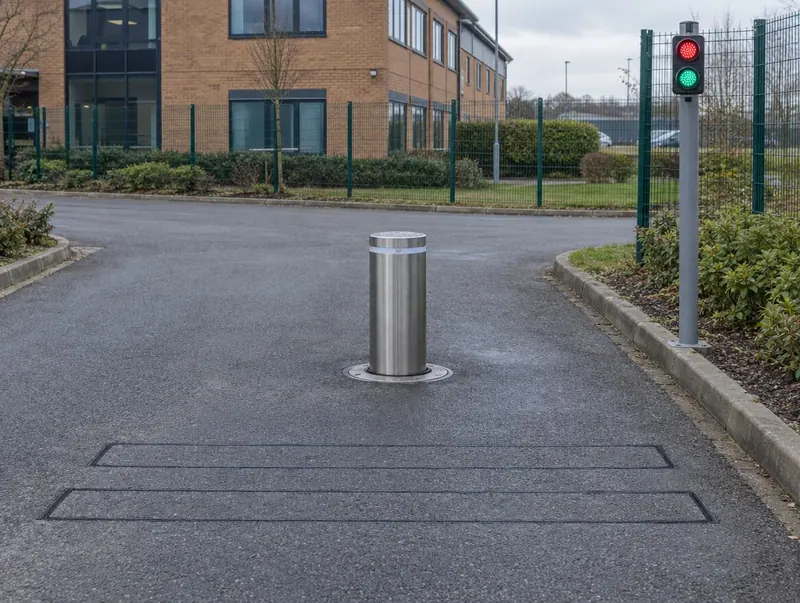 Computer-generated image
Automatic bollards in Paignton
Automatic bollards suit plenty of Paignton sites, filling-station forecourts, high street shopfronts and community car parks among them. Automatic bollards are available unrated for traffic control or crash-tested for security entrances.
We work across TQ3, TQ4 and TQ5 — Paignton itself and places including Lower Blagdon, Collaton St Mary and Brixham. We also cover neighbouring Torquay (2.6 miles), Newton Abbot (6.7 miles), Exmouth (14.5 miles) and Exeter (20 miles) — distances are straight-line. Paignton is about 26 miles from Plymouth.
Local details
- Area
- Devon, England
- Highway authority
- Torbay Council (local roads)
- Planning authority
- Torbay Council
- Postcodes
- TQ3, TQ4 and TQ5
- Guide price
- Typically £2,995–£14,995 per bollard + VAT
- Survey
- Free, with a fixed written quote
- Nearby
- Torquay (2.6 mi), Newton Abbot (6.7 mi), Exmouth (14.5 mi), Exeter (20 mi)
What automatic bollards cost in Paignton
| Specification | Guide price | Includes |
|---|---|---|
| Standard | £2,995–£8,045 + VAT | Electro-mechanical or entry hydraulic, controls, loops and photocell |
| Upgraded | £6,595–£11,595 + VAT | Heavy-duty hydraulic, traffic light, signs and LED head |
| Premium | £10,195–£14,995 + VAT | High-cycle or crash-rated automatic bollard |
Per bollard, installed with controls, loops and commissioning; no regional adjustment. Guide only — the fixed price follows a survey.
Automatic bollards in Paignton: common uses
Typical reasons Paignton sites choose automatic bollards:
- Private estates and gated developments without a full gate
- Entrances where a gate would block pedestrian desire lines
- Pedestrianised streets with permitted delivery windows
Before we dig in Paignton
Torbay Council is the highway authority covering Paignton's local roads. If any post would stand on adopted highway rather than your land, that consent is the first thing we sort out.
Many private-land installations in Paignton need no planning application, but the rules don't clearly cover bollards, so listed buildings, conservation areas and prominent frontages are worth raising with the planning team at Torbay Council before posts go in.
Duct routes cross the carriageway and often the footway, so buried services along those routes must be traced first. Without drainage, rainwater and silt collect in the cassette, corrode the mechanism and can freeze around the post in winter.
- For rated units, keep the test certificate and confirm the foundation matches the tested design.
- Prepare a written risk assessment covering pedestrians, cyclists, following vehicles and children, and choose safety devices to match.
From survey to handover
Survey and risk assessment
A free site survey covers traffic patterns, who uses the entrance, power, drainage routes and buried services. We draft the safety arrangement from that, and you receive a fixed written quote.
Excavate and set cassettes
Each cassette pit is excavated to the manufacturer's depth, with the base prepared to drain. Cassettes are set to finished road level and fall, then concreted in.
Commission and test
Rise and fall times, loop detection, photocells, lights and the manual release are tested with vehicles present. Safety settings are recorded against the risk assessment.
Finishes and options
| Option | Detail |
|---|---|
| Unrated or crash-rated | Unrated units control traffic; rated units are tested to IWA 14-1, ISO 22343-1 or PAS 68 for security entrances, with deeper, heavier foundations. |
| Head lighting and finishes | LED rings or lights in the head, reflective bands, and powder-coated or stainless finishes. Lit heads help drivers see the post when it is raised. |
| Electro-mechanical drive | Motor and gearbox inside the bollard with no hydraulic fluid. Often simpler to service, with duty cycles that suit moderate traffic. |
What affects the quote
Our South West guide prices are a starting point; the survey in Paignton firms them up. What tends to move them:
- Traffic management during installation on live roads
- Unrated or crash-rated model and its foundation size
- Surface condition for loops and the extent of reinstatement
After installation
Between visits, site staff should keep the head clear of grit and leaves, report slow or noisy movement early and never override safety devices to keep an entrance open. Automatic bollards need planned servicing, not just repair when they fail.
If posts in Paignton are later hit or damaged, we can repair or replace them — see bollard repairs.
Automatic bollards in Paignton: FAQs
Can you install automatic bollards anywhere in Paignton?
We cover all of Paignton (TQ3, TQ4 and TQ5) and the rest of Devon. We also work in Torquay, Newton Abbot and Exmouth.
Who gives permission for bollards on the pavement in Paignton?
The highway authority for local roads in Paignton is Torbay Council; motorways and trunk roads sit with National Highways. Automatic bollards on the adopted footway are a matter for the highway authority, so we only install there with its written agreement.
What's a typical price for automatic bollards in Paignton?
In Paignton, typically £2,995–£14,995 per bollard, installed with controls, loops and commissioning, plus VAT, using our South West guide prices. The fixed figure comes in writing after we've seen the site.
Can rising bollards be installed on a public road?
Only with the highway authority's approval, and they will set requirements for signs, signals and operation. On private land the decision is yours, but the same safety principles apply.
What stops a rising bollard hitting a car?
A safety loop in the road detects a vehicle above or close to the bollard and blocks the rise, backed up by photocells. Traffic lights and head lights tell drivers when to stop. The settings are tested on site with vehicles before handover.