Devon · England
Automatic rising bollard installation in Exeter
Automatic bollards for sites across Exeter and the rest of Devon, from the first measurement to the last relaid paving block.
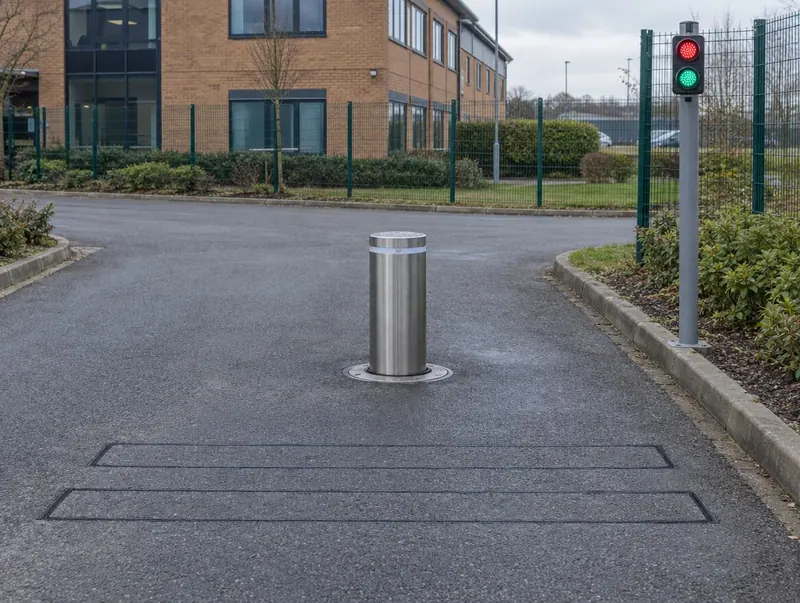 Computer-generated image
Automatic bollards in Exeter
Across Exeter, typical sites for automatic bollards include college campuses, business parks and leisure centres. Hydraulic and electro-mechanical rising bollards installed with controls, safety loops, signals and power, for managed vehicle access.
Coverage in Exeter takes in the EX4, EX2, EX1 and EX3 postcode districts and nearby places like Nadderwater, Topsham, Ide and West Clyst. Nearby, we also work in Exmouth (9.2 miles), Tiverton (12.4 miles), Newton Abbot (14 miles) and Torquay (18.1 miles), measured as the crow flies. Plymouth is around 36 miles away.
Local details
- Area
- Devon, England
- Highway authority
- Devon County Council (local roads)
- Planning authority
- the council for Exeter
- Postcodes
- EX4, EX2, EX1 and EX3
- Guide price
- Typically £2,995–£14,995 per bollard + VAT
- Survey
- Free, with a fixed written quote
- Nearby
- Exmouth (9.2 mi), Tiverton (12.4 mi), Newton Abbot (14 mi), Torquay (18.1 mi)
Where automatic bollards go in around Exeter
Around Exeter, automatic bollards usually solve one of these:
- Bus gates and access-only routes where the highway authority agrees
- Private estates and gated developments without a full gate
- Pedestrianised streets with permitted delivery windows
What automatic bollards cost in Exeter
| Specification | Guide price | Includes |
|---|---|---|
| Standard | £2,995–£8,045 + VAT | Electro-mechanical or entry hydraulic, controls, loops and photocell |
| Upgraded | £6,595–£11,595 + VAT | Heavy-duty hydraulic, traffic light, signs and LED head |
| Premium | £10,195–£14,995 + VAT | High-cycle or crash-rated automatic bollard |
Per bollard, installed with controls, loops and commissioning; no regional adjustment. Guide only — the fixed price follows a survey.
Before we dig in Exeter
Devon County Council is the highway authority covering Exeter's local roads. If any post would stand on adopted highway rather than your land, that consent is the first thing we sort out.
If your site in Exeter is listed or inside a conservation area, check with the local planning authority (the council for Exeter) before choosing a finish — heritage settings often favour cast iron or painted steel over stainless.
Duct routes cross the carriageway and often the footway, so buried services along those routes must be traced first. Loops are cut into a sound surface: badly cracked tarmac or block paving may need resurfacing first, because loops in broken surfaces fail early.
- Prepare a written risk assessment covering pedestrians, cyclists, following vehicles and children, and choose safety devices to match.
- On public highway, rising bollards normally need highway authority approval, with signs and signals to their requirements.
What happens on site
Excavate and set cassettes
Each cassette pit is excavated to the manufacturer's depth, with the base prepared to drain. Cassettes are set to finished road level and fall, then concreted in.
Commission and test
Rise and fall times, loop detection, photocells, lights and the manual release are tested with vehicles present. Safety settings are recorded against the risk assessment.
Train and hand over
Site staff are shown how to lower the bollard in an emergency and how to recognise faults. You receive keys, the commissioning record and the manufacturer's manuals.
Specification choices
| Option | Detail |
|---|---|
| Fail-safe behaviour | Configured to lower or stay raised on power loss, with a manual release, depending on whether access or security takes priority. |
| Electro-mechanical drive | Motor and gearbox inside the bollard with no hydraulic fluid. Often simpler to service, with duty cycles that suit moderate traffic. |
| Paired or multi-bollard lanes | Several bollards can run from one controller to close a wider entrance, with lane-by-lane control where needed. |
Pricing automatic bollards in Exeter
Our South West guide prices are a starting point; the survey in Exeter firms them up. What tends to move them:
- Traffic management during installation on live roads
- Number of bollards and lanes controlled
- Unrated or crash-rated model and its foundation size
Keeping them working
Between visits, site staff should keep the head clear of grit and leaves, report slow or noisy movement early and never override safety devices to keep an entrance open. Frequency depends on how often the bollard cycles; a busy entrance needs more visits than a rarely used one.
For damaged or loose posts in Exeter, repairs and replacements are priced in writing first.
Common questions
Do you install automatic bollards in Exeter?
We cover all of Exeter (EX4, EX2, EX1 and EX3) and the rest of Devon. We also work in Exmouth, Tiverton and Newton Abbot.
Who gives permission for bollards on the pavement in Exeter?
Devon County Council is the highway authority covering Exeter's local roads. If any post would stand on adopted highway rather than your land, that consent is the first thing we sort out.
What's a typical price for automatic bollards in Exeter?
In Exeter, typically £2,995–£14,995 per bollard, installed with controls, loops and commissioning, plus VAT, using our South West guide prices. The fixed figure comes in writing after we've seen the site.
Should I choose hydraulic or electro-mechanical bollards?
Choose by how often the bollard will move and how you want it maintained. Hydraulic units suit busy entrances and heavier rated posts but need fluid and seal checks. Electro-mechanical units avoid fluid and are often simpler to look after at moderate traffic levels.
Can rising bollards be installed on a public road?
Only with the highway authority's approval, and they will set requirements for signs, signals and operation. On private land the decision is yours, but the same safety principles apply.