Devon · England
Automatic rising bollard installation in Torquay
Planning automatic bollards in Torquay? We check ownership, consents and buried services first, then quote a fixed price.
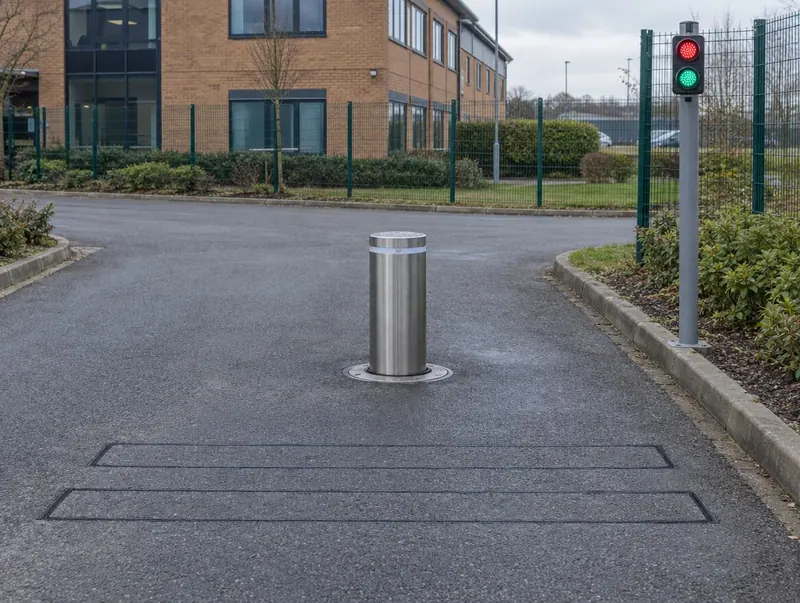 Computer-generated image
Torquay automatic bollards
Automatic bollards suit plenty of Torquay sites, high street shopfronts, schools and town-centre squares among them. Automatic bollards are available unrated for traffic control or crash-tested for security entrances.
We cover every part of Torquay in the TQ1 and TQ2 postcode districts. Nearby, we also work in Paignton (2.6 miles), Newton Abbot (6 miles), Exmouth (12 miles) and Exeter (18.1 miles), measured as the crow flies. Torquay is about 28 miles from Plymouth.
Torquay at a glance
- Area
- Devon, England
- Highway authority
- Torbay Council (local roads)
- Planning authority
- Torbay Council
- Postcodes
- TQ1 and TQ2
- Guide price
- Typically £2,995–£14,995 per bollard + VAT
- Survey
- Free, with a fixed written quote
- Nearby
- Paignton (2.6 mi), Newton Abbot (6 mi), Exmouth (12 mi), Exeter (18.1 mi)
Typical automatic bollards jobs in Torquay
Typical reasons Torquay sites choose automatic bollards:
- Entrances where a gate would block pedestrian desire lines
- Secure loading yards where rated automatic posts are specified
- Emergency access routes that must open on demand
What automatic bollards cost in Torquay
| Specification | Guide price | Includes |
|---|---|---|
| Standard | £2,995–£8,045 + VAT | Electro-mechanical or entry hydraulic, controls, loops and photocell |
| Upgraded | £6,595–£11,595 + VAT | Heavy-duty hydraulic, traffic light, signs and LED head |
| Premium | £10,195–£14,995 + VAT | High-cycle or crash-rated automatic bollard |
Per bollard, installed with controls, loops and commissioning; no regional adjustment. Guide only — the fixed price follows a survey.
Permissions and groundwork in Torquay
Torbay Council is the highway authority covering Torquay's local roads. If any post would stand on adopted highway rather than your land, that consent is the first thing we sort out.
Many private-land installations in Torquay need no planning application, but the rules don't clearly cover bollards, so listed buildings, conservation areas and prominent frontages are worth raising with the planning team at Torbay Council before posts go in.
Reinstatement around each cassette is made flush so vehicles pass smoothly over the lowered head. The pit base is usually connected to a surface water drain or a soakaway, and on clay or high water table sites that connection needs particular attention.
- Prepare a written risk assessment covering pedestrians, cyclists, following vehicles and children, and choose safety devices to match.
- On public highway, rising bollards normally need highway authority approval, with signs and signals to their requirements.
How the job runs
Survey and risk assessment
A free site survey covers traffic patterns, who uses the entrance, power, drainage routes and buried services. We draft the safety arrangement from that, and you receive a fixed written quote.
Ducts, drainage and loops
Ducts are laid between the bollards, the controller cabinet and access devices, with draw pits where runs change direction. The drain is connected and the safety and exit loops are cut into the surface and sealed.
Commission and test
Rise and fall times, loop detection, photocells, lights and the manual release are tested with vehicles present. Safety settings are recorded against the risk assessment.
Finishes and options
| Option | Detail |
|---|---|
| Paired or multi-bollard lanes | Several bollards can run from one controller to close a wider entrance, with lane-by-lane control where needed. |
| Unrated or crash-rated | Unrated units control traffic; rated units are tested to IWA 14-1, ISO 22343-1 or PAS 68 for security entrances, with deeper, heavier foundations. |
| Electro-mechanical drive | Motor and gearbox inside the bollard with no hydraulic fluid. Often simpler to service, with duty cycles that suit moderate traffic. |
What moves the price in Torquay
Our South West guide prices are a starting point; the survey in Torquay firms them up. What tends to move them:
- Unrated or crash-rated model and its foundation size
- Hydraulic or electro-mechanical drive and the duty cycle needed
- Number of bollards and lanes controlled
After installation
Automatic bollards need planned servicing, not just repair when they fail. Typical visits clean and inspect the cassette and drain, check hydraulic fluid or gearbox condition, test loops, photocells, lights and the manual release, and read the controller's fault log.
If posts in Torquay are later hit or damaged, we can repair or replace them — see bollard repairs.
Questions about automatic bollards in Torquay
Which parts of Torquay do you cover for automatic bollards?
We cover all of Torquay (TQ1 and TQ2) and the rest of Devon. We also work in Paignton, Newton Abbot and Exmouth.
Who gives permission for bollards on the pavement in Torquay?
The highway authority for local roads in Torquay is Torbay Council; motorways and trunk roads sit with National Highways. Automatic bollards on the adopted footway are a matter for the highway authority, so we only install there with its written agreement.
What's a typical price for automatic bollards in Torquay?
In Torquay, typically £2,995–£14,995 per bollard, installed with controls, loops and commissioning, plus VAT, using our South West guide prices. The fixed figure comes in writing after we've seen the site.
Why do automatic bollards need drainage?
The bollard sits in a pit that collects rain and silt. Without a drain, water corrodes the mechanism, short-circuits electrics and can freeze the post in place. A drain connection is part of every automatic installation we carry out.
Should I choose hydraulic or electro-mechanical bollards?
Choose by how often the bollard will move and how you want it maintained. Hydraulic units suit busy entrances and heavier rated posts but need fluid and seal checks. Electro-mechanical units avoid fluid and are often simpler to look after at moderate traffic levels.