East Lothian · Scotland
Automatic rising bollard installation in Dunbar
Local installation of automatic bollards in Dunbar — free survey, fixed written price, and posts set to the right spacing for people and vehicles.
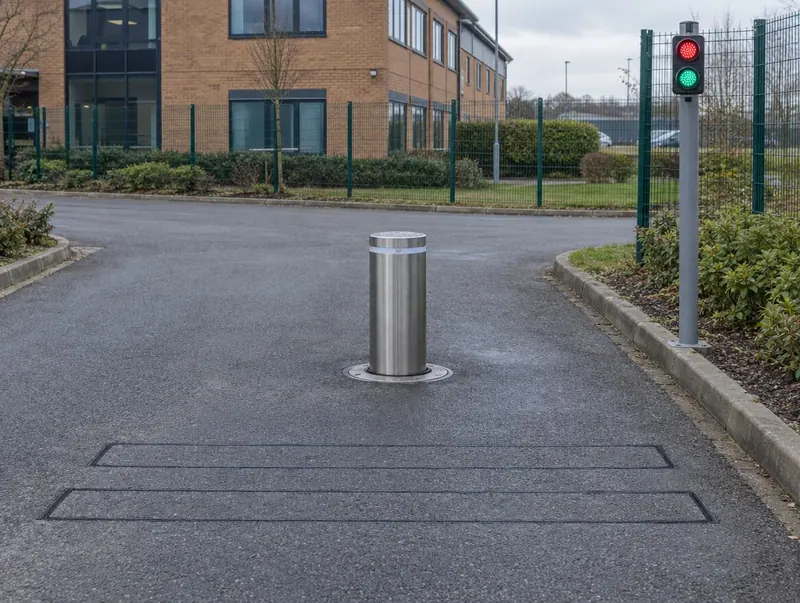 Computer-generated image
About automatic bollards in Dunbar
Automatic bollards suit plenty of Dunbar sites, schools, small industrial units and filling-station forecourts among them. Hydraulic and electro-mechanical rising bollards installed with controls, safety loops, signals and power, for managed vehicle access.
We work across EH42 and EH40 — Dunbar itself and places including West Barns, Innerwick, Spott and Whitekirk. We also cover neighbouring Tranent (17.4 miles) and Musselburgh (21.1 miles) — distances are straight-line. It sits roughly 27 miles from Edinburgh as the crow flies.
Local details
- Area
- East Lothian, Scotland
- Roads authority
- East Lothian Council (local roads)
- Planning authority
- East Lothian Council
- Postcodes
- EH42 and EH40
- Guide price
- Typically £2,995–£14,995 per bollard + VAT
- Survey
- Free, with a fixed written quote
- Nearby
- Tranent (17.4 mi), Musselburgh (21.1 mi)
Where automatic bollards go in around Dunbar
Typical reasons Dunbar sites choose automatic bollards:
- Emergency access routes that must open on demand
- Entrances where a gate would block pedestrian desire lines
- Business parks and campus roads with controlled vehicle access
What automatic bollards cost in Dunbar
| Specification | Guide price | Includes |
|---|---|---|
| Standard | £2,995–£8,045 + VAT | Electro-mechanical or entry hydraulic, controls, loops and photocell |
| Upgraded | £6,595–£11,595 + VAT | Heavy-duty hydraulic, traffic light, signs and LED head |
| Premium | £10,195–£14,995 + VAT | High-cycle or crash-rated automatic bollard |
Per bollard, installed with controls, loops and commissioning; no regional adjustment. Guide only — the fixed price follows a survey.
Permissions and groundwork in Dunbar
In Scotland the council is the roads authority for local roads, which in Dunbar means East Lothian Council. Automatic bollards on an adopted footway need its consent; trunk roads sit with Transport Scotland.
Many private-land installations in Dunbar need no planning application, but the rules don't clearly cover bollards, so listed buildings, conservation areas and prominent frontages are worth raising with the planning team at East Lothian Council before posts go in.
Reinstatement around each cassette is made flush so vehicles pass smoothly over the lowered head. Without drainage, rainwater and silt collect in the cassette, corrode the mechanism and can freeze around the post in winter.
- For rated units, keep the test certificate and confirm the foundation matches the tested design.
- Agree emergency access with the fire and ambulance services, including how they will lower the bollards.
Installation, step by step
Ducts, drainage and loops
Ducts are laid between the bollards, the controller cabinet and access devices, with draw pits where runs change direction. The drain is connected and the safety and exit loops are cut into the surface and sealed.
Power and controls
A qualified electrician installs the supply and isolation, and the controller, traffic lights, photocells and access devices are mounted and wired.
Train and hand over
Site staff are shown how to lower the bollard in an emergency and how to recognise faults. You receive keys, the commissioning record and the manufacturer's manuals.
Options to consider
| Option | Detail |
|---|---|
| Electro-mechanical drive | Motor and gearbox inside the bollard with no hydraulic fluid. Often simpler to service, with duty cycles that suit moderate traffic. |
| Hydraulic drive | Integral or remote power pack. Suits high-frequency entrances and heavier rated units, with periodic checks on fluid, seals and hoses. |
| Heights and diameters | Raised heights are commonly around 500–800 mm for traffic control and taller for security models, with diameters varying by drive and rating. |
Pricing automatic bollards in Dunbar
When we price automatic bollards in Dunbar, these make the biggest difference:
- Length of duct runs, drainage connections and power supply distance
- Traffic management during installation on live roads
- Unrated or crash-rated model and its foundation size
Looking after them
Typical visits clean and inspect the cassette and drain, check hydraulic fluid or gearbox condition, test loops, photocells, lights and the manual release, and read the controller's fault log. Automatic bollards need planned servicing, not just repair when they fail.
We can also service, repair or replace existing posts anywhere in Dunbar.
Common questions
Which parts of Dunbar do you cover for automatic bollards?
We cover all of Dunbar (EH42 and EH40) and the rest of East Lothian. We also work in Tranent and Musselburgh.
Do I need consent for automatic bollards on a public footway in Dunbar?
Dunbar falls under East Lothian Council as roads authority. If the line of posts crosses onto adopted road or pavement, permission comes before excavation; on private land it does not.
What's a typical price for automatic bollards in Dunbar?
In Dunbar, typically £2,995–£14,995 per bollard, installed with controls, loops and commissioning, plus VAT, using our Scotland guide prices. The fixed figure comes in writing after we've seen the site.
Should I choose hydraulic or electro-mechanical bollards?
Choose by how often the bollard will move and how you want it maintained. Hydraulic units suit busy entrances and heavier rated posts but need fluid and seal checks. Electro-mechanical units avoid fluid and are often simpler to look after at moderate traffic levels.
Why do automatic bollards need drainage?
The bollard sits in a pit that collects rain and silt. Without a drain, water corrodes the mechanism, short-circuits electrics and can freeze the post in place. A drain connection is part of every automatic installation we carry out.