Suffolk · England
Bollard repairs in Lowestoft
Bollard repairs in Lowestoft, Suffolk: the visit price confirmed in writing first, then a clear report and a fixed price for anything further.
 Computer-generated image
Bollard repairs in Lowestoft
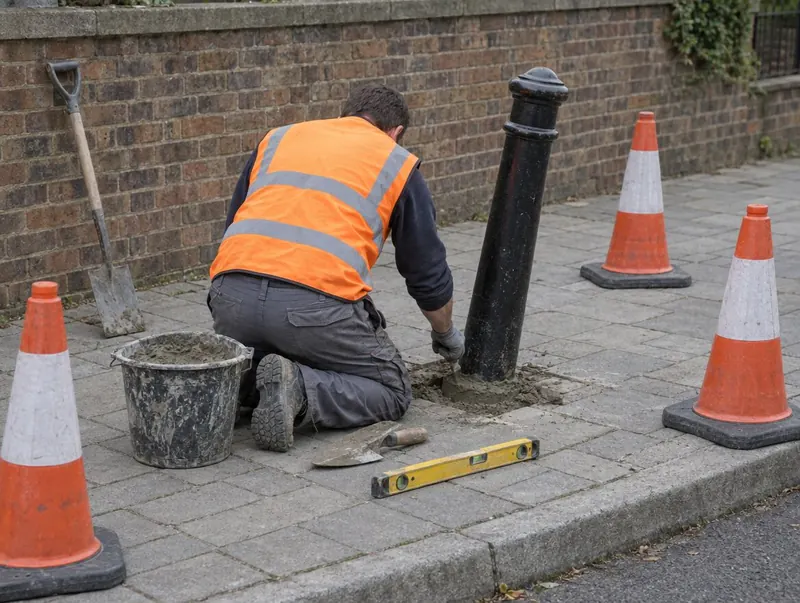
Across Lowestoft, bollard repairs are typically needed at local parades, filling-station forecourts and community car parks. Typical repairs include re-bedding a loose or leaning post, re-fixing a base plate with new anchors, replacing a seized socket, lock, cap or hinge, clearing a blocked cassette and renewing reflective bands.
Coverage in Lowestoft takes in the NR32 and NR33 postcode districts and nearby places like Blundeston, Corton, Somerleyton and Camps Heath. We also cover neighbouring Great Yarmouth (9.2 miles) and Norwich (21.8 miles) — distances are straight-line.
Local details
- Area
- Suffolk, England
- Highway authority
- Suffolk County Council (local roads)
- Planning authority
- the council for East Suffolk
- Postcodes
- NR32 and NR33
- Guide price
- Typically £115–£455 per visit + VAT (£135–£545 inc VAT for homes)
- Survey
- Paid visit, price confirmed in writing first
- Nearby
- Great Yarmouth (9.2 mi), Norwich (21.8 mi)
Guide prices for Lowestoft
| Specification | Guide price | Includes |
|---|---|---|
| Standard | £115–£265 + VAT · £135–£315 inc VAT | Straighten or re-bed one post |
| Upgraded | £225–£365 + VAT · £265–£435 inc VAT | Several posts, or new socket, lock or band |
| Premium | £325–£455 + VAT · £385–£545 inc VAT | Larger repair with new foundation |
Per visit, typically one to three posts; +3% for East of England. Guide only — the visit price is confirmed in writing first.
Typical bollard repairs requests in Lowestoft
Typical reasons for bollard repairs in Lowestoft:
- Removable bollards with seized locks or damaged sockets
- Base-plated bollards with loose or sheared anchors
- Fold-down posts with bent hinges or broken locks
Before we dig in Lowestoft
In Lowestoft, work on adopted pavements and verges needs consent from Suffolk County Council, the local highway authority. Car parks, forecourts and other private land only need the owner's permission.
Bollards on private land often don't need planning permission, but it depends on the council's view, the height and the location; in a conservation area, next to a listed building or under an Article 4 direction, ask the local planning authority (the council for East Suffolk) first — we flag this at survey.
Reinstatement matches what is there, whether tarmac, block paving, flags, resin or turf, though older or weathered surfaces may show a visible patch. Base-plate repairs depend on the slab: if the concrete has cracked or crumbled around the anchors, it is cut back and repaired before new fixings go in.
- Do not repair crash-rated bollards in ways that change the tested product; involve the manufacturer.
- Make damaged posts safe promptly, as a leaning post or open socket on a footway is a trip hazard.
Installation, step by step
Receive a written price
We confirm the cost of the visit and the expected work in writing before anyone attends. Nothing is done until you have agreed it.
Make safe if needed
Where a post is a hazard now, the first step can be to make it safe by removing or capping it, priced separately in writing so you can approve it on its own.
Carry out the repair
The crew carries out the agreed work. If they find something different, such as a cracked slab under a base plate, they stop and we price the extra work in writing before continuing.
Options to consider
| Option | Detail |
|---|---|
| Re-fixing base plates | New resin anchors in fresh positions, a larger plate to spread the load, or a slab repair before re-fixing. |
| Re-bedding | Breaking out a failed foundation and resetting the existing post plumb in new concrete, then reinstating the surface. |
| Coatings | Touch-up or full repainting of steel and cast iron posts to stop corrosion taking hold. |
Pricing bollard repairs in Lowestoft
Two Lowestoft jobs with the same number of posts can price quite differently. The usual reasons:
- Surface type and reinstatement
- Access, traffic management and working hours
- Availability of matching parts, locks and caps
Looking after them
Most repair call-outs come from small problems left too long. Lubricating locks a few times a year, lifting removable and telescopic posts periodically, keeping cassettes clear of grit, touching up chipped paint and checking for lean after knocks will prevent many of them.
For damaged or loose posts in Lowestoft, repairs and replacements are priced in writing first.
Bollard repairs in Lowestoft: FAQs
Which parts of Lowestoft do you cover for bollard repairs?
We cover all of Lowestoft (NR32 and NR33) and the rest of Suffolk. We also work in Great Yarmouth and Norwich.
Do I need consent for bollards on a public footway in Lowestoft?
The highway authority for local roads in Lowestoft is Suffolk County Council; motorways and trunk roads sit with National Highways. Bollards on the adopted footway are a matter for the highway authority, so we only install there with its written agreement.
What's a typical price for bollard repairs in Lowestoft?
In Lowestoft, typically £115–£455 per visit, typically one to three posts, plus VAT (£135–£545 including VAT for homeowners), using our East of England guide prices. We confirm the visit price in writing before attending.
Can you free a seized removable bollard?
Usually, by working the lock free or drilling it out, then lifting the post and cleaning the socket. If the socket is crushed or corroded, it is cut out and replaced. A new lock and keys can be fitted at the same time.
Can you repair a bollard we did not install?
Yes. We repair fixed, removable, telescopic, fold-down and other manual bollards whoever installed them. Photographs help us identify the type and find matching parts.