Suffolk · England
Automatic bollard servicing in Lowestoft
Automatic bollard service visits for sites in Lowestoft and the rest of Suffolk, by crews working under our management.
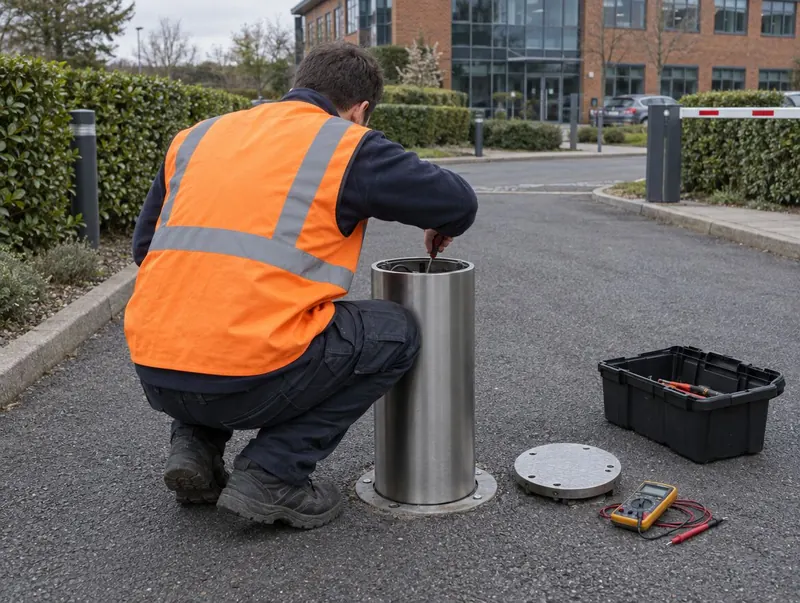 Computer-generated image
Bollard servicing in Lowestoft
In Lowestoft, typical sites for automatic bollard service visits include filling-station forecourts, small industrial units and community car parks. Each visit is recorded, giving a maintenance history for the installation.
Coverage in Lowestoft takes in the NR32 and NR33 postcode districts and nearby places like Blundeston, Corton, Somerleyton and Camps Heath. Nearby, we also work in Great Yarmouth (9.2 miles) and Norwich (21.8 miles), measured as the crow flies.
Local details
- Area
- Suffolk, England
- Highway authority
- Suffolk County Council (local roads)
- Planning authority
- the council for East Suffolk
- Postcodes
- NR32 and NR33
- Guide price
- Typically £95–£355 per visit + VAT
- Survey
- Paid visit, price confirmed in writing first
- Nearby
- Great Yarmouth (9.2 mi), Norwich (21.8 mi)
Typical automatic bollard service visits requests in Lowestoft
What automatic bollard service visits usually sort out in Lowestoft:
- Systems that have started to run slowly or noisily
- Secure sites with crash-rated automatic bollards
- Bollards inherited with a building and no service history
Lowestoft: typical servicing prices
| Specification | Guide price | Includes |
|---|---|---|
| Standard | £95–£205 + VAT | One bollard, planned service and safety checks |
| Upgraded | £175–£285 + VAT | Two bollards, full service and written report |
| Premium | £255–£355 + VAT | Larger or rated systems to manufacturer procedures |
Per planned service visit, first bollard; +3% for East of England. Guide only — the visit price is confirmed in writing first.
What we check first in Lowestoft
The highway authority for local roads in Lowestoft is Suffolk County Council; motorways and trunk roads sit with National Highways. Bollards on the adopted footway are a matter for the highway authority, so we only install there with its written agreement.
Bollards on private land often don't need planning permission, but it depends on the council's view, the height and the location; in a conservation area, next to a listed building or under an Article 4 direction, ask the local planning authority (the council for East Suffolk) first — we flag this at survey.
Silt and grit washed in from the surrounding road are a steady source of wear, so where the road drains towards the bollard, a small change such as a channel or gully nearby can reduce how much debris reaches the pit. Loops fail when the road surface around them cracks or is patched, so loop condition is checked alongside surface condition.
- Have electrical faults and modifications handled by a qualified electrician, to BS 7671.
- Keep safety devices tested and working; a bollard with disabled or faulty safety loops or photocells should not stay in service.
How the job runs
Plan around the entrance
Visits are planned to keep the entrance usable, usually servicing one lane or bollard at a time, with cones and staff on hand while a bollard is out of service.
Service and test
The pit, drainage, drive, electrics, safety devices and access inputs are serviced and tested, and the controller log is read.
Report and recommend
You receive a written report of what was checked and found. Any repair needed is quoted separately in writing for your approval.
Choosing the right spec
| Option | Detail |
|---|---|
| Hydraulic servicing | Fluid, hoses, seals, pump and valve checks, with fluid topped up or changed as needed. |
| Planned maintenance contract | Scheduled visits at agreed intervals, priced in writing, with a consistent record kept across visits. |
| Safety and access testing | Loops, photocells, lights, manual release, emergency functions and access control inputs tested on every visit. |
What moves the price in Lowestoft
Two Lowestoft jobs with the same number of posts can price quite differently. The usual reasons:
- Rated bollards with manufacturer-specified procedures
- Access control equipment to be tested
- Visit frequency and contract length
Looking after them
If the road around the bollard is being resurfaced, tell us beforehand so loops and ducts can be protected or reinstated. Between service visits, site staff can do a lot to keep bollards reliable: keep the head and surrounding road clear of leaves and grit, report any change in speed, noise or behaviour, keep a note of faults with the date and time, and never bypass or disconnect safety devices to keep an entrance open.
For damaged or loose posts in Lowestoft, repairs and replacements are priced in writing first.
Bollard servicing in Lowestoft: FAQs
Do you carry out automatic bollard service visits in Lowestoft?
We cover all of Lowestoft (NR32 and NR33) and the rest of Suffolk. We also work in Great Yarmouth and Norwich.
Do I need consent for bollards on a public footway in Lowestoft?
The highway authority for local roads in Lowestoft is Suffolk County Council; motorways and trunk roads sit with National Highways. Bollards on the adopted footway are a matter for the highway authority, so we only install there with its written agreement.
How much do automatic bollard service visits cost in Lowestoft?
In Lowestoft, typically £95–£355 per planned service visit, first bollard, plus VAT, using our East of England guide prices. We confirm the visit price in writing before attending.
How often should automatic bollards be serviced?
It depends on how often they cycle and the risk at the site. Commonly that means every three to six months, with busier or security entrances at the more frequent end. We suggest a frequency once we know your usage.
What happens if the service finds a fault?
It is recorded in the report and quoted separately in writing. You decide whether to go ahead. Small adjustments within the service scope are made during the visit.