Suffolk · England
Flexible bollard installation in Lowestoft
Flexible bollards for sites across Lowestoft and the rest of Suffolk, from the first measurement to the last relaid paving block.
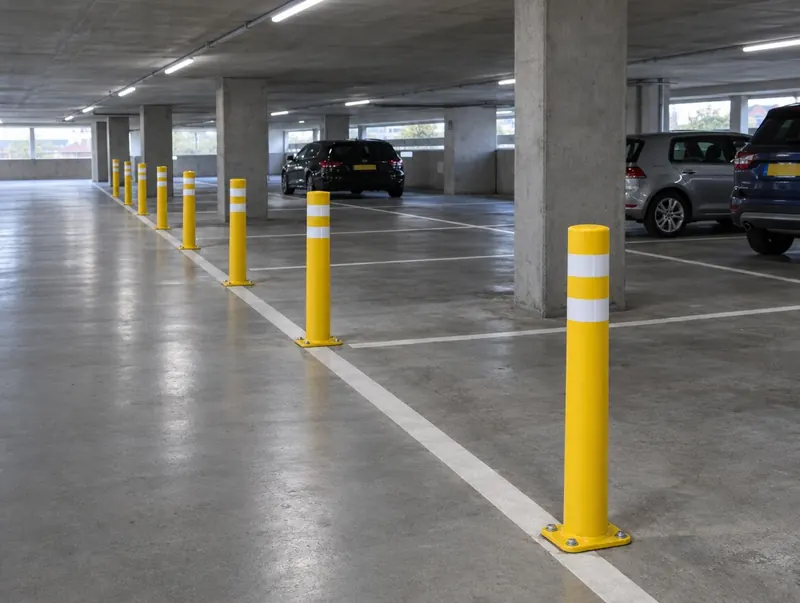 Computer-generated image
About flexible bollards in Lowestoft
We supply and fit flexible bollards throughout Lowestoft, typically for sites such as small industrial units, filling-station forecourts and community car parks. Polyurethane and spring-based bollards that bend when hit and return upright, for car parks, depots and lane separation.
Coverage in Lowestoft takes in the NR32 and NR33 postcode districts and nearby places like Blundeston, Corton, Somerleyton and Camps Heath. Jobs in Lowestoft can be combined with work in Great Yarmouth (9.2 miles) and Norwich (21.8 miles) (straight-line distances).
Key facts for this area
- Area
- Suffolk, England
- Highway authority
- Suffolk County Council (local roads)
- Planning authority
- the council for East Suffolk
- Postcodes
- NR32 and NR33
- Guide price
- Typically £205–£615 per bollard + VAT; minimum job £455
- Survey
- Free, with a fixed written quote
- Nearby
- Great Yarmouth (9.2 mi), Norwich (21.8 mi)
Typical flexible bollards jobs in Lowestoft
Typical reasons Lowestoft sites choose flexible bollards:
- Bus stations and coach parks
- Approaches to barriers, pay stations and ticket machines
- Marking pedestrian routes inside multi-storey car parks
What flexible bollards cost in Lowestoft
| Specification | Guide price | Includes |
|---|---|---|
| Standard | £205–£375 + VAT | Standard post, foundation, reinstatement |
| Upgraded | £325–£495 + VAT | Upgraded finish or fittings, reflective band, matched keys |
| Premium | £445–£615 + VAT | Heavy-duty or architectural spec, premium finish |
Per bollard, supplied and fixed; +3% for East of England. Guide only — the fixed price follows a survey.
Before we dig in Lowestoft
The highway authority for local roads in Lowestoft is Suffolk County Council; motorways and trunk roads sit with National Highways. Flexible bollards on the adopted footway are a matter for the highway authority, so we only install there with its written agreement.
If your site in Lowestoft is listed or inside a conservation area, check with the local planning authority (the council for East Suffolk) before choosing a finish — heritage settings often favour cast iron or painted steel over stainless.
Where posts go in a line across a drainage fall, positions avoid channels and gullies. Multi-storey and rooftop decks are a special case: slabs may be post-tensioned or carry waterproofing and heating, so drilling depth and positions are agreed with the building owner and scanned first.
- Check drilling into car park decks or podium slabs with the building owner before fixing.
- Keep pedestrian gaps and routes clear, referring to Inclusive Mobility guidance where people walk through the line.
From survey to handover
Set out the line
Posts are set out to guide vehicles along the intended path, with spacing that reads as a line to drivers.
Fix the bases
Holes are drilled and cleaned, resin anchors or bolts are set and the bases fixed and torqued once cured. Socket bases are set flush in concrete.
Fit posts and test
Posts are fitted and bent by hand to confirm they return upright, and reflective sleeves are applied.
Choosing the right spec
| Option | Detail |
|---|---|
| Heights and diameters | Commonly 750–1,000 mm high and around 80–200 mm diameter, with slimmer wand-style posts for lane lines. |
| Sprung-base bollards | A rigid post on a heavy spring or elastomer base that tilts and returns. Looks like a conventional bollard. |
| Low-profile deck bases | Shallow fixings for multi-storey decks where deep drilling is not permitted. |
What moves the price in Lowestoft
Two Lowestoft jobs with the same number of posts can price quite differently. The usual reasons:
- Polymer posts or sprung-base bollards
- Surface condition and need for concrete pads
- Bolt-down or socket base
Looking after them
Keep a few spare posts on site where knocks are frequent, so a damaged one can be swapped before the line develops a gap. Check flexible bollards for splits, permanent bends and loose bases, and tighten or replace fixings that have worked loose.
For damaged or loose posts in Lowestoft, repairs and replacements are priced in writing first.
Flexible bollards in Lowestoft: FAQs
Do you install flexible bollards in Lowestoft?
We cover all of Lowestoft (NR32 and NR33) and the rest of Suffolk. We also work in Great Yarmouth and Norwich.
Do I need consent for flexible bollards on a public footway in Lowestoft?
The highway authority for local roads in Lowestoft is Suffolk County Council; motorways and trunk roads sit with National Highways. Flexible bollards on the adopted footway are a matter for the highway authority, so we only install there with its written agreement.
What's a typical price for flexible bollards in Lowestoft?
In Lowestoft, typically £205–£615 per bollard, supplied and fixed, plus VAT, with a minimum job of £455 plus VAT, using our East of England guide prices. The fixed figure comes in writing after we've seen the site.
Can a damaged flexible post be replaced on the same base?
Usually, yes, especially with socket bases designed for it. The post is removed and a new one fitted. If the base itself is damaged or loose, it is re-fixed or replaced at the same time.
Do flexible bollards work in cold weather?
They do, but polymers become stiffer in cold conditions and recover more slowly after a knock. Sprung-base designs are less affected. Neither type is damaged by normal UK winter temperatures.