Suffolk · England
Removable bollard installation in Lowestoft
Removable bollards for sites across Lowestoft and the rest of Suffolk, from the first measurement to the last relaid paving block.
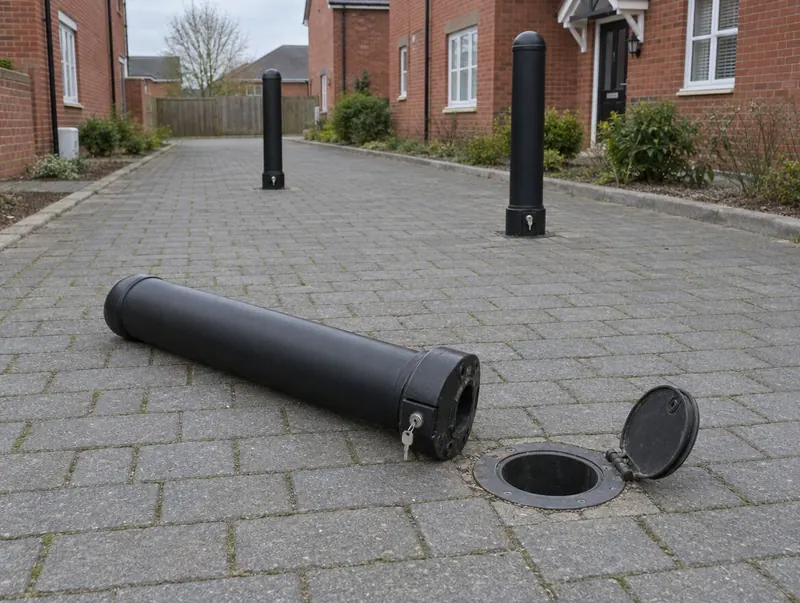 Computer-generated image
About removable bollards in Lowestoft
In the town of Lowestoft, removable bollards tend to go in at high street shopfronts, small industrial units and residential driveways. Lift-out bollards in lockable ground sockets for driveways, delivery routes, access roads and emergency access points.
We work across NR32 and NR33 — Lowestoft itself and places including Blundeston, Corton, Somerleyton and Camps Heath. Nearby, we also work in Great Yarmouth (9.2 miles) and Norwich (21.8 miles), measured as the crow flies.
Key facts for this area
- Area
- Suffolk, England
- Highway authority
- Suffolk County Council (local roads)
- Planning authority
- the council for East Suffolk
- Postcodes
- NR32 and NR33
- Guide price
- Typically £255–£875 per bollard + VAT (£305–£1,045 inc VAT for homes); minimum job £605
- Survey
- Free, with a fixed written quote
- Nearby
- Great Yarmouth (9.2 mi), Norwich (21.8 mi)
Removable bollard prices in Lowestoft
| Specification | Guide price | Includes |
|---|---|---|
| Standard | £255–£515 + VAT · £305–£615 inc VAT | Standard post, foundation, reinstatement |
| Upgraded | £435–£695 + VAT · £515–£825 inc VAT | Upgraded finish or fittings, reflective band, matched keys |
| Premium | £625–£875 + VAT · £745–£1,045 inc VAT | Heavy-duty or architectural spec, premium finish |
Per bollard with ground socket, supplied and installed; +3% for East of England. Guide only — the fixed price follows a survey.
What Lowestoft sites use removable bollards for
Typical reasons Lowestoft sites choose removable bollards:
- Temporary event closures and market streets
- Driveways and private parking bays
- Gaps in a fixed bollard line that must open occasionally
Consents, ground and services in Lowestoft
Suffolk County Council is the highway authority covering Lowestoft's local roads. If any post would stand on adopted highway rather than your land, that consent is the first thing we sort out.
Bollards on private land often don't need planning permission, but it depends on the council's view, the height and the location; in a conservation area, next to a listed building or under an Article 4 direction, ask the local planning authority (the council for East Suffolk) first — we flag this at survey.
On thin tarmac drives, the surround is sized so the socket does not loosen over time. Removable bollards need modest depth, which makes them one of the easier bollards to fit around services.
- Fit reflective or contrasting bands near the top so posts are visible when in place.
- Keep a clear route of typically at least 1,000–1,200 mm between posts on pedestrian routes, and check against Inclusive Mobility guidance.
What happens on site
Cut and excavate
A small square of surface is cut out and excavated to socket depth, with a bed of free-draining stone at the bottom so water can leave the socket.
Set the socket flush
The socket is set in concrete with its rim exactly at finished surface level and to the fall of the ground, so the lid sits flat and nothing catches on it.
Fit posts and hand over keys
Posts are fitted and locked, and the lift-out and refit routine is checked on site. Keys and any storage brackets are handed over.
Choosing the right spec
| Option | Detail |
|---|---|
| Heads and handles | Dome, flat or ball heads, with lifting handles or eyes so posts can be pulled out without strain. |
| Locking type | Triangular or square key, padlock, or integral keyed cylinder. Keyed-alike locks let one key open every post on a site. |
| Steel, stainless or aluminium posts | Galvanised and powder-coated steel for robustness, stainless for appearance, aluminium where lightness matters for frequent lifting. |
Pricing removable bollards in Lowestoft
Two Lowestoft jobs with the same number of posts can price quite differently. The usual reasons:
- Rated removable posts where security is required
- Lock type and whether locks are keyed alike
- Drainage at the socket base
Keeping them working
Removable bollards fail in predictable ways: seized locks, sockets full of grit and lids that no longer close. Lubricate locks a few times a year with a graphite or lock-specific spray, lift the posts out periodically even if they are not needed, and clear the socket of debris.
For damaged or loose posts in Lowestoft, repairs and replacements are priced in writing first.
Questions about removable bollards in Lowestoft
Which parts of Lowestoft do you cover for removable bollards?
We cover all of Lowestoft (NR32 and NR33) and the rest of Suffolk. We also work in Great Yarmouth and Norwich.
Who gives permission for bollards on the pavement in Lowestoft?
Suffolk County Council is the highway authority covering Lowestoft's local roads. If any post would stand on adopted highway rather than your land, that consent is the first thing we sort out.
How much do removable bollards cost in Lowestoft?
In Lowestoft, typically £255–£875 per bollard with ground socket, supplied and installed, plus VAT (£305–£1,045 including VAT for homeowners), with a minimum job of £605 plus VAT, using our East of England guide prices. The fixed figure comes in writing after we've seen the site.
Where do we keep the post when it is removed?
Somewhere it cannot become a trip hazard or be taken. A wall-mounted storage bracket or a locked store nearby works well. Leaving posts lying on the ground is how they get damaged or lost.
How heavy is a removable bollard to lift?
It depends on material and size; a slim aluminium post is easy to lift, while a large concrete-filled steel post is not designed for daily handling. If the post will come out every day, say so at the survey and we will suggest something lighter with a handle.