Isle of Anglesey · Wales
Bollard replacement in Holyhead
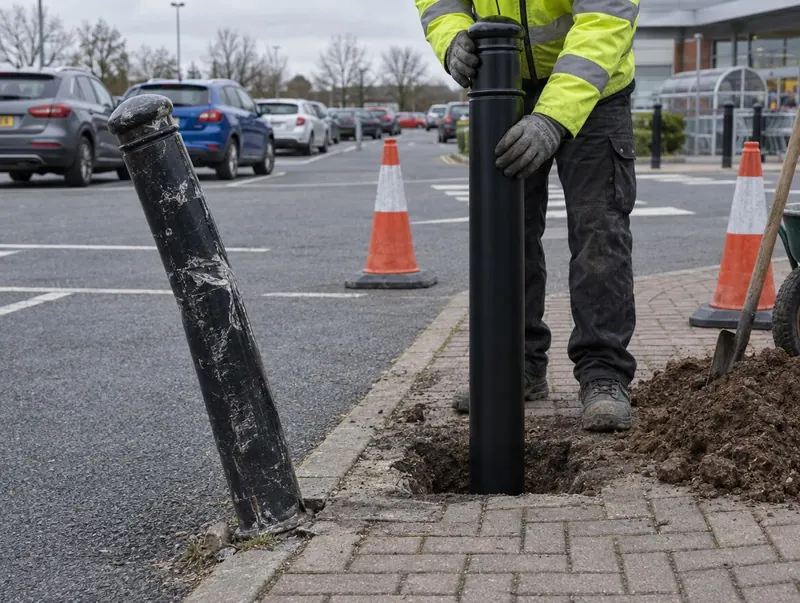
Replacement bollards supplied and fitted in Holyhead, Isle of Anglesey: surveyed, scanned for services, set in proper foundations and finished to match the ground.
 Computer-generated image
Holyhead replacement bollards
Across Holyhead, typical sites for replacement bollards include small industrial units, schools and local parades. Replacement is the right answer when a post is too damaged to repair or no longer suits how the site is used.
We cover Holyhead's LL65 postcode district, including places such as Trearddur, Bodedern, Bryngwran and Llanfihangel yn Nhowyn. There are no other towns of Holyhead's size close by, so crews travel in specifically for jobs here.
Holyhead at a glance
- Area
- Isle of Anglesey, Wales
- Highway authority
- Isle of Anglesey County Council (local roads)
- Planning authority
- Isle of Anglesey County Council
- Postcodes
- LL65
- Guide price
- Typically £205–£1,145 per post + VAT (£245–£1,345 inc VAT for homes); minimum job £425
- Survey
- Free, with a fixed written quote
Typical replacement bollards requests in Holyhead
Why sites in Holyhead book replacement bollards:
- Cracked cast iron or chipped concrete bollards
- Corroded steel posts at the end of their life
- Posts bent, sheared or broken by vehicle impacts
What replacement bollards cost in Holyhead
| Specification | Guide price | Includes |
|---|---|---|
| Standard | £205–£605 + VAT · £245–£725 inc VAT | Standard post, foundation, reinstatement |
| Upgraded | £495–£895 + VAT · £585–£1,045 inc VAT | Upgraded finish or fittings, reflective band, matched keys |
| Premium | £775–£1,145 + VAT · £925–£1,345 inc VAT | Heavy-duty or architectural spec, premium finish |
Per post replaced, old post and footing removed; -3% for Wales. Guide only — the fixed price follows a survey.
Before we dig in Holyhead
Before digging near the kerb in Holyhead we establish who owns the ground: adopted footways are Isle of Anglesey County Council's responsibility, trunk roads the Welsh Government's, and everything else belongs to the site owner.
Bollards on private land often don't need planning permission, but it depends on the council's view, the height and the location; in a conservation area, next to a listed building or under an Article 4 direction, ask the local planning authority (Isle of Anglesey County Council) first — we flag this at survey.
Reinstatement matches the surrounding surface, though weathered paving and older tarmac may leave a visible patch. Removing an old bollard often reveals more concrete than expected, because foundations from different eras vary widely in size.
- Keep gaps and visibility bands in line with Inclusive Mobility guidance when replacing posts on pedestrian routes.
- Where bollards were required by a planning condition, a security plan or a lease, check that any change of type still meets that requirement.
What happens on site
Order the replacement
Matching posts, sockets or castings are ordered, and you see details of any close equivalent before it is confirmed.
Remove the old bollard
The damaged post is cut or extracted and the old foundation broken out, checking for services as the hole is opened.
Install the new post
The new bollard is set in a fresh foundation, aligned with its neighbours and the surface is reinstated to match.
Specification choices
| Option | Detail |
|---|---|
| Matched finishes | RAL powder coat, stainless grade and finish, or heritage paint schemes matched to the existing line. |
| Heavier section | Larger diameter, thicker wall or concrete-filled steel where posts keep getting bent. |
| Like-for-like | Same diameter, height, finish and fixing, so the line looks unchanged. |
Pricing replacement bollards in Holyhead
Our Wales guide prices are a starting point; the survey in Holyhead firms them up. What tends to move them:
- Matching special finishes, castings or discontinued products
- Number of posts and the product chosen
- Size and condition of the old foundation
After installation
Keep a record of the new product, finish and supplier so future replacements match. A single impact on a rarely struck post is bad luck; repeated strikes in the same spot point to a layout problem, such as a tight turn or a missing wheel stop, that a stronger bollard alone will not solve.
If posts in Holyhead are later hit or damaged, we can repair or replace them — see bollard repairs.
Questions about replacement bollards in Holyhead
Which parts of Holyhead do you cover for replacement bollards?
We cover all of Holyhead (LL65) and the rest of Isle of Anglesey.
Who gives permission for bollards on the pavement in Holyhead?
Before digging near the kerb in Holyhead we establish who owns the ground: adopted footways are Isle of Anglesey County Council's responsibility, trunk roads the Welsh Government's, and everything else belongs to the site owner.
What's a typical price for replacement bollards in Holyhead?
In Holyhead, typically £205–£1,145 per post replaced, old post and footing removed, plus VAT (£245–£1,345 including VAT for homeowners), with a minimum job of £425 plus VAT, using our Wales guide prices. The fixed figure comes in writing after we've seen the site.
Should we replace like-for-like or upgrade?
Like-for-like if the post was hit once in an unusual incident. Consider an upgrade if the same position is struck repeatedly or the post no longer suits how the site is used. The survey will show which makes sense.
Can you provide paperwork for an insurance claim?
Yes. The written quote, photographs and itemised invoice are usually what an insurer asks for when recovering the cost from the driver responsible. We can provide them in the format your insurer needs.