London · England
Bollard replacement in Barking and Dagenham
Local installation of replacement bollards in Barking and Dagenham — free survey, fixed written price, and posts set to the right spacing for people and vehicles.
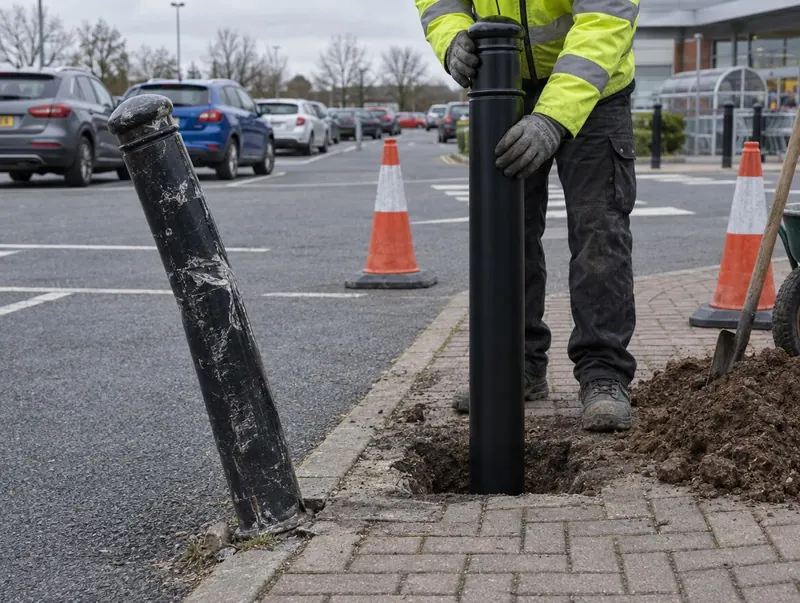 Computer-generated image
Barking and Dagenham replacement bollards
Whether it's station forecourts, school gates and hospital approaches, replacement bollards in Barking and Dagenham are planned around who needs to get through and who doesn't. Like-for-like or upgraded replacement of bollards damaged by vehicles, corrosion or wear, matched to the existing line.
We cover the RM10, RM8, RM9, RM6 and IG11 postcode districts in Barking and Dagenham. We also cover neighbouring Redbridge (4 miles), Havering (4.3 miles), Newham (5.5 miles) and Bexley (6.6 miles) — distances are straight-line.
Local details
- Area
- London, England
- Highway authority
- Barking and Dagenham Council (local roads)
- Planning authority
- Barking and Dagenham Council
- Postcodes
- RM10, RM8, RM9, RM6 and IG11
- Guide price
- Typically £245–£1,395 per post + VAT (£285–£1,645 inc VAT for homes); minimum job £505
- Survey
- Free, with a fixed written quote
Guide prices for Barking and Dagenham
| Specification | Guide price | Includes |
|---|---|---|
| Standard | £245–£725 + VAT · £285–£865 inc VAT | Standard post, foundation, reinstatement |
| Upgraded | £585–£1,045 + VAT · £695–£1,245 inc VAT | Upgraded finish or fittings, reflective band, matched keys |
| Premium | £925–£1,395 + VAT · £1,095–£1,645 inc VAT | Heavy-duty or architectural spec, premium finish |
Per post replaced, old post and footing removed; +15% for London. Guide only — the fixed price follows a survey.
Typical replacement bollards requests in Barking and Dagenham
Typical reasons for replacement bollards in Barking and Dagenham:
- Replacing mixed, mismatched posts with a consistent line
- Cracked cast iron or chipped concrete bollards
- Upgrading posts that keep being hit
Permissions and groundwork in Barking and Dagenham
Barking and Dagenham Council is the highway authority covering Barking and Dagenham's local roads. Red routes are managed by Transport for London. If any post would stand on adopted highway rather than your land, that consent is the first thing we sort out.
Many private-land installations in Barking and Dagenham need no planning application, but the rules don't clearly cover bollards, so listed buildings, conservation areas and prominent frontages are worth raising with the planning team at Barking and Dagenham Council before posts go in.
Removing an old bollard often reveals more concrete than expected, because foundations from different eras vary widely in size. Breaking out is done carefully near services, particularly where cables have been laid close to posts since the original installation.
- Keep gaps and visibility bands in line with Inclusive Mobility guidance when replacing posts on pedestrian routes.
- Where bollards were required by a planning condition, a security plan or a lease, check that any change of type still meets that requirement.
From survey to handover
Make safe
If a broken post or stub is a hazard, it can be removed or capped first. That is priced separately in writing so you can approve it on its own.
Remove the old bollard
The damaged post is cut or extracted and the old foundation broken out, checking for services as the hole is opened.
Hand over records
Photographs and an itemised invoice are provided, which is useful when recovering the cost from a driver's insurer.
Finishes and options
| Option | Detail |
|---|---|
| Like-for-like | Same diameter, height, finish and fixing, so the line looks unchanged. |
| Heavier section | Larger diameter, thicker wall or concrete-filled steel where posts keep getting bent. |
| Making safe | Removing or capping a dangerous broken stub before the replacement is fitted. |
What affects the quote
When we price replacement bollards in Barking and Dagenham, these make the biggest difference:
- Making safe before the replacement
- Surface type and reinstatement
- Upgrades that need larger foundations
Looking after them
Treat new posts as part of your routine inspections: check for lean, chips and faded bands. A single impact on a rarely struck post is bad luck; repeated strikes in the same spot point to a layout problem, such as a tight turn or a missing wheel stop, that a stronger bollard alone will not solve.
We can also service, repair or replace existing posts anywhere in Barking and Dagenham.
Bollard replacement in Barking and Dagenham: FAQs
Which parts of Barking and Dagenham do you cover for replacement bollards?
We cover all of Barking and Dagenham (RM10, RM8, RM9, RM6 and IG11) and the rest of London. We also work in Redbridge, Havering and Newham.
Do I need consent for bollards on a public footway in Barking and Dagenham?
The highway authority for local roads in Barking and Dagenham is Barking and Dagenham Council; motorways and trunk roads sit with National Highways. Red routes are managed by Transport for London. Bollards on the adopted footway are a matter for the highway authority, so we only install there with its written agreement.
What's a typical price for replacement bollards in Barking and Dagenham?
In Barking and Dagenham, typically £245–£1,395 per post replaced, old post and footing removed, plus VAT (£285–£1,645 including VAT for homeowners), with a minimum job of £505 plus VAT, using our London guide prices. The fixed figure comes in writing after we've seen the site.
Can a new bollard reuse the old foundation?
Sometimes, if the old foundation is sound and suits the new post. Foundations cracked by an impact are broken out. Rated bollards always need the manufacturer's tested foundation.
What happens to the old bollard?
It is taken away with the broken-out concrete. Steel and iron are recycled where possible. Original heritage bollards can be returned to you if you want to keep them.
Bollard replacement near Barking and Dagenham
- Redbridge (4 mi)
- Havering (4.3 mi)
- Newham (5.5 mi)
- Bexley (6.6 mi)
- South Ockendon (6.6 mi)
- Greenwich (7.5 mi)