Devon · England
Crash-rated bollard installation in Plymouth
Planning crash-rated bollards in Plymouth? We check ownership, consents and buried services first, then quote a fixed price.
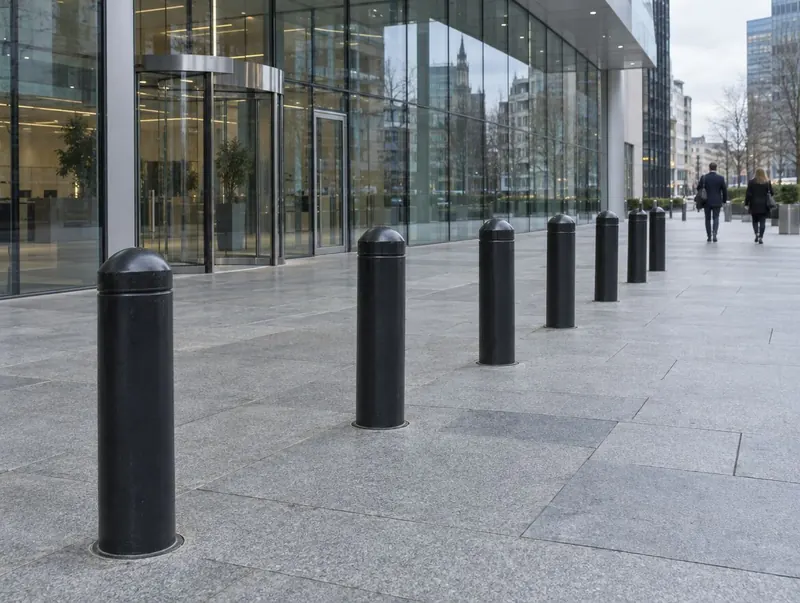 Computer-generated image
Plymouth crash-rated bollards
Across Plymouth, typical sites for crash-rated bollards include pedestrianised streets, stadium approaches and university campuses. The rating only holds when the bollard is installed to the same foundation design that was tested.
We cover the PL1, PL4, PL3, PL2, PL9 and PL5 postcode districts in Plymouth. We also cover neighbouring Plymstock (2.4 miles) — distances are straight-line.
Local details
- Area
- Devon, England
- Highway authority
- Plymouth City Council (local roads)
- Planning authority
- Plymouth City Council
- Postcodes
- PL1, PL4, PL3, PL2, PL9, PL5, PL6 and PL7
- Guide price
- Typically £1,995–£9,995 per bollard + VAT; minimum job £3,995
- Survey
- Free, with a fixed written quote
- Nearby
- Plymstock (2.4 mi)
What Plymouth sites use crash-rated bollards for
Typical reasons Plymouth sites choose crash-rated bollards:
- Building entrances and forecourts flagged in a security risk assessment
- Data centres, utilities and critical infrastructure perimeters
- Glazed frontages on corporate and public buildings
Plymouth: typical crash-rated bollard prices
| Specification | Guide price | Includes |
|---|---|---|
| Standard | £1,995–£5,345 + VAT | Rated for a 7.5 t vehicle at 30 mph (48 km/h), tested foundation |
| Upgraded | £4,395–£7,745 + VAT | Rated for 7.5 t at 40 mph (64 km/h), tested foundation |
| Premium | £6,795–£9,995 + VAT | Rated for 7.5 t at 50 mph (80 km/h), or a specialist foundation |
Per bollard, supplied and installed on a standard tested foundation; no regional adjustment. Guide only — the fixed price follows a survey.
Before we dig in Plymouth
In Plymouth, work on adopted pavements and verges needs consent from Plymouth City Council, the local highway authority. Car parks, forecourts and other private land only need the owner's permission.
Many private-land installations in Plymouth need no planning application, but the rules don't clearly cover bollards, so listed buildings, conservation areas and prominent frontages are worth raising with the planning team at Plymouth City Council before posts go in.
Rated foundations are large, and excavation is often where projects run into trouble. Reinstatement matches paving, tactile surfaces and kerbs.
- Ask the local planning authority whether consent is needed, particularly in conservation areas or near listed buildings.
- Check that the test certificate matches the exact model, configuration and foundation being installed, and keep it with the site records.
Installation, step by step
Free site survey and ground checks
A free site survey looks at access, surfaces and likely services, followed by utility searches, radar scanning and trial holes where needed. You then receive a fixed written quote based on what the survey found.
Set out and excavate
Positions are set out to the drawing and excavated to the tested depth and width, with shoring where the ground needs it. Spoil is removed as work progresses.
Fix reinforcement and set the posts
The reinforcement cage is built to the drawing and the bollards are held to line and level in templates. Concrete is poured to the specified grade, with samples taken for testing if the specification calls for them.
Options to consider
| Option | Detail |
|---|---|
| Decorative covers | Stainless steel, cast or polymer sleeves can be fitted over the steel core to suit a streetscape. Use covers supplied or approved by the manufacturer so the tested product is not altered. |
| Finishes and visibility bands | Galvanised and powder-coated finishes in RAL colours, with contrasting or reflective bands near the top so the posts are visible to pedestrians and drivers. |
| Static rated bollards | Fixed posts for permanent lines where vehicles never need to pass. They are a straightforward rated option to install and maintain. |
What affects the quote
Our South West guide prices are a starting point; the survey in Plymouth firms them up. What tends to move them:
- Number of posts and whether a linked beam system is needed
- Buried services, diversions and ground investigation
- Reinstatement of natural stone, tactile paving or specialist surfaces
Looking after them
Movable rated bollards need a planned servicing schedule. Look for cracked surfacing at the base, movement, damaged covers and faded bands.
We can also service, repair or replace existing posts anywhere in Plymouth.
Common questions
Do you install crash-rated bollards in Plymouth?
We cover all of Plymouth (PL1, PL4, PL3, PL2, PL9 and PL5) and the rest of Devon. We also work in Plymstock.
Who gives permission for bollards on the pavement in Plymouth?
The highway authority for local roads in Plymouth is Plymouth City Council; motorways and trunk roads sit with National Highways. Crash-rated bollards on the adopted footway are a matter for the highway authority, so we only install there with its written agreement.
What's a typical price for crash-rated bollards in Plymouth?
In Plymouth, typically £1,995–£9,995 per bollard, supplied and installed on a standard tested foundation, plus VAT, with a minimum job of £3,995 plus VAT, using our South West guide prices. The fixed figure comes in writing after we've seen the site.
Will you design our HVM layout?
No. Scheme design and threat assessment belong with your security adviser, a specialist consultant or the manufacturer's technical team. We install the products they specify, to the tested foundation, and work alongside them on site so the build matches the design.
What does a crash rating code actually tell me?
It tells you the vehicle used in the test, how fast it was travelling, the angle it hit at and how far it got past the bollard line. Your security adviser compares those figures with the vehicle and speed achievable on your approach. A rating that does not match the site's real risk is either more than you need or not enough.