Surrey · England
Crash-rated bollard installation in Caterham
Local installation of crash-rated bollards in Caterham — free survey, fixed written price, and posts set to the right spacing for people and vehicles.
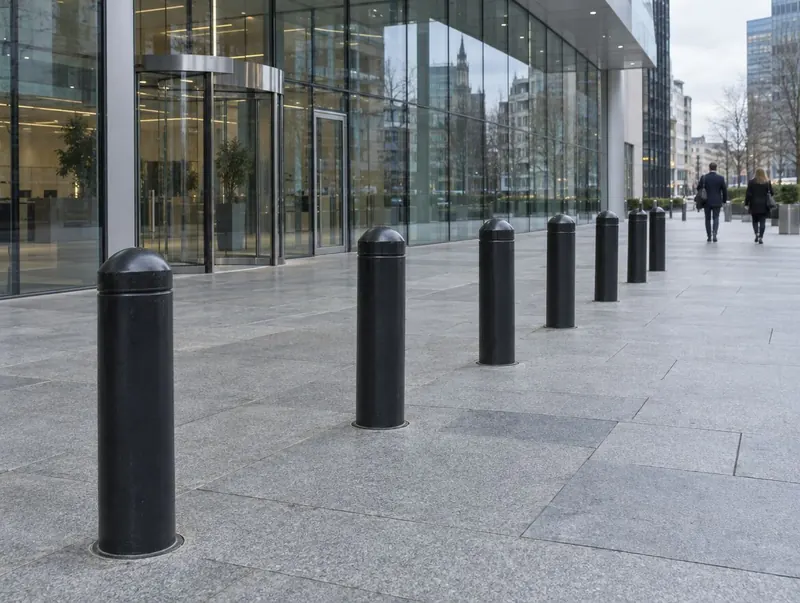 Computer-generated image
Crash-rated bollards in Caterham
Installation of impact-tested HVM bollards rated to ISO 22343-1 (or the superseded, still-accepted PAS 68 / IWA 14-1) on the tested foundation. In Caterham, that tends to mean sites such as filling-station forecourts, schools and town-centre squares.
We work across CR3, CR6, RH9 and RH8 — Caterham itself and places including Whyteleafe, Chaldon, Woldingham and Woldingham Garden Village. Nearby, we also work in Redhill (4.9 miles), Croydon (5 miles), Banstead (6.2 miles) and Reigate (6.3 miles), measured as the crow flies. Brighton is around 31 miles away.
Caterham at a glance
- Area
- Surrey, England
- Highway authority
- Surrey County Council (local roads)
- Planning authority
- the council for Tandridge
- Postcodes
- CR3, CR6, RH9 and RH8
- Guide price
- Typically £2,295–£11,495 per bollard + VAT; minimum job £4,595
- Survey
- Free, with a fixed written quote
Crash-rated bollards in Caterham: common uses
Common uses in a place like Caterham:
- Data centres, utilities and critical infrastructure perimeters
- Sites where a vehicle dynamics assessment shows a long straight run-up
- Stadiums, arenas and event venues with predictable crowd flows
Crash-rated bollard prices in Caterham
| Specification | Guide price | Includes |
|---|---|---|
| Standard | £2,295–£6,145 + VAT | Rated for a 7.5 t vehicle at 30 mph (48 km/h), tested foundation |
| Upgraded | £5,045–£8,895 + VAT | Rated for 7.5 t at 40 mph (64 km/h), tested foundation |
| Premium | £7,795–£11,495 + VAT | Rated for 7.5 t at 50 mph (80 km/h), or a specialist foundation |
Per bollard, supplied and installed on a standard tested foundation; +15% for London. Guide only — the fixed price follows a survey.
What we check first in Caterham
Surrey County Council is the highway authority covering Caterham's local roads. If any post would stand on adopted highway rather than your land, that consent is the first thing we sort out.
Many private-land installations in Caterham need no planning application, but the rules don't clearly cover bollards, so listed buildings, conservation areas and prominent frontages are worth raising with the planning team at the council for Tandridge before posts go in.
Footways and forecourts in towns are usually crowded with cables, gas mains, water pipes and old drainage, and a single unexpected duct can stop a bollard position. Made ground, a high water table or soft clay may need an engineer to confirm the tested design suits the site; any change to depth, width or reinforcement must be agreed in writing by the manufacturer, or the rating may no longer apply.
- Check that the test certificate matches the exact model, configuration and foundation being installed, and keep it with the site records.
- Balance the gaps: narrow enough to stop a vehicle, typically no more than about 1,200 mm, but wide enough for wheelchair users and buggies — check against Inclusive Mobility guidance.
How the job runs
Start from the specification
We work from the specification issued by your security adviser or the manufacturer: product, rating, positions and foundation drawing. If no specification exists yet, we can put you in touch with the manufacturer's technical team, but we do not set the threat level ourselves.
Free site survey and ground checks
A free site survey looks at access, surfaces and likely services, followed by utility searches, radar scanning and trial holes where needed. You then receive a fixed written quote based on what the survey found.
Cure, protect and reinstate
The posts are protected while the concrete gains strength, and the surface is reinstated to match. The line should not be treated as fully effective until the specified curing period has passed.
Options to consider
| Option | Detail |
|---|---|
| Deep or standard foundation designs | Deep foundations suit open ground where excavation is unrestricted. Where services or slabs get in the way, shallow-mount tested designs may be a better fit. |
| Heights and diameters | Exposed heights are commonly around 800 to 1,000 mm, with core diameters varying by model and rating. Larger diameters are not always needed to achieve a given rating. |
| Static rated bollards | Fixed posts for permanent lines where vehicles never need to pass. They are a straightforward rated option to install and maintain. |
What affects the quote
Our London guide prices are a starting point; the survey in Caterham firms them up. What tends to move them:
- Reinstatement of natural stone, tactile paving or specialist surfaces
- Depth and volume of excavation, reinforcement and concrete
- Buried services, diversions and ground investigation
Looking after them
Keep inspection records with the original test certificate so the line's condition can be shown to insurers or a security adviser. Look for cracked surfacing at the base, movement, damaged covers and faded bands.
If posts in Caterham are later hit or damaged, we can repair or replace them — see bollard repairs.
Crash-rated bollards in Caterham: FAQs
Do you install crash-rated bollards in Caterham?
We cover all of Caterham (CR3, CR6, RH9 and RH8) and the rest of Surrey. We also work in Redhill, Croydon and Banstead.
Do I need consent for crash-rated bollards on a public footway in Caterham?
Surrey County Council is the highway authority covering Caterham's local roads. If any post would stand on adopted highway rather than your land, that consent is the first thing we sort out.
What's a typical price for crash-rated bollards in Caterham?
In Caterham, typically £2,295–£11,495 per bollard, supplied and installed on a standard tested foundation, plus VAT, with a minimum job of £4,595 plus VAT, using our London guide prices. The fixed figure comes in writing after we've seen the site.
Why can't the foundation be adjusted to suit our ground?
Because the rating belongs to the bollard and foundation as tested together. Making the hole shallower, narrower or lighter on steel changes how the system behaves on impact. If site conditions force a change, the manufacturer has to approve it in writing, and some changes mean choosing a different product such as a shallow-mount system.
When can we rely on the new bollards?
Only once the concrete has reached the strength set in the specification. The posts are physically in place as soon as the pour is finished, but the rated performance depends on the foundation, and full design strength is commonly taken at around 28 days. Your adviser may arrange temporary measures to cover the gap.