East Sussex · England
Flexible bollard installation in Brighton
Flexible bollards supplied and fitted in Brighton, East Sussex: surveyed, scanned for services, set in proper foundations and finished to match the ground.
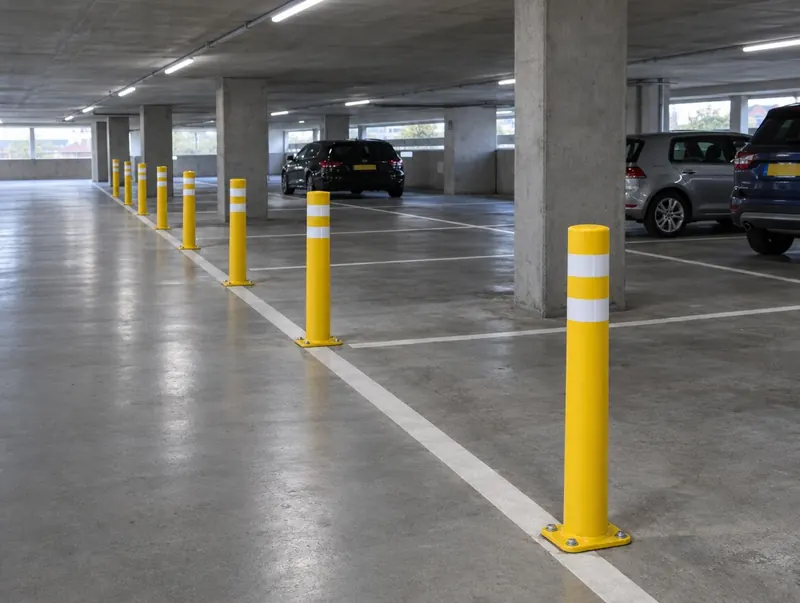 Computer-generated image
Brighton flexible bollards
Flexible bollards are traffic management products, not barriers, and will not stop a vehicle that is driven at them. In Brighton, that tends to mean sites such as city-centre plazas, pedestrianised streets and multi-storey car parks.
We work across BN1 and BN2 — Brighton itself and places including Falmer and Waterhall. Nearby, we also work in Hove (1.2 miles), Portslade (3.5 miles), Rottingdean (3.7 miles) and Burgess Hill (9 miles), measured as the crow flies.
Local details
- Area
- East Sussex, England
- Highway authority
- Brighton and Hove City Council (local roads)
- Planning authority
- Brighton and Hove City Council
- Postcodes
- BN1 and BN2
- Guide price
- Typically £205–£635 per bollard + VAT; minimum job £465
- Survey
- Free, with a fixed written quote
- Nearby
- Hove (1.2 mi), Portslade (3.5 mi), Rottingdean (3.7 mi), Burgess Hill (9 mi)
Flexible bollard prices in Brighton
| Specification | Guide price | Includes |
|---|---|---|
| Standard | £205–£385 + VAT | Standard post, foundation, reinstatement |
| Upgraded | £335–£515 + VAT | Upgraded finish or fittings, reflective band, matched keys |
| Premium | £465–£635 + VAT | Heavy-duty or architectural spec, premium finish |
Per bollard, supplied and fixed; +6% for South East. Guide only — the fixed price follows a survey.
Where flexible bollards go in around Brighton
Typical reasons Brighton sites choose flexible bollards:
- Drive-thru lanes and fuel forecourts
- Bus stations and coach parks
- Approaches to barriers, pay stations and ticket machines
Consents, ground and services in Brighton
In Brighton, work on adopted pavements and verges needs consent from Brighton and Hove City Council, the local highway authority. Car parks, forecourts and other private land only need the owner's permission.
If your site in Brighton is listed or inside a conservation area, check with the local planning authority (Brighton and Hove City Council) before choosing a finish — heritage settings often favour cast iron or painted steel over stainless.
Anchors therefore need sound concrete with enough edge distance; anchoring into thin, cracked or weak surfaces means the base works loose within weeks. Flexible bollards put repeated load on their fixings, because every knock rocks the base.
- Keep pedestrian gaps and routes clear, referring to Inclusive Mobility guidance where people walk through the line.
- Do not use flexible bollards where a physical barrier is needed to protect people or buildings; they guide rather than stop.
Installation, step by step
Set out the line
Posts are set out to guide vehicles along the intended path, with spacing that reads as a line to drivers.
Fix the bases
Holes are drilled and cleaned, resin anchors or bolts are set and the bases fixed and torqued once cured. Socket bases are set flush in concrete.
Fit posts and test
Posts are fitted and bent by hand to confirm they return upright, and reflective sleeves are applied.
Options to consider
| Option | Detail |
|---|---|
| Low-profile deck bases | Shallow fixings for multi-storey decks where deep drilling is not permitted. |
| Sprung-base bollards | A rigid post on a heavy spring or elastomer base that tilts and returns. Looks like a conventional bollard. |
| Polyurethane posts | Flex along their length and return to shape. Gentle on vehicles and common in car parks and on forecourts. |
What affects the quote
Our South East guide prices are a starting point; the survey in Brighton firms them up. What tends to move them:
- Deck scanning and restrictions on drilling
- Out-of-hours working in busy car parks
- Polymer posts or sprung-base bollards
Keeping them working
Check flexible bollards for splits, permanent bends and loose bases, and tighten or replace fixings that have worked loose. Keep a few spare posts on site where knocks are frequent, so a damaged one can be swapped before the line develops a gap.
We can also service, repair or replace existing posts anywhere in Brighton.
Common questions
Do you install flexible bollards in Brighton?
We cover all of Brighton (BN1 and BN2) and the rest of East Sussex. We also work in Hove, Portslade and Rottingdean.
Who gives permission for bollards on the pavement in Brighton?
Brighton and Hove City Council is the highway authority covering Brighton's local roads. If any post would stand on adopted highway rather than your land, that consent is the first thing we sort out.
How much do flexible bollards cost in Brighton?
In Brighton, typically £205–£635 per bollard, supplied and fixed, plus VAT, with a minimum job of £465 plus VAT, using our South East guide prices. The fixed figure comes in writing after we've seen the site.
Can flexible bollards go in a multi-storey car park?
Yes, often with low-profile bases. The deck has to be checked first, as some slabs contain tendons or waterproofing that must not be drilled. The building owner usually needs to agree the fixing method.
Do flexible bollards damage vehicles?
Typically very little in a low-speed knock, which is a large part of their appeal. They may leave a scuff on paintwork. A rigid post in the same position would usually dent the vehicle and bend itself.
Flexible bollards near Brighton
- Hove (1.2 mi)
- Portslade (3.5 mi)
- Rottingdean (3.7 mi)
- Burgess Hill (9 mi)
- Worthing (10.3 mi)
- Seaford (11.3 mi)