Glasgow City · Scotland
Flexible bollard installation in Glasgow
Local installation of flexible bollards in Glasgow — free survey, fixed written price, and posts set to the right spacing for people and vehicles.
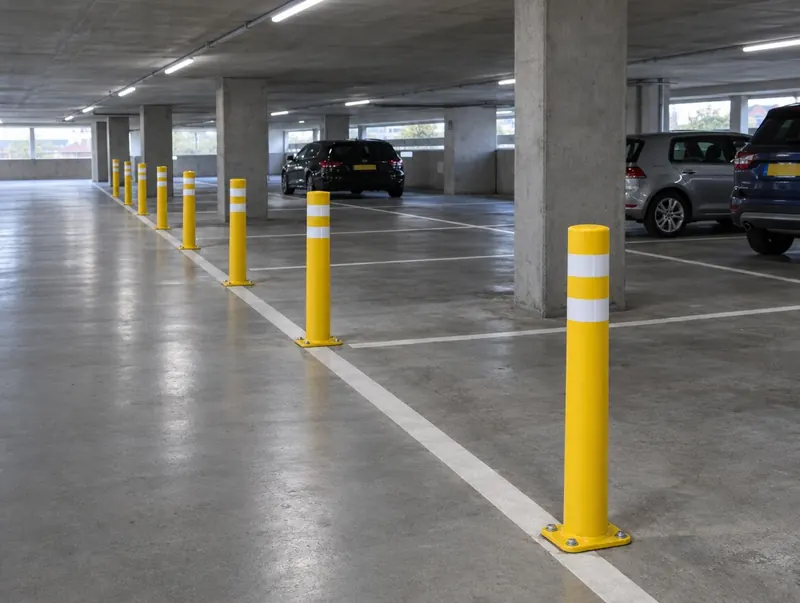 Computer-generated image
About flexible bollards in Glasgow
Flexible bollards are traffic management products, not barriers, and will not stop a vehicle that is driven at them. In Glasgow, that tends to mean sites such as office forecourts, distribution parks and multi-storey car parks.
We cover the G2, G4, G1, G3, G5 and G20 postcode districts in Glasgow. Jobs in Glasgow can be combined with work in Rutherglen (3 miles), Bishopbriggs (3.2 miles), Bearsden (4.5 miles) and Giffnock (4.5 miles) (straight-line distances).
Local details
- Area
- Glasgow City, Scotland
- Roads authority
- Glasgow City Council (local roads)
- Planning authority
- Glasgow City Council
- Postcodes
- G2, G4, G1, G3, G5, G20, G22 and G21
- Guide price
- Typically £195–£595 per bollard + VAT; minimum job £445
- Survey
- Free, with a fixed written quote
- Nearby
- Rutherglen (3 mi), Bishopbriggs (3.2 mi), Bearsden (4.5 mi), Giffnock (4.5 mi)
What Glasgow sites use flexible bollards for
Typical reasons Glasgow sites choose flexible bollards:
- Temporary or trial layouts before permanent kerbs
- Lane separation at car park entrances and exits
- Drive-thru lanes and fuel forecourts
Guide prices for Glasgow
| Specification | Guide price | Includes |
|---|---|---|
| Standard | £195–£365 + VAT | Standard post, foundation, reinstatement |
| Upgraded | £315–£485 + VAT | Upgraded finish or fittings, reflective band, matched keys |
| Premium | £435–£595 + VAT | Heavy-duty or architectural spec, premium finish |
Per bollard, supplied and fixed; no regional adjustment. Guide only — the fixed price follows a survey.
Permissions and groundwork in Glasgow
Glasgow falls under Glasgow City Council as roads authority. If the line of posts crosses onto adopted road or pavement, permission comes before excavation; on private land it does not.
If your site in Glasgow is listed or inside a conservation area, check with the local planning authority (Glasgow City Council) before choosing a finish — heritage settings often favour cast iron or painted steel over stainless.
Anchors therefore need sound concrete with enough edge distance; anchoring into thin, cracked or weak surfaces means the base works loose within weeks. Flexible bollards put repeated load on their fixings, because every knock rocks the base.
- On public highway, including cycle lane segregation, the roads authority's agreement and specification are needed.
- Do not use flexible bollards where a physical barrier is needed to protect people or buildings; they guide rather than stop.
Installation, step by step
Survey traffic movements
The free site survey looks at vehicle sizes, turning paths and where drivers currently clip posts or kerbs. You receive a fixed written quote with post type and fixing.
Set out the line
Posts are set out to guide vehicles along the intended path, with spacing that reads as a line to drivers.
Fit posts and test
Posts are fitted and bent by hand to confirm they return upright, and reflective sleeves are applied.
Finishes and options
| Option | Detail |
|---|---|
| Heights and diameters | Commonly 750–1,000 mm high and around 80–200 mm diameter, with slimmer wand-style posts for lane lines. |
| Sprung-base bollards | A rigid post on a heavy spring or elastomer base that tilts and returns. Looks like a conventional bollard. |
| Low-profile deck bases | Shallow fixings for multi-storey decks where deep drilling is not permitted. |
Pricing flexible bollards in Glasgow
Two Glasgow jobs with the same number of posts can price quite differently. The usual reasons:
- Out-of-hours working in busy car parks
- Polymer posts or sprung-base bollards
- Deck scanning and restrictions on drilling
Looking after them
Check flexible bollards for splits, permanent bends and loose bases, and tighten or replace fixings that have worked loose. Clean reflective sleeves so they stay visible, and replace them when they fade or peel.
If posts in Glasgow are later hit or damaged, we can repair or replace them — see bollard repairs.
Questions about flexible bollards in Glasgow
Can you install flexible bollards anywhere in Glasgow?
We cover all of Glasgow (G2, G4, G1, G3, G5 and G20) and the rest of Glasgow City. We also work in Rutherglen, Bishopbriggs and Bearsden.
Who gives permission for bollards on the pavement in Glasgow?
Glasgow falls under Glasgow City Council as roads authority. If the line of posts crosses onto adopted road or pavement, permission comes before excavation; on private land it does not.
How much do flexible bollards cost in Glasgow?
In Glasgow, typically £195–£595 per bollard, supplied and fixed, plus VAT, with a minimum job of £445 plus VAT, using our Scotland guide prices. The fixed figure comes in writing after we've seen the site.
How many times can a flexible bollard be hit?
Many times in normal use, as long as the impacts are the low-speed bumps it is designed for. A heavy vehicle running right over it, or a high-speed strike, can tear it. Manufacturers give guidance for their products.
Do flexible bollards work in cold weather?
They do, but polymers become stiffer in cold conditions and recover more slowly after a knock. Sprung-base designs are less affected. Neither type is damaged by normal UK winter temperatures.
Flexible bollards in nearby towns
- Rutherglen (3 mi)
- Bishopbriggs (3.2 mi)
- Bearsden (4.5 mi)
- Giffnock (4.5 mi)
- Renfrew (5.3 mi)
- Cambuslang (5.4 mi)