Glasgow City · Scotland
Semi-automatic bollard installation in Glasgow
Semi-automatic bollards supplied and fitted in Glasgow, Glasgow City: surveyed, scanned for services, set in proper foundations and finished to match the ground.
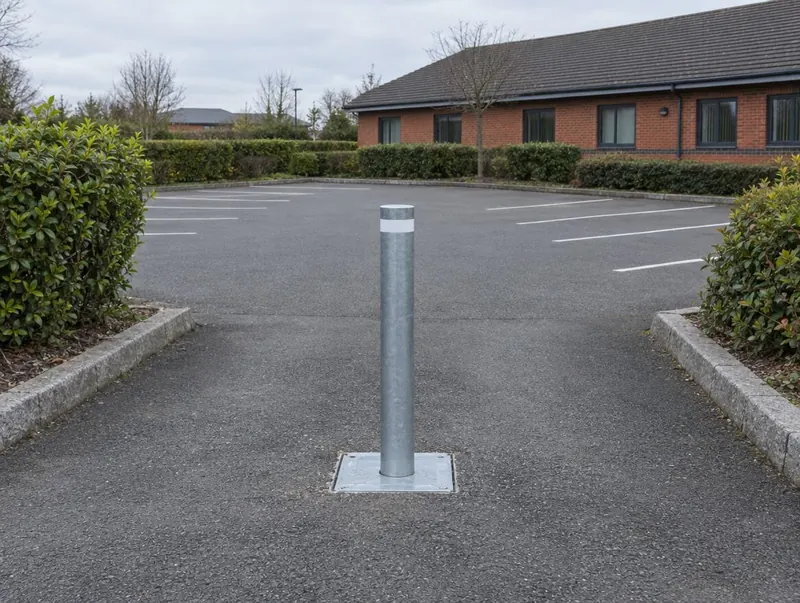 Computer-generated image
About semi-automatic bollards in Glasgow
Across Glasgow, typical sites for semi-automatic bollards include office forecourts, multi-storey car parks and city-centre plazas. Gas-strut assisted bollards that rise on their own when unlocked and lower by hand, with no mains power needed.
We cover the G2, G4, G1, G3, G5 and G20 postcode districts in Glasgow. We also cover neighbouring Rutherglen (3 miles), Bishopbriggs (3.2 miles), Bearsden (4.5 miles) and Giffnock (4.5 miles) — distances are straight-line.
Key facts for this area
- Area
- Glasgow City, Scotland
- Roads authority
- Glasgow City Council (local roads)
- Planning authority
- Glasgow City Council
- Postcodes
- G2, G4, G1, G3, G5, G20, G22 and G21
- Guide price
- Typically £1,095–£3,495 per bollard + VAT (£1,295–£4,195 inc VAT for homes); minimum job £1,195
- Survey
- Free, with a fixed written quote
- Nearby
- Rutherglen (3 mi), Bishopbriggs (3.2 mi), Bearsden (4.5 mi), Giffnock (4.5 mi)
Typical semi-automatic bollards jobs in Glasgow
Typical reasons Glasgow sites choose semi-automatic bollards:
- Locations where automatic bollards are not justified
- Delivery entrances without a power supply nearby
- Sites where telescopic posts are too heavy for regular users
Guide prices for Glasgow
| Specification | Guide price | Includes |
|---|---|---|
| Standard | £1,095–£2,095 + VAT · £1,295–£2,495 inc VAT | Standard post, foundation, reinstatement |
| Upgraded | £1,795–£2,845 + VAT · £2,145–£3,395 inc VAT | Upgraded finish or fittings, reflective band, matched keys |
| Premium | £2,545–£3,495 + VAT · £3,045–£4,195 inc VAT | Heavy-duty or architectural spec, premium finish |
Per bollard, supplied and installed; no regional adjustment. Guide only — the fixed price follows a survey.
Consents, ground and services in Glasgow
For anything on the public footway in Glasgow we check with the roads authority first — Glasgow City Council for local roads, Transport Scotland on trunk routes. Private ground such as a car park or forecourt only needs the owner's go-ahead.
Many private-land installations in Glasgow need no planning application, but the rules don't clearly cover bollards, so listed buildings, conservation areas and prominent frontages are worth raising with the planning team at Glasgow City Council before posts go in.
Buried services across the entrance are traced and the position adjusted if needed, as the cassette cannot simply be made shallower. Because the cassette houses both the post and its strut mechanism, the pit is deep and must stay dry.
- Agree how emergency services will gain access if the post is locked up.
- Check land ownership; bollards on public highway need the roads authority's agreement.
Installation, step by step
Survey use and ground
At the free site survey we look at how often the post will be used, who will operate it and what is under the surface. A fixed written quote follows, including drainage.
Set the cassette
The cassette is set plumb and flush with the finished surface, connected to drainage and concreted in. The strut is fitted or released only as the manufacturer instructs.
Test and show users
The post is cycled several times to check it rises fully, locks at both heights and lowers smoothly. Users are shown how to operate it and to keep clear of the head when it rises.
Finishes and options
| Option | Detail |
|---|---|
| Height and diameter | Raised heights commonly around 500–900 mm and diameters around 100–200 mm, depending on model and duty. |
| Head lighting | Some models include battery or solar LEDs in the head to improve visibility on unlit sites. |
| Lock types | Keyed cylinder locks, typically operating at ground level, with keyed-alike options for multi-post sites. |
What moves the price in Glasgow
Our Scotland guide prices are a starting point; the survey in Glasgow firms them up. What tends to move them:
- Drainage method
- Surface reinstatement
- Domestic or commercial duty model
After installation
Watch the rising speed: when it slows or the post no longer reaches full height, the strut is losing pressure and should be replaced before it fails altogether. If several posts on one site were installed at the same time, their struts tend to wear at a similar rate, so it can make sense to replace them together.
If posts in Glasgow are later hit or damaged, we can repair or replace them — see bollard repairs.
Semi-automatic bollards in Glasgow: FAQs
Can you install semi-automatic bollards anywhere in Glasgow?
We cover all of Glasgow (G2, G4, G1, G3, G5 and G20) and the rest of Glasgow City. We also work in Rutherglen, Bishopbriggs and Bearsden.
Do I need consent for semi-automatic bollards on a public footway in Glasgow?
In Scotland the council is the roads authority for local roads, which in Glasgow means Glasgow City Council. Semi-automatic bollards on an adopted footway need its consent; trunk roads sit with Transport Scotland.
How much do semi-automatic bollards cost in Glasgow?
In Glasgow, typically £1,095–£3,495 per bollard, supplied and installed, plus VAT (£1,295–£4,195 including VAT for homeowners), with a minimum job of £1,195 plus VAT, using our Scotland guide prices. The fixed figure comes in writing after we've seen the site.
Why has my semi-automatic bollard stopped rising fully?
Usually because the gas strut has lost pressure, or debris and water in the cassette are slowing it. Check and clean the cassette first. If it still stops short, the strut needs replacing.
How is a semi-automatic bollard different from an automatic one?
An automatic bollard is powered and controlled by a panel, loops and access devices. A semi-automatic one rises on its own when unlocked but must be pushed down by hand. It needs no electrics, which keeps installation simpler.
Semi-automatic bollards in nearby towns
- Rutherglen (3 mi)
- Bishopbriggs (3.2 mi)
- Bearsden (4.5 mi)
- Giffnock (4.5 mi)
- Renfrew (5.3 mi)
- Cambuslang (5.4 mi)