Glasgow City · Scotland
Automatic rising bollard installation in Glasgow
Automatic bollards supplied and fitted in Glasgow, Glasgow City: surveyed, scanned for services, set in proper foundations and finished to match the ground.
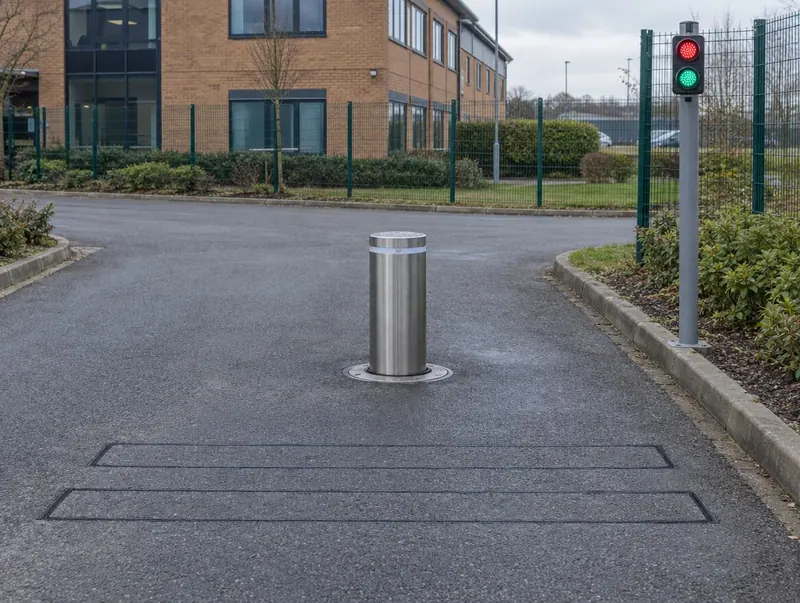 Computer-generated image
Automatic bollards in Glasgow
From retail parks, office forecourts and university campuses, Glasgow has plenty of places where automatic bollards earn their keep. Automatic bollards are available unrated for traffic control or crash-tested for security entrances.
Coverage in Glasgow takes in the G2, G4, G1, G3, G5 and G20 postcode districts. Jobs in Glasgow can be combined with work in Rutherglen (3 miles), Bishopbriggs (3.2 miles), Bearsden (4.5 miles) and Giffnock (4.5 miles) (straight-line distances).
Key facts for this area
- Area
- Glasgow City, Scotland
- Roads authority
- Glasgow City Council (local roads)
- Planning authority
- Glasgow City Council
- Postcodes
- G2, G4, G1, G3, G5, G20, G22 and G21
- Guide price
- Typically £2,995–£14,995 per bollard + VAT
- Survey
- Free, with a fixed written quote
- Nearby
- Rutherglen (3 mi), Bishopbriggs (3.2 mi), Bearsden (4.5 mi), Giffnock (4.5 mi)
What automatic bollards cost in Glasgow
| Specification | Guide price | Includes |
|---|---|---|
| Standard | £2,995–£8,045 + VAT | Electro-mechanical or entry hydraulic, controls, loops and photocell |
| Upgraded | £6,595–£11,595 + VAT | Heavy-duty hydraulic, traffic light, signs and LED head |
| Premium | £10,195–£14,995 + VAT | High-cycle or crash-rated automatic bollard |
Per bollard, installed with controls, loops and commissioning; no regional adjustment. Guide only — the fixed price follows a survey.
Automatic bollards in Glasgow: common uses
Common uses in a place like Glasgow:
- Private estates and gated developments without a full gate
- Emergency access routes that must open on demand
- Bus gates and access-only routes where the highway authority agrees
Before we dig in Glasgow
In Scotland the council is the roads authority for local roads, which in Glasgow means Glasgow City Council. Automatic bollards on an adopted footway need its consent; trunk roads sit with Transport Scotland.
Bollards on private land often need no planning application, but listed buildings and conservation areas are different; the planning service at Glasgow City Council can confirm before anything is ordered.
Without drainage, rainwater and silt collect in the cassette, corrode the mechanism and can freeze around the post in winter. The pit base is usually connected to a surface water drain or a soakaway, and on clay or high water table sites that connection needs particular attention.
- Agree emergency access with the fire and ambulance services, including how they will lower the bollards.
- Have the electrical installation carried out and certified by a qualified electrician to BS 7671.
Installation, step by step
Survey and risk assessment
A free site survey covers traffic patterns, who uses the entrance, power, drainage routes and buried services. We draft the safety arrangement from that, and you receive a fixed written quote.
Ducts, drainage and loops
Ducts are laid between the bollards, the controller cabinet and access devices, with draw pits where runs change direction. The drain is connected and the safety and exit loops are cut into the surface and sealed.
Commission and test
Rise and fall times, loop detection, photocells, lights and the manual release are tested with vehicles present. Safety settings are recorded against the risk assessment.
Specification choices
| Option | Detail |
|---|---|
| Hydraulic drive | Integral or remote power pack. Suits high-frequency entrances and heavier rated units, with periodic checks on fluid, seals and hoses. |
| Electro-mechanical drive | Motor and gearbox inside the bollard with no hydraulic fluid. Often simpler to service, with duty cycles that suit moderate traffic. |
| Unrated or crash-rated | Unrated units control traffic; rated units are tested to IWA 14-1, ISO 22343-1 or PAS 68 for security entrances, with deeper, heavier foundations. |
Pricing automatic bollards in Glasgow
Two Glasgow jobs with the same number of posts can price quite differently. The usual reasons:
- Hydraulic or electro-mechanical drive and the duty cycle needed
- Access control devices, traffic lights and signage
- Number of bollards and lanes controlled
After installation
Frequency depends on how often the bollard cycles; a busy entrance needs more visits than a rarely used one. Typical visits clean and inspect the cassette and drain, check hydraulic fluid or gearbox condition, test loops, photocells, lights and the manual release, and read the controller's fault log.
For damaged or loose posts in Glasgow, repairs and replacements are priced in writing first.
Common questions
Do you install automatic bollards in Glasgow?
We cover all of Glasgow (G2, G4, G1, G3, G5 and G20) and the rest of Glasgow City. We also work in Rutherglen, Bishopbriggs and Bearsden.
Who gives permission for bollards on the pavement in Glasgow?
For anything on the public footway in Glasgow we check with the roads authority first — Glasgow City Council for local roads, Transport Scotland on trunk routes. Private ground such as a car park or forecourt only needs the owner's go-ahead.
What's a typical price for automatic bollards in Glasgow?
In Glasgow, typically £2,995–£14,995 per bollard, installed with controls, loops and commissioning, plus VAT, using our Scotland guide prices. The fixed figure comes in writing after we've seen the site.
How will emergency vehicles get through?
Usually by an agreed method such as a fire service key switch, a code, a remote handset held by the site or a free-exit arrangement. It should be agreed with the emergency services before the bollards go live.
Can rising bollards be installed on a public road?
Only with the roads authority's approval, and they will set requirements for signs, signals and operation. On private land the decision is yours, but the same safety principles apply.
Automatic bollards in nearby towns
- Rutherglen (3 mi)
- Bishopbriggs (3.2 mi)
- Bearsden (4.5 mi)
- Giffnock (4.5 mi)
- Renfrew (5.3 mi)
- Cambuslang (5.4 mi)