London · England
Flexible bollard installation in Kensington and Chelsea
Flexible bollards supplied and fitted in Kensington and Chelsea, London: surveyed, scanned for services, set in proper foundations and finished to match the ground.
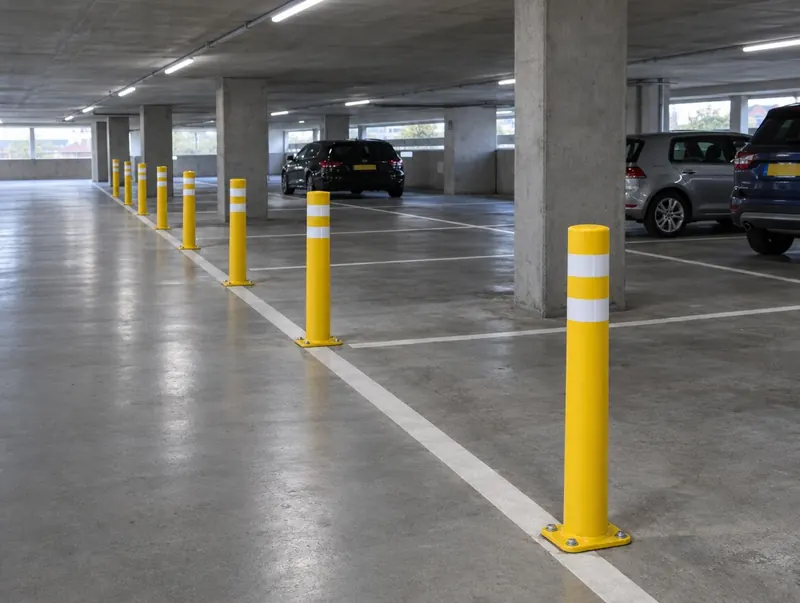 Computer-generated image
Kensington and Chelsea flexible bollards
Flexible bollards are traffic management products, not barriers, and will not stop a vehicle that is driven at them. In Kensington and Chelsea, that tends to mean sites such as office entrances, school gates and estate car parks.
We cover the W8, W11, SW5, SW7, W10 and SW10 postcode districts in Kensington and Chelsea. Nearby, we also work in Hammersmith and Fulham (1.4 miles), Westminster (2.1 miles), Camden (3.2 miles) and Wandsworth (3.6 miles), measured as the crow flies.
Local details
- Area
- London, England
- Highway authority
- Kensington and Chelsea Council (local roads)
- Planning authority
- Kensington and Chelsea Council
- Postcodes
- W8, W11, SW5, SW7, W10, SW10 and SW3
- Guide price
- Typically £225–£685 per bollard + VAT; minimum job £505
- Survey
- Free, with a fixed written quote
- Nearby
- Hammersmith and Fulham (1.4 mi), Westminster (2.1 mi), Camden (3.2 mi), Wandsworth (3.6 mi)
Typical flexible bollards jobs in Kensington and Chelsea
Common uses in a place like Kensington and Chelsea:
- Bus stations and coach parks
- Depot and yard routes where vehicles knock posts daily
- Marking pedestrian routes inside multi-storey car parks
What flexible bollards cost in Kensington and Chelsea
| Specification | Guide price | Includes |
|---|---|---|
| Standard | £225–£415 + VAT | Standard post, foundation, reinstatement |
| Upgraded | £365–£555 + VAT | Upgraded finish or fittings, reflective band, matched keys |
| Premium | £505–£685 + VAT | Heavy-duty or architectural spec, premium finish |
Per bollard, supplied and fixed; +15% for London. Guide only — the fixed price follows a survey.
What we check first in Kensington and Chelsea
The highway authority for local roads in Kensington and Chelsea is Kensington and Chelsea Council; motorways and trunk roads sit with National Highways. Red routes are managed by Transport for London. Flexible bollards on the adopted footway are a matter for the highway authority, so we only install there with its written agreement.
If your site in Kensington and Chelsea is listed or inside a conservation area, check with the local planning authority (Kensington and Chelsea Council) before choosing a finish — heritage settings often favour cast iron or painted steel over stainless.
Flexible bollards put repeated load on their fixings, because every knock rocks the base. Where posts go in a line across a drainage fall, positions avoid channels and gullies.
- Keep pedestrian gaps and routes clear, referring to Inclusive Mobility guidance where people walk through the line.
- Do not use flexible bollards where a physical barrier is needed to protect people or buildings; they guide rather than stop.
Installation, step by step
Set out the line
Posts are set out to guide vehicles along the intended path, with spacing that reads as a line to drivers.
Fit posts and test
Posts are fitted and bent by hand to confirm they return upright, and reflective sleeves are applied.
Hand over spares and records
Post and base details are recorded so replacements match, and spare posts can be left on site for busy locations. Staff are shown how a post is swapped on its base.
Options to consider
| Option | Detail |
|---|---|
| Heights and diameters | Commonly 750–1,000 mm high and around 80–200 mm diameter, with slimmer wand-style posts for lane lines. |
| Polyurethane posts | Flex along their length and return to shape. Gentle on vehicles and common in car parks and on forecourts. |
| Low-profile deck bases | Shallow fixings for multi-storey decks where deep drilling is not permitted. |
What affects the quote
When we price flexible bollards in Kensington and Chelsea, these make the biggest difference:
- Surface condition and need for concrete pads
- Polymer posts or sprung-base bollards
- Deck scanning and restrictions on drilling
Looking after them
Keep a few spare posts on site where knocks are frequent, so a damaged one can be swapped before the line develops a gap. After resurfacing or line repainting, check that the bases were not disturbed or painted over, and that posts still line up with the new markings.
For damaged or loose posts in Kensington and Chelsea, repairs and replacements are priced in writing first.
Common questions
Which parts of Kensington and Chelsea do you cover for flexible bollards?
We cover all of Kensington and Chelsea (W8, W11, SW5, SW7, W10 and SW10) and the rest of London. We also work in Hammersmith and Fulham, Westminster and Camden.
Do I need consent for flexible bollards on a public footway in Kensington and Chelsea?
The highway authority for local roads in Kensington and Chelsea is Kensington and Chelsea Council; motorways and trunk roads sit with National Highways. Red routes are managed by Transport for London. Flexible bollards on the adopted footway are a matter for the highway authority, so we only install there with its written agreement.
How much do flexible bollards cost in Kensington and Chelsea?
In Kensington and Chelsea, typically £225–£685 per bollard, supplied and fixed, plus VAT, with a minimum job of £505 plus VAT, using our London guide prices. The fixed figure comes in writing after we've seen the site.
Do flexible bollards damage vehicles?
Typically very little in a low-speed knock, which is a large part of their appeal. They may leave a scuff on paintwork. A rigid post in the same position would usually dent the vehicle and bend itself.
Will a flexible bollard stop a car?
No. It is designed to bend and recover, so a car can push past it. It marks the line and discourages drivers from crossing it. Where a vehicle must be physically stopped, use a rigid bollard.
Flexible bollards in nearby towns
- Hammersmith and Fulham (1.4 mi)
- Westminster (2.1 mi)
- Camden (3.2 mi)
- Wandsworth (3.6 mi)
- Lambeth (4.5 mi)
- City of London (4.7 mi)