Fife · Scotland
Ram-raid protection bollards in Kirkcaldy
Local installation of ram-raid bollards in Kirkcaldy — free survey, fixed written price, and posts set to the right spacing for people and vehicles.
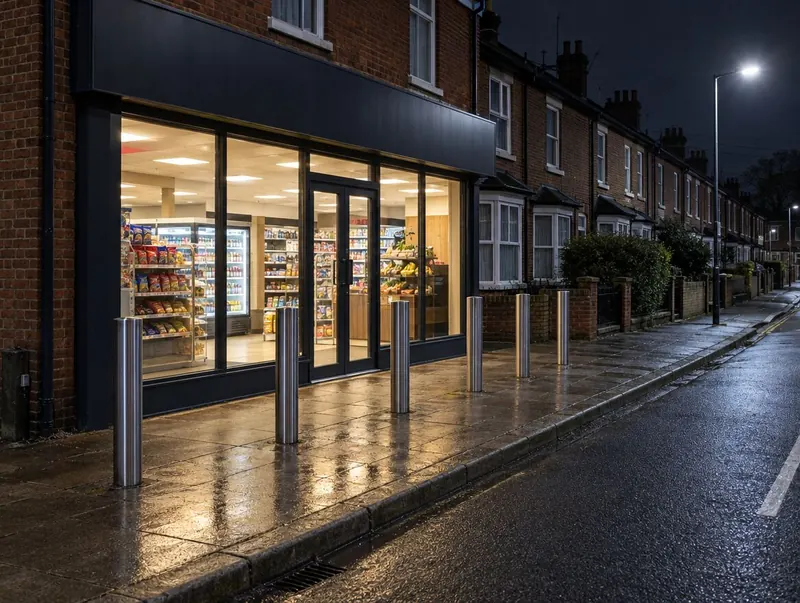 Computer-generated image
Kirkcaldy ram-raid bollards
In the town of Kirkcaldy, ram-raid bollards tend to go in at small industrial units, schools and high street shopfronts. Bollards fitted in front of shopfronts, ATMs, jewellers and convenience stores to stop vehicles being used to break in.
We work across KY2, KY1 and KY3 — Kirkcaldy itself and places including Auchtertool, Cluny, East Wemyss and Coaltown of Wemyss. Jobs in Kirkcaldy can be combined with work in Glenrothes (5.4 miles), Cowdenbeath (7.1 miles), Methil (7.1 miles) and Dunfermline (11.9 miles) (straight-line distances).
Local details
- Area
- Fife, Scotland
- Roads authority
- Fife Council (local roads)
- Planning authority
- Fife Council
- Postcodes
- KY2, KY1 and KY3
- Guide price
- Typically £395–£1,495 per bollard + VAT; minimum job £945
- Survey
- Free, with a fixed written quote
- Nearby
- Glenrothes (5.4 mi), Cowdenbeath (7.1 mi), Methil (7.1 mi), Dunfermline (11.9 mi)
Ram-raid bollards in Kirkcaldy: common uses
Around Kirkcaldy, ram-raid bollards usually solve one of these:
- Convenience stores and off-licences with glazed frontages
- Pharmacies and late-opening premises
- Jewellers, pawnbrokers and phone shops holding high-value stock
Guide prices for Kirkcaldy
| Specification | Guide price | Includes |
|---|---|---|
| Standard | £395–£855 + VAT | Standard post, foundation, reinstatement |
| Upgraded | £725–£1,195 + VAT | Upgraded finish or fittings, reflective band, matched keys |
| Premium | £1,045–£1,495 + VAT | Heavy-duty or architectural spec, premium finish |
Per bollard, supplied and installed; no regional adjustment. Guide only — the fixed price follows a survey.
Consents, ground and services in Kirkcaldy
Kirkcaldy falls under Fife Council as roads authority. If the line of posts crosses onto adopted road or pavement, permission comes before excavation; on private land it does not.
Bollards on private land often need no planning application, but listed buildings and conservation areas are different; the planning service at Fife Council can confirm before anything is ordered.
Shopfronts often sit over cellars, coal holes, vaults and service entries, so what lies under the pavement can be more complicated than it looks. Shop forecourts may be thin concrete over old fill, and filling station forecourts carry fuel lines, tank vents and interceptors that must be located precisely before anything is dug.
- Check who owns the ground in front of the shop; if it is public highway, the roads authority's agreement is needed.
- Ask your landlord, and check any lease restrictions on alterations to the frontage.
How the job runs
Look at how a vehicle would approach
At the free site survey we look at where a vehicle could reverse from, the kerb line, the forecourt and the frontage construction. Ownership of the pavement in front of the shop is checked at the same time.
Excavate and set the posts
Each position is hand-dug near services and taken to depth, then the post is set plumb in a reinforced concrete base. Work is planned around trading hours where possible.
Reinstate the pavement
Paving, tarmac or forecourt concrete is made good flush with the base of each post, leaving no trip edges.
Choosing the right spec
| Option | Detail |
|---|---|
| Crash-rated bollards | Tested to IWA 14-1, ISO 22343-1 or PAS 68 for high-value premises or where a vehicle could build up speed. |
| Concrete-filled steel posts | Thick-walled steel tube root-fixed in a deep reinforced base. The usual unrated choice for shopfronts and ATMs. |
| Removable posts | Lockable removable positions allow deliveries, shopfitting or shutter maintenance without leaving the frontage open permanently. |
Pricing ram-raid bollards in Kirkcaldy
Our Scotland guide prices are a starting point; the survey in Kirkcaldy firms them up. What tends to move them:
- Unrated, PAS 170-1 or crash-rated product
- Number of posts across the frontage or ATM
- Covers and finishes for shopping streets
Keeping them working
Ram-raid bollards are robust but not maintenance-free. Check them after any knock, because a post that has been hit may have cracked its foundation even if it still looks straight.
We can also service, repair or replace existing posts anywhere in Kirkcaldy.
Ram-raid bollards in Kirkcaldy: FAQs
Do you install ram-raid bollards in Kirkcaldy?
We cover all of Kirkcaldy (KY2, KY1 and KY3) and the rest of Fife. We also work in Glenrothes, Cowdenbeath and Methil.
Who gives permission for bollards on the pavement in Kirkcaldy?
In Scotland the council is the roads authority for local roads, which in Kirkcaldy means Fife Council. Ram-raid bollards on an adopted footway need its consent; trunk roads sit with Transport Scotland.
What's a typical price for ram-raid bollards in Kirkcaldy?
In Kirkcaldy, typically £395–£1,495 per bollard, supplied and installed, plus VAT, with a minimum job of £945 plus VAT, using our Scotland guide prices. The fixed figure comes in writing after we've seen the site.
Can we still take deliveries through the front?
Yes, if one or more positions are removable. Staff unlock and lift out the post for deliveries, then refit it. The socket is designed to sit flush when the post is out.
What is PAS 170-1 and do I need it?
PAS 170-1 is a standard for testing vehicle security barriers against low-speed impacts. It suits ram-raid risks where someone has asked for tested performance, such as an insurer or security adviser. If nobody has asked for a tested product, a well-founded unrated post is often adequate.
Ram-raid bollards in nearby towns
- Glenrothes (5.4 mi)
- Cowdenbeath (7.1 mi)
- Methil (7.1 mi)
- Dunfermline (11.9 mi)
- Rosyth (12.1 mi)
- St Andrews (20.7 mi)