Somerset · England
Ram-raid protection bollards in Yeovil
Ram-raid bollards supplied and fitted in Yeovil, Somerset: surveyed, scanned for services, set in proper foundations and finished to match the ground.
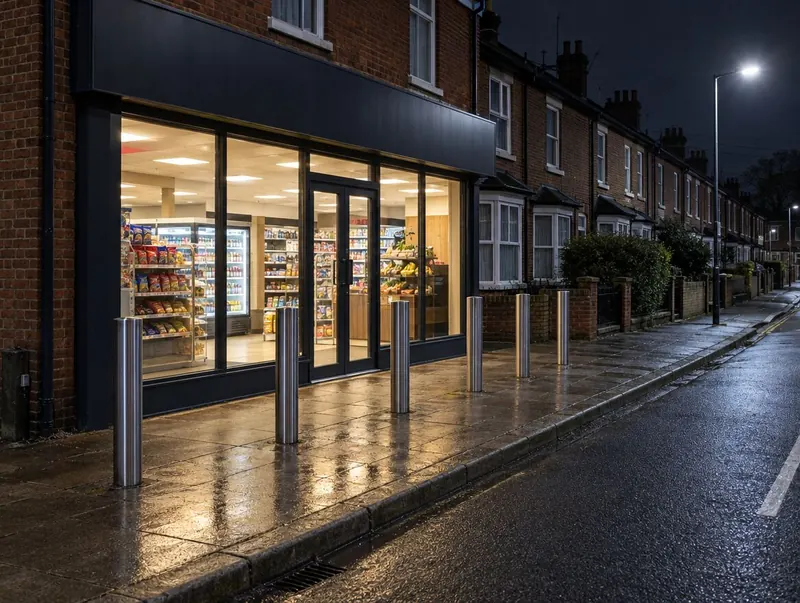 Computer-generated image
About ram-raid bollards in Yeovil
In the town of Yeovil, ram-raid bollards tend to go in at community car parks, filling-station forecourts and schools. Bollards fitted in front of shopfronts, ATMs, jewellers and convenience stores to stop vehicles being used to break in.
We work across BA20, BA21, BA22, TA15 and TA14 — Yeovil itself and places including Mudford Sock, Mudford, Coppits Hill and Lower Vagg. We also cover neighbouring Bridgwater (20.7 miles) and Taunton (21.1 miles) — distances are straight-line. It sits roughly 36 miles from Bristol as the crow flies.
Local details
- Area
- Somerset, England
- Highway authority
- Somerset Council (local roads)
- Planning authority
- Somerset Council
- Postcodes
- BA20, BA21, BA22, TA15 and TA14
- Guide price
- Typically £395–£1,495 per bollard + VAT; minimum job £945
- Survey
- Free, with a fixed written quote
- Nearby
- Bridgwater (20.7 mi), Taunton (21.1 mi)
Guide prices for Yeovil
| Specification | Guide price | Includes |
|---|---|---|
| Standard | £395–£855 + VAT | Standard post, foundation, reinstatement |
| Upgraded | £725–£1,195 + VAT | Upgraded finish or fittings, reflective band, matched keys |
| Premium | £1,045–£1,495 + VAT | Heavy-duty or architectural spec, premium finish |
Per bollard, supplied and installed; no regional adjustment. Guide only — the fixed price follows a survey.
Where ram-raid bollards go in around Yeovil
Typical reasons Yeovil sites choose ram-raid bollards:
- Pharmacies and late-opening premises
- Premises that have already been targeted once
- Filling station kiosks and forecourt shops
Consents, ground and services in Yeovil
In Yeovil, work on adopted pavements and verges needs consent from Somerset Council, the local highway authority. Car parks, forecourts and other private land only need the owner's permission.
Bollards on private land often don't need planning permission, but it depends on the council's view, the height and the location; in a conservation area, next to a listed building or under an Article 4 direction, ask the local planning authority (Somerset Council) first — we flag this at survey.
Shop forecourts may be thin concrete over old fill, and filling station forecourts carry fuel lines, tank vents and interceptors that must be located precisely before anything is dug. Shopfronts often sit over cellars, coal holes, vaults and service entries, so what lies under the pavement can be more complicated than it looks.
- In conservation areas or on listed buildings, ask the local planning authority whether consent is needed.
- Leave clear gaps for wheelchairs and buggies, typically at least 1,000 mm, and keep the footway width usable, referring to Inclusive Mobility guidance.
What happens on site
Look at how a vehicle would approach
At the free site survey we look at where a vehicle could reverse from, the kerb line, the forecourt and the frontage construction. Ownership of the pavement in front of the shop is checked at the same time.
Agree the post type and positions
We agree unrated or tested posts with you, your landlord and any insurer or security adviser involved. A fixed written quote sets out the positions, foundations and reinstatement.
Arrange consents
If the posts will stand on public highway, the highway authority's agreement is needed before work starts. Landlord consent is usually needed for leased units.
Specification choices
| Option | Detail |
|---|---|
| Crash-rated bollards | Tested to IWA 14-1, ISO 22343-1 or PAS 68 for high-value premises or where a vehicle could build up speed. |
| Concrete-filled steel posts | Thick-walled steel tube root-fixed in a deep reinforced base. The usual unrated choice for shopfronts and ATMs. |
| Reflective and contrasting bands | Bands near the top help pedestrians, including partially sighted people, see the posts on a busy pavement. |
Pricing ram-raid bollards in Yeovil
When we price ram-raid bollards in Yeovil, these make the biggest difference:
- Out-of-hours working to avoid closing the shop
- Reinstatement of forecourt or natural stone surfaces
- Removable positions and their locks
After installation
Keep visibility bands clean, repaint chips before rust sets in on steel, and keep locks on removable posts lubricated so staff can actually use them. Check them after any knock, because a post that has been hit may have cracked its foundation even if it still looks straight.
We can also service, repair or replace existing posts anywhere in Yeovil.
Ram-raid bollards in Yeovil: FAQs
Which parts of Yeovil do you cover for ram-raid bollards?
We cover all of Yeovil (BA20, BA21, BA22, TA15 and TA14) and the rest of Somerset. We also work in Bridgwater and Taunton.
Do I need consent for ram-raid bollards on a public footway in Yeovil?
The highway authority for local roads in Yeovil is Somerset Council; motorways and trunk roads sit with National Highways. Ram-raid bollards on the adopted footway are a matter for the highway authority, so we only install there with its written agreement.
What's a typical price for ram-raid bollards in Yeovil?
In Yeovil, typically £395–£1,495 per bollard, supplied and installed, plus VAT, with a minimum job of £945 plus VAT, using our South West guide prices. The fixed figure comes in writing after we've seen the site.
What is PAS 170-1 and do I need it?
PAS 170-1 is a standard for testing vehicle security barriers against low-speed impacts. It suits ram-raid risks where someone has asked for tested performance, such as an insurer or security adviser. If nobody has asked for a tested product, a well-founded unrated post is often adequate.
Will bollards stop an ATM being ripped out?
Correctly placed bollards stop a vehicle getting close enough to attach chains or ram the surround. They work alongside the machine's own anchoring and the bank's security measures. Positions need to cover the wall either side of the ATM as well as the front.