Flintshire · Wales
Removable bollard installation in Mold
Local installation of removable bollards in Mold — free survey, fixed written price, and posts set to the right spacing for people and vehicles.
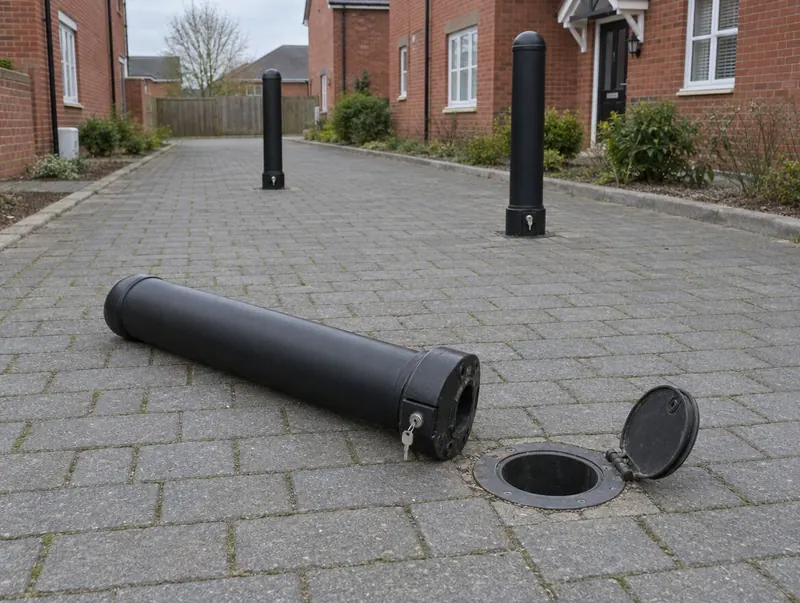 Computer-generated image
About removable bollards in Mold
Whether it's residential driveways, schools and community buildings, removable bollards in Mold are planned around who needs to get through and who doesn't. Lift-out bollards in lockable ground sockets for driveways, delivery routes, access roads and emergency access points.
We work across CH7 — Mold itself and places including Mynydd Isa, Northop Hall, Drury and Treuddyn. Jobs in Mold can be combined with work in Deeside (4.9 miles), Flint (5.4 miles), Coedpoeth (8.5 miles) and Wrexham (10.4 miles) (straight-line distances).
Mold at a glance
- Area
- Flintshire, Wales
- Highway authority
- Flintshire County Council (local roads)
- Planning authority
- Flintshire County Council
- Postcodes
- CH7
- Guide price
- Typically £235–£815 per bollard + VAT (£275–£975 inc VAT for homes); minimum job £575
- Survey
- Free, with a fixed written quote
Guide prices for Mold
| Specification | Guide price | Includes |
|---|---|---|
| Standard | £235–£485 + VAT · £275–£575 inc VAT | Standard post, foundation, reinstatement |
| Upgraded | £415–£655 + VAT · £495–£785 inc VAT | Upgraded finish or fittings, reflective band, matched keys |
| Premium | £585–£815 + VAT · £695–£975 inc VAT | Heavy-duty or architectural spec, premium finish |
Per bollard with ground socket, supplied and installed; -3% for Wales. Guide only — the fixed price follows a survey.
Where removable bollards go in around Mold
Common uses in a place like Mold:
- Temporary event closures and market streets
- Emergency and fire service access routes
- Delivery bays in pedestrian areas and shop frontages
What we check first in Mold
Before digging near the kerb in Mold we establish who owns the ground: adopted footways are Flintshire County Council's responsibility, trunk roads the Welsh Government's, and everything else belongs to the site owner.
If your site in Mold is listed or inside a conservation area, check with the local planning authority (Flintshire County Council) before choosing a finish — heritage settings often favour cast iron or painted steel over stainless.
A socket set even a few millimetres proud becomes a trip edge and gets clipped by tyres and snow ploughs; one set low collects water and grit. The base sits on free-draining stone or connects to a drainage route, so rainwater does not stand in the socket and freeze around the post in winter.
- On emergency access routes, agree with the fire service how they will remove the posts, such as standard keys or bolt croppers on padlocks.
- Fit reflective or contrasting bands near the top so posts are visible when in place.
How the job runs
Agree who will lift the post
At the free site survey we talk through who will remove the post, how often and where it will be stored. That decides material, diameter and lock, and goes into a fixed written quote.
Cut and excavate
A small square of surface is cut out and excavated to socket depth, with a bed of free-draining stone at the bottom so water can leave the socket.
Reinstate around the socket
Block paving, tarmac or flags are cut tight to the collar and made good. On resin or bound surfaces, the edge is sealed neatly.
Specification choices
| Option | Detail |
|---|---|
| Socket lids | Spring-closing, hinged or lockable lids that sit flush when the post is removed, so there is no open hole. |
| Heads and handles | Dome, flat or ball heads, with lifting handles or eyes so posts can be pulled out without strain. |
| Diameter and height | Commonly 76–140 mm diameter and around 900–1,000 mm high, chosen to suit visibility and handling. |
Pricing removable bollards in Mold
When we price removable bollards in Mold, these make the biggest difference:
- Post material: steel, stainless or aluminium
- Surface type and reinstatement
- Drainage at the socket base
After installation
Check the lid springs and hinges. Lubricate locks a few times a year with a graphite or lock-specific spray, lift the posts out periodically even if they are not needed, and clear the socket of debris.
If posts in Mold are later hit or damaged, we can repair or replace them — see bollard repairs.
Removable bollards in Mold: FAQs
Can you install removable bollards anywhere in Mold?
We cover all of Mold (CH7) and the rest of Flintshire. We also work in Deeside, Flint and Coedpoeth.
Do I need consent for removable bollards on a public footway in Mold?
Local roads and pavements in Mold are the responsibility of Flintshire County Council as highway authority, with the Welsh Government's trunk road agents handling trunk roads. Posts on the public highway need that authority's consent; private land does not.
What's a typical price for removable bollards in Mold?
In Mold, typically £235–£815 per bollard with ground socket, supplied and installed, plus VAT (£275–£975 including VAT for homeowners), with a minimum job of £575 plus VAT, using our Wales guide prices. The fixed figure comes in writing after we've seen the site.
Can all the bollards on our site use one key?
Yes, if the locks are ordered keyed alike. That is common on estates and car parks with several access points. Spare keys can be supplied at the same time.
Can removable bollards be installed on block paving?
Yes. The socket is set in concrete beneath the blocks and the blocks are cut tight around the collar. It finishes neatly if the socket is set to the exact paving level.