East Lothian · Scotland
Semi-automatic bollard installation in Dunbar
Planning semi-automatic bollards in Dunbar? We check ownership, consents and buried services first, then quote a fixed price.
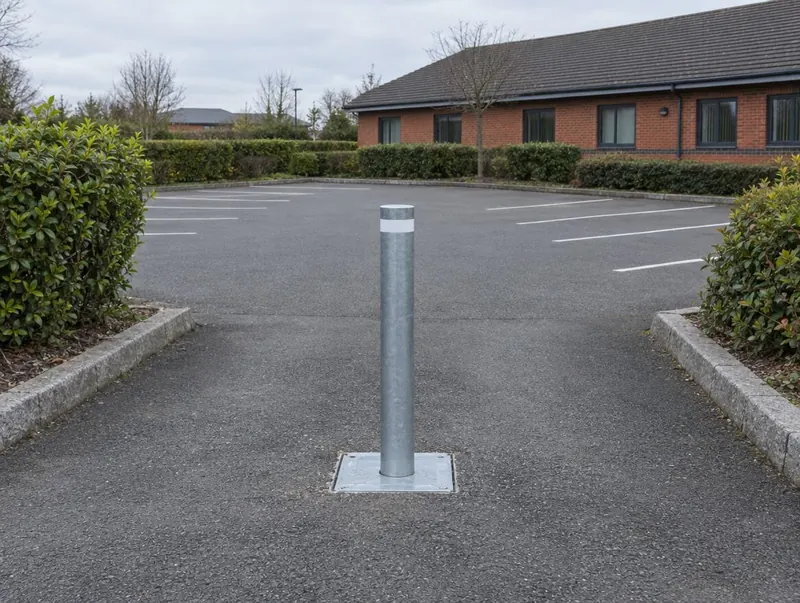 Computer-generated image
Semi-automatic bollards in Dunbar
Gas-strut assisted bollards that rise on their own when unlocked and lower by hand, with no mains power needed. In Dunbar, that tends to mean sites such as community buildings, high street shopfronts and filling-station forecourts.
We work across EH42 and EH40 — Dunbar itself and places including West Barns, Innerwick, Spott and Whitekirk. Nearby, we also work in Tranent (17.4 miles) and Musselburgh (21.1 miles), measured as the crow flies. It sits roughly 27 miles from Edinburgh as the crow flies.
Local details
- Area
- East Lothian, Scotland
- Roads authority
- East Lothian Council (local roads)
- Planning authority
- East Lothian Council
- Postcodes
- EH42 and EH40
- Guide price
- Typically £1,095–£3,495 per bollard + VAT (£1,295–£4,195 inc VAT for homes); minimum job £1,195
- Survey
- Free, with a fixed written quote
- Nearby
- Tranent (17.4 mi), Musselburgh (21.1 mi)
What Dunbar sites use semi-automatic bollards for
Typical reasons Dunbar sites choose semi-automatic bollards:
- Driveways where the owner wants minimal effort
- Sites where telescopic posts are too heavy for regular users
- Staff car parks and reserved bays used several times a day
Guide prices for Dunbar
| Specification | Guide price | Includes |
|---|---|---|
| Standard | £1,095–£2,095 + VAT · £1,295–£2,495 inc VAT | Standard post, foundation, reinstatement |
| Upgraded | £1,795–£2,845 + VAT · £2,145–£3,395 inc VAT | Upgraded finish or fittings, reflective band, matched keys |
| Premium | £2,545–£3,495 + VAT · £3,045–£4,195 inc VAT | Heavy-duty or architectural spec, premium finish |
Per bollard, supplied and installed; no regional adjustment. Guide only — the fixed price follows a survey.
Consents, ground and services in Dunbar
Dunbar falls under East Lothian Council as roads authority. If the line of posts crosses onto adopted road or pavement, permission comes before excavation; on private land it does not.
If your site in Dunbar is listed or inside a conservation area, check with the local planning authority (East Lothian Council) before choosing a finish — heritage settings often favour cast iron or painted steel over stainless.
On sandy or gravel ground a soakaway beneath the cassette often drains it adequately; on clay, chalk with poor drainage or where groundwater rises, a pipe to a surface water drain or a dedicated soakaway is needed. Reinstatement around the collar has to be firm, because the post is pushed down by foot and any movement in the surround soon shows as cracking.
- Check land ownership; bollards on public highway need the roads authority's agreement.
- Agree how emergency services will gain access if the post is locked up.
How the job runs
Set the cassette
The cassette is set plumb and flush with the finished surface, connected to drainage and concreted in. The strut is fitted or released only as the manufacturer instructs.
Reinstate the surface
Paving or surfacing is made good tight to the cassette collar so there is no lip for tyres or feet to catch.
Test and show users
The post is cycled several times to check it rises fully, locks at both heights and lowers smoothly. Users are shown how to operate it and to keep clear of the head when it rises.
Finishes and options
| Option | Detail |
|---|---|
| Lock types | Keyed cylinder locks, typically operating at ground level, with keyed-alike options for multi-post sites. |
| Gas strut or spring assist | Most models use a gas strut; some use springs. Both store energy to raise the post when unlocked. |
| Head lighting | Some models include battery or solar LEDs in the head to improve visibility on unlit sites. |
Pricing semi-automatic bollards in Dunbar
When we price semi-automatic bollards in Dunbar, these make the biggest difference:
- Drainage method
- Excavation depth and services in the way
- Number of posts and keyed-alike locks
Looking after them
In winter, keep an eye on the lid after frost or snow; ice around the head can stop the post rising, and forcing the key or the post at that point damages the latch. Operate the bollard regularly and keep the head and lid clear of grit.
For damaged or loose posts in Dunbar, repairs and replacements are priced in writing first.
Common questions
Which parts of Dunbar do you cover for semi-automatic bollards?
We cover all of Dunbar (EH42 and EH40) and the rest of East Lothian. We also work in Tranent and Musselburgh.
Who gives permission for bollards on the pavement in Dunbar?
Dunbar falls under East Lothian Council as roads authority. If the line of posts crosses onto adopted road or pavement, permission comes before excavation; on private land it does not.
How much do semi-automatic bollards cost in Dunbar?
In Dunbar, typically £1,095–£3,495 per bollard, supplied and installed, plus VAT (£1,295–£4,195 including VAT for homeowners), with a minimum job of £1,195 plus VAT, using our Scotland guide prices. The fixed figure comes in writing after we've seen the site.
What makes a semi-automatic bollard rise without power?
A gas strut or spring inside the cassette. Pushing the post down compresses it and a latch holds the post below ground. Turning the key releases the latch and the stored energy lifts the post.
Can a semi-automatic bollard injure someone as it rises?
It rises with some force, so nobody should stand over it or put a hand on the head when releasing it. Users should be shown how to operate it safely. On busy sites, a sign and reflective bands help.