West Yorkshire · England
Semi-automatic bollard installation in Wakefield
Semi-automatic bollards for sites across Wakefield and the rest of West Yorkshire, from the first measurement to the last relaid paving block.
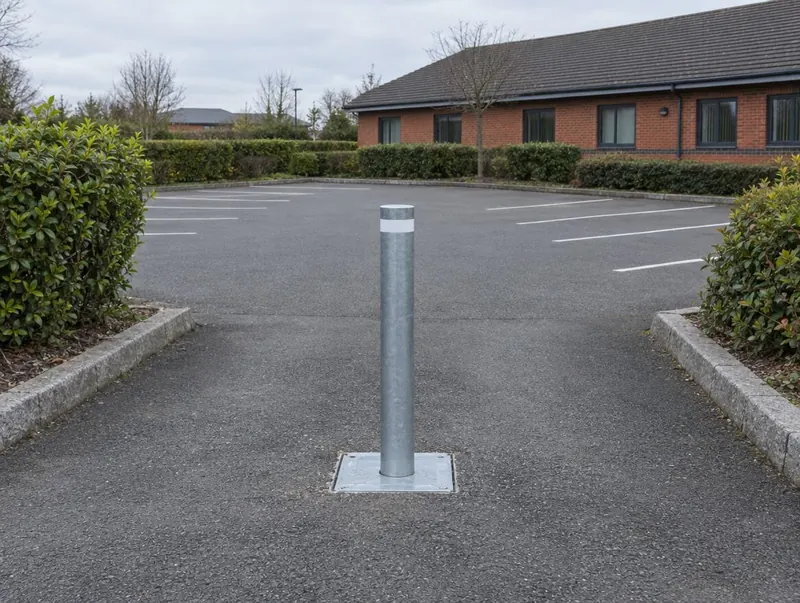 Computer-generated image
Semi-automatic bollards in Wakefield
We supply and fit semi-automatic bollards throughout Wakefield, typically for sites such as leisure centres, retail parks and industrial estates. Gas-strut assisted bollards that rise on their own when unlocked and lower by hand, with no mains power needed.
We cover Wakefield's WF1, WF2, WF3 and WF4 postcode districts, including places such as Kirkthorpe, Warmfield, Horse Race End and Kirkhamgate. We also cover neighbouring Ossett (3.4 miles), Dewsbury (5.4 miles), Batley (5.7 miles) and Morley (5.7 miles) — distances are straight-line. Wakefield is about 8 miles from Leeds.
Local details
- Area
- West Yorkshire, England
- Highway authority
- Wakefield Council (local roads)
- Planning authority
- Wakefield Council
- Postcodes
- WF1, WF2, WF3 and WF4
- Guide price
- Typically £1,045–£3,395 per bollard + VAT (£1,245–£4,045 inc VAT for homes); minimum job £1,145
- Survey
- Free, with a fixed written quote
What Wakefield sites use semi-automatic bollards for
Around Wakefield, semi-automatic bollards usually solve one of these:
- Driveways where the owner wants minimal effort
- Temporary closure points on campuses and estates
- Staff car parks and reserved bays used several times a day
Wakefield: typical semi-automatic bollard prices
| Specification | Guide price | Includes |
|---|---|---|
| Standard | £1,045–£2,045 + VAT · £1,245–£2,445 inc VAT | Standard post, foundation, reinstatement |
| Upgraded | £1,745–£2,745 + VAT · £2,095–£3,295 inc VAT | Upgraded finish or fittings, reflective band, matched keys |
| Premium | £2,445–£3,395 + VAT · £2,945–£4,045 inc VAT | Heavy-duty or architectural spec, premium finish |
Per bollard, supplied and installed; -3% for Yorkshire and the Humber. Guide only — the fixed price follows a survey.
Consents, ground and services in Wakefield
In Wakefield, work on adopted pavements and verges needs consent from Wakefield Council, the local highway authority. Car parks, forecourts and other private land only need the owner's permission.
Bollards on private land often don't need planning permission, but it depends on the council's view, the height and the location; in a conservation area, next to a listed building or under an Article 4 direction, ask the local planning authority (Wakefield Council) first — we flag this at survey.
Buried services across the entrance are traced and the position adjusted if needed, as the cassette cannot simply be made shallower. Reinstatement around the collar has to be firm, because the post is pushed down by foot and any movement in the surround soon shows as cracking.
- Keep clear gaps of typically at least 1,000–1,200 mm where pedestrians pass between posts, referring to Inclusive Mobility guidance.
- Warn users and passers-by that the post rises on its own; fit reflective bands and consider a sign at busy sites.
How the job runs
Set the cassette
The cassette is set plumb and flush with the finished surface, connected to drainage and concreted in. The strut is fitted or released only as the manufacturer instructs.
Reinstate the surface
Paving or surfacing is made good tight to the cassette collar so there is no lip for tyres or feet to catch.
Test and show users
The post is cycled several times to check it rises fully, locks at both heights and lowers smoothly. Users are shown how to operate it and to keep clear of the head when it rises.
Options to consider
| Option | Detail |
|---|---|
| Lock types | Keyed cylinder locks, typically operating at ground level, with keyed-alike options for multi-post sites. |
| Head lighting | Some models include battery or solar LEDs in the head to improve visibility on unlit sites. |
| Finishes | Galvanised and powder-coated or stainless steel, with reflective bands for visibility. |
What moves the price in Wakefield
Two Wakefield jobs with the same number of posts can price quite differently. The usual reasons:
- Finish and any head lighting
- Drainage method
- Domestic or commercial duty model
Looking after them
Look into the cassette periodically for water or debris, and lubricate the lock and latch as the manufacturer suggests. If several posts on one site were installed at the same time, their struts tend to wear at a similar rate, so it can make sense to replace them together.
For damaged or loose posts in Wakefield, repairs and replacements are priced in writing first.
Questions about semi-automatic bollards in Wakefield
Do you install semi-automatic bollards in Wakefield?
We cover all of Wakefield (WF1, WF2, WF3 and WF4) and the rest of West Yorkshire. We also work in Ossett, Dewsbury and Batley.
Do I need consent for semi-automatic bollards on a public footway in Wakefield?
In Wakefield, work on adopted pavements and verges needs consent from Wakefield Council, the local highway authority. Car parks, forecourts and other private land only need the owner's permission.
What's a typical price for semi-automatic bollards in Wakefield?
In Wakefield, typically £1,045–£3,395 per bollard, supplied and installed, plus VAT (£1,245–£4,045 including VAT for homeowners), with a minimum job of £1,145 plus VAT, using our Yorkshire and the Humber guide prices. The fixed figure comes in writing after we've seen the site.
How is a semi-automatic bollard different from an automatic one?
An automatic bollard is powered and controlled by a panel, loops and access devices. A semi-automatic one rises on its own when unlocked but must be pushed down by hand. It needs no electrics, which keeps installation simpler.
Is it hard to push the bollard back down?
Not usually; most users press it down with a hand or foot. The strut resists, so it needs a steady push rather than a sharp kick. Heavier commercial models take more effort than domestic ones.