Devon · England
Shallow-mount security bollard installation in Plymstock
Planning shallow-mount bollards in Plymstock? We check ownership, consents and buried services first, then quote a fixed price.
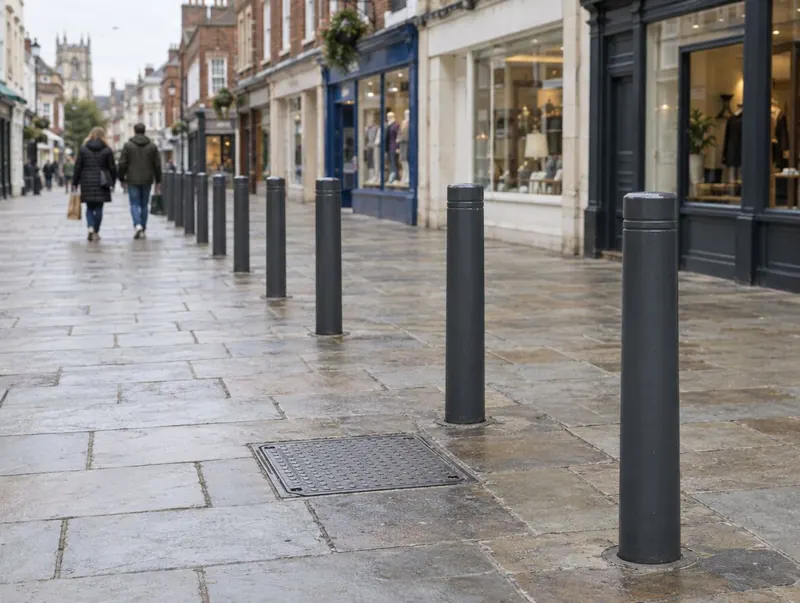 Computer-generated image
Plymstock shallow-mount bollards
We supply and fit shallow-mount bollards throughout Plymstock, typically for sites such as high street shopfronts, small industrial units and schools. Like any rated product, its performance applies only to the configuration and foundation that were tested.
We work across PL9 — Plymstock itself and places including Staddiscombe. Jobs in Plymstock can be combined with work in Plymouth (2.4 miles) (straight-line distances).
Local details
- Area
- Devon, England
- Highway authority
- Plymouth City Council (local roads)
- Planning authority
- Plymouth City Council
- Postcodes
- PL9
- Guide price
- Typically £1,995–£8,995 per bollard + VAT; minimum job £4,995
- Survey
- Free, with a fixed written quote
- Nearby
- Plymouth (2.4 mi)
What shallow-mount bollards cost in Plymstock
| Specification | Guide price | Includes |
|---|---|---|
| Standard | £1,995–£4,945 + VAT | Rated for a 7.5 t vehicle at 30 mph (48 km/h), tested foundation |
| Upgraded | £4,095–£7,045 + VAT | Rated for 7.5 t at 40 mph (64 km/h), tested foundation |
| Premium | £6,195–£8,995 + VAT | Rated for 7.5 t at 50 mph (80 km/h), or a specialist foundation |
Per bollard position, supplied and installed; no regional adjustment. Guide only — the fixed price follows a survey.
Where shallow-mount bollards go in around Plymstock
Common uses in a place like Plymstock:
- Listed or historic streets where deep digging is unwelcome
- Footways with dense utility runs just below the surface
- Lines that must cross over shallow drainage or ducts
Consents, ground and services in Plymstock
Plymouth City Council is the highway authority covering Plymstock's local roads. If any post would stand on adopted highway rather than your land, that consent is the first thing we sort out.
If your site in Plymstock is listed or inside a conservation area, check with the local planning authority (Plymouth City Council) before choosing a finish — heritage settings often favour cast iron or painted steel over stainless.
On decks and roofs, the waterproofing and drainage layers must be protected or rebuilt, and fixings must not puncture membranes unless the structural and waterproofing designers have agreed a detail. Utility owners may set minimum separation distances or ask to be present when digging near their apparatus.
- Keep the test certificate for the exact system and configuration, including the minimum run length and end details.
- Agree works and separation distances with utility owners, and with the highway authority where the line is on public highway.
What happens on site
Confirm the system with the manufacturer
The survey findings go back to the manufacturer and the client's adviser to confirm the system, its layout and any end details. A fixed written quote follows the free site survey.
Assemble and level the frame
Frame sections are placed, joined and set to line and level, with posts fixed as the drawing shows. Joints and fixings are photographed before any concrete goes in.
Pour, cure and reinstate
Concrete is placed to the specified grade and finish depth, then the surface is rebuilt to match. The line is protected until the specified curing period has passed.
Options to consider
| Option | Detail |
|---|---|
| Surface-mounted rated units | Some tested products sit on or very close to the surface with minimal digging. These are often used for temporary or semi-permanent protection and need careful checking of the surface they bear on. |
| Covers and sleeves | Stainless, cast or powder-coated covers fitted over the cores to match surrounding street furniture, supplied or approved by the manufacturer. |
| Modular cassette sections | Pre-made sections joined on site, allowing short runs and changes of direction within the manufacturer's tested limits. |
What moves the price in Plymstock
Two Plymstock jobs with the same number of posts can price quite differently. The usual reasons:
- Structural engineering checks on slabs or decks
- Restricted working hours in busy streets or occupied sites
- Changes of direction, end details and removable positions
After installation
Pay attention to the surface around the posts, because settlement or loose paving can indicate movement in the bearing layer. Once cured, a shallow-mount line needs much the same care as any static rated barrier: periodic visual checks, cleaning of covers and renewal of visibility bands.
We can also service, repair or replace existing posts anywhere in Plymstock.
Common questions
Which parts of Plymstock do you cover for shallow-mount bollards?
We cover all of Plymstock (PL9) and the rest of Devon. We also work in Plymouth.
Who gives permission for bollards on the pavement in Plymstock?
The highway authority for local roads in Plymstock is Plymouth City Council; motorways and trunk roads sit with National Highways. Shallow-mount bollards on the adopted footway are a matter for the highway authority, so we only install there with its written agreement.
How much do shallow-mount bollards cost in Plymstock?
In Plymstock, typically £1,995–£8,995 per bollard position, supplied and installed, plus VAT, with a minimum job of £4,995 plus VAT, using our South West guide prices. The fixed figure comes in writing after we've seen the site.
How much shallower is a shallow-mount bollard foundation?
Often a fraction of the depth of a conventional rated foundation, commonly a few hundred millimetres. The exact depth depends on the system and rating chosen. What you gain in depth is usually traded for width, because the load is spread along a linked frame.
Will future roadworks damage the system?
They can if contractors dig beside it without knowing it is there. That is why we provide as-built drawings showing the frame position. Ask anyone excavating nearby to check those drawings first.