Isle of Anglesey · Wales
Shallow-mount security bollard installation in Holyhead
Shallow-mount bollards for sites across Holyhead and the rest of Isle of Anglesey, from the first measurement to the last relaid paving block.
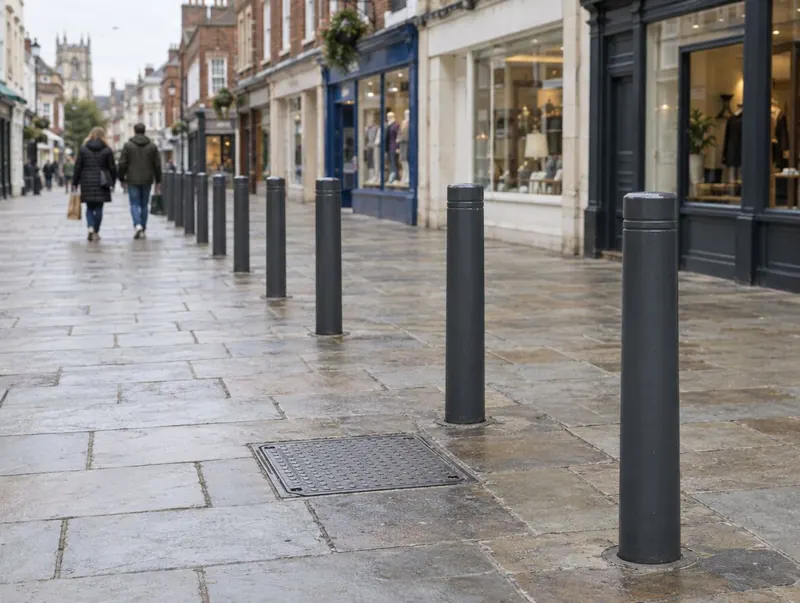 Computer-generated image
Shallow-mount bollards in Holyhead
Shallow-mount bollards suit plenty of Holyhead sites, schools, community car parks and town-centre squares among them. Rated shallow-foundation bollard systems installed where buried services, basements or slabs rule out deep excavation.
Coverage in Holyhead takes in the LL65 postcode district and nearby places like Trearddur, Bodedern, Bryngwran and Llanfihangel yn Nhowyn. Holyhead is fairly self-contained, with no other large town within about 20 miles.
Key facts for this area
- Area
- Isle of Anglesey, Wales
- Highway authority
- Isle of Anglesey County Council (local roads)
- Planning authority
- Isle of Anglesey County Council
- Postcodes
- LL65
- Guide price
- Typically £1,945–£8,745 per bollard + VAT; minimum job £4,845
- Survey
- Free, with a fixed written quote
Holyhead: typical shallow-mount bollard prices
| Specification | Guide price | Includes |
|---|---|---|
| Standard | £1,945–£4,795 + VAT | Rated for a 7.5 t vehicle at 30 mph (48 km/h), tested foundation |
| Upgraded | £3,995–£6,845 + VAT | Rated for 7.5 t at 40 mph (64 km/h), tested foundation |
| Premium | £5,995–£8,745 + VAT | Rated for 7.5 t at 50 mph (80 km/h), or a specialist foundation |
Per bollard position, supplied and installed; -3% for Wales. Guide only — the fixed price follows a survey.
Where shallow-mount bollards go in around Holyhead
Typical reasons Holyhead sites choose shallow-mount bollards:
- Bridges and structures where excavation depth is limited
- Footways with dense utility runs just below the surface
- Listed or historic streets where deep digging is unwelcome
Before we dig in Holyhead
Before digging near the kerb in Holyhead we establish who owns the ground: adopted footways are Isle of Anglesey County Council's responsibility, trunk roads the Welsh Government's, and everything else belongs to the site owner.
Many private-land installations in Holyhead need no planning application, but the rules don't clearly cover bollards, so listed buildings, conservation areas and prominent frontages are worth raising with the planning team at Isle of Anglesey County Council before posts go in.
The trench has to sit over services with enough cover to protect them, but the frame also needs a firm, consistent bearing; soft spots, old backfill around pipe trenches and voids under paving can all need treating first. Shallow does not mean simple.
- Keep the test certificate for the exact system and configuration, including the minimum run length and end details.
- Check gaps work for wheelchair users and buggies while still stopping vehicles, referring to Inclusive Mobility guidance.
What happens on site
Cut and excavate the trench
Paving is lifted and kept for reuse where possible, and a shallow trench is excavated by hand near known services. Where a service sits higher than expected, work stops and the detail is referred back.
Assemble and level the frame
Frame sections are placed, joined and set to line and level, with posts fixed as the drawing shows. Joints and fixings are photographed before any concrete goes in.
Record and hand over
As-built drawings show the frame position relative to services, which matters for anyone digging nearby later. Product certificates and photographs go to the client's adviser.
Choosing the right spec
| Option | Detail |
|---|---|
| Surface-mounted rated units | Some tested products sit on or very close to the surface with minimal digging. These are often used for temporary or semi-permanent protection and need careful checking of the surface they bear on. |
| Covers and sleeves | Stainless, cast or powder-coated covers fitted over the cores to match surrounding street furniture, supplied or approved by the manufacturer. |
| Rated planters and street furniture | Benches, planters and cycle stands built around a tested shallow core, used where a line of posts would look out of place. |
What moves the price in Holyhead
Two Holyhead jobs with the same number of posts can price quite differently. The usual reasons:
- Lifting, storing and relaying natural stone paving
- Structural engineering checks on slabs or decks
- Length of run and the system needed to achieve the rating
Keeping them working
Pay attention to the surface around the posts, because settlement or loose paving can indicate movement in the bearing layer. Any later utility work beside the line should be supervised so the frame is not undermined.
We can also service, repair or replace existing posts anywhere in Holyhead.
Shallow-mount bollards in Holyhead: FAQs
Which parts of Holyhead do you cover for shallow-mount bollards?
We cover all of Holyhead (LL65) and the rest of Isle of Anglesey.
Who gives permission for bollards on the pavement in Holyhead?
Local roads and pavements in Holyhead are the responsibility of Isle of Anglesey County Council as highway authority, with the Welsh Government's trunk road agents handling trunk roads. Posts on the public highway need that authority's consent; private land does not.
How much do shallow-mount bollards cost in Holyhead?
In Holyhead, typically £1,945–£8,745 per bollard position, supplied and installed, plus VAT, with a minimum job of £4,845 plus VAT, using our Wales guide prices. The fixed figure comes in writing after we've seen the site.
Does a shallow system protect as well as a deep one?
It can achieve the same rating, because both are tested to the same standards. What differs is how the load is resisted. Your security adviser should compare the specific ratings, not the foundation depths.
What if a service turns out to be higher than the records show?
Work stops at that position and the finding goes back to the manufacturer and your adviser. Sometimes the frame can be adjusted within tested limits; sometimes the utility has to be lowered or the line moved. We do not improvise a change to a rated foundation on site.