London · England
Shallow-mount security bollard installation in Harrow
Shallow-mount bollards supplied and fitted in Harrow, London: surveyed, scanned for services, set in proper foundations and finished to match the ground.
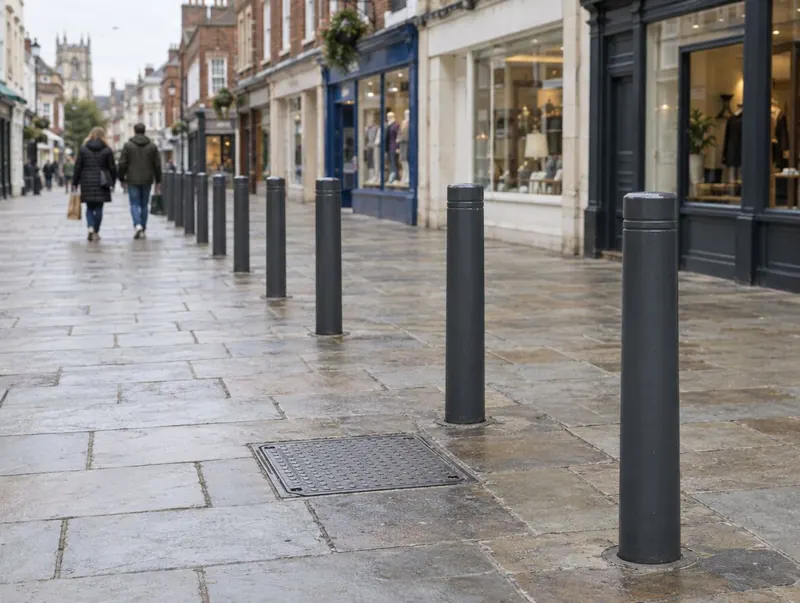 Computer-generated image
Shallow-mount bollards in Harrow
Across Harrow, typical sites for shallow-mount bollards include estate car parks, hospital approaches and places of worship. Like any rated product, its performance applies only to the configuration and foundation that were tested.
We work across HA1, HA2, HA3, HA7 and HA5 — Harrow itself and places including Stanmore. Jobs in Harrow can be combined with work in Brent (3.4 miles), Bushey (3.4 miles), Borehamwood (4.8 miles) and Watford (4.8 miles) (straight-line distances).
Key facts for this area
- Area
- London, England
- Highway authority
- Harrow Council (local roads)
- Planning authority
- Harrow Council
- Postcodes
- HA1, HA2, HA3, HA7 and HA5
- Guide price
- Typically £2,295–£10,395 per bollard + VAT; minimum job £5,745
- Survey
- Free, with a fixed written quote
- Nearby
- Brent (3.4 mi), Bushey (3.4 mi), Borehamwood (4.8 mi), Watford (4.8 mi)
Guide prices for Harrow
| Specification | Guide price | Includes |
|---|---|---|
| Standard | £2,295–£5,695 + VAT | Rated for a 7.5 t vehicle at 30 mph (48 km/h), tested foundation |
| Upgraded | £4,695–£8,095 + VAT | Rated for 7.5 t at 40 mph (64 km/h), tested foundation |
| Premium | £7,145–£10,395 + VAT | Rated for 7.5 t at 50 mph (80 km/h), or a specialist foundation |
Per bollard position, supplied and installed; +15% for London. Guide only — the fixed price follows a survey.
What Harrow sites use shallow-mount bollards for
Common uses in a place like Harrow:
- Podium decks, car park roofs and basement slabs
- Bridges and structures where excavation depth is limited
- Sites where service diversions would be slow or impractical
Permissions and groundwork in Harrow
Harrow Council is the highway authority covering Harrow's local roads. Red routes are managed by Transport for London. If any post would stand on adopted highway rather than your land, that consent is the first thing we sort out.
Many private-land installations in Harrow need no planning application, but the rules don't clearly cover bollards, so listed buildings, conservation areas and prominent frontages are worth raising with the planning team at Harrow Council before posts go in.
The trench has to sit over services with enough cover to protect them, but the frame also needs a firm, consistent bearing; soft spots, old backfill around pipe trenches and voids under paving can all need treating first. On decks and roofs, the waterproofing and drainage layers must be protected or rebuilt, and fixings must not puncture membranes unless the structural and waterproofing designers have agreed a detail.
- Get written confirmation from a structural engineer before installing on slabs, decks, basements or over voids.
- Keep the test certificate for the exact system and configuration, including the minimum run length and end details.
How the job runs
Map what is underground
Utility records, radar scanning and trial holes establish exactly how much depth is available along the line. This is the survey that decides whether a shallow system will fit at all.
Confirm the system with the manufacturer
The survey findings go back to the manufacturer and the client's adviser to confirm the system, its layout and any end details. A fixed written quote follows the free site survey.
Pour, cure and reinstate
Concrete is placed to the specified grade and finish depth, then the surface is rebuilt to match. The line is protected until the specified curing period has passed.
Finishes and options
| Option | Detail |
|---|---|
| Surface-mounted rated units | Some tested products sit on or very close to the surface with minimal digging. These are often used for temporary or semi-permanent protection and need careful checking of the surface they bear on. |
| Covers and sleeves | Stainless, cast or powder-coated covers fitted over the cores to match surrounding street furniture, supplied or approved by the manufacturer. |
| Linked-frame systems | Posts are welded or bolted to a continuous steel frame laid in a shallow trench and encased in concrete. Suited to straight or gently curved lines. |
What affects the quote
When we price shallow-mount bollards in Harrow, these make the biggest difference:
- Restricted working hours in busy streets or occupied sites
- Amount of hand digging needed around live services
- Changes of direction, end details and removable positions
After installation
If one post is struck, the frame may have transmitted load to its neighbours, so the whole run near the impact should be checked with the manufacturer rather than replacing a single post in isolation. Once cured, a shallow-mount line needs much the same care as any static rated barrier: periodic visual checks, cleaning of covers and renewal of visibility bands.
If posts in Harrow are later hit or damaged, we can repair or replace them — see bollard repairs.
Questions about shallow-mount bollards in Harrow
Which parts of Harrow do you cover for shallow-mount bollards?
We cover all of Harrow (HA1, HA2, HA3, HA7 and HA5) and the rest of London. We also work in Brent, Bushey and Borehamwood.
Do I need consent for shallow-mount bollards on a public footway in Harrow?
The highway authority for local roads in Harrow is Harrow Council; motorways and trunk roads sit with National Highways. Red routes are managed by Transport for London. Shallow-mount bollards on the adopted footway are a matter for the highway authority, so we only install there with its written agreement.
How much do shallow-mount bollards cost in Harrow?
In Harrow, typically £2,295–£10,395 per bollard position, supplied and installed, plus VAT, with a minimum job of £5,745 plus VAT, using our London guide prices. The fixed figure comes in writing after we've seen the site.
Can I install a single shallow-mount bollard on its own?
Usually not. Most shallow systems rely on several posts working together, and the rating applies to a tested run with a stated minimum number of posts. A single position generally needs a different solution.
Will future roadworks damage the system?
They can if contractors dig beside it without knowing it is there. That is why we provide as-built drawings showing the frame position. Ask anyone excavating nearby to check those drawings first.