Somerset · England
Shallow-mount security bollard installation in Yeovil
Planning shallow-mount bollards in Yeovil? We check ownership, consents and buried services first, then quote a fixed price.
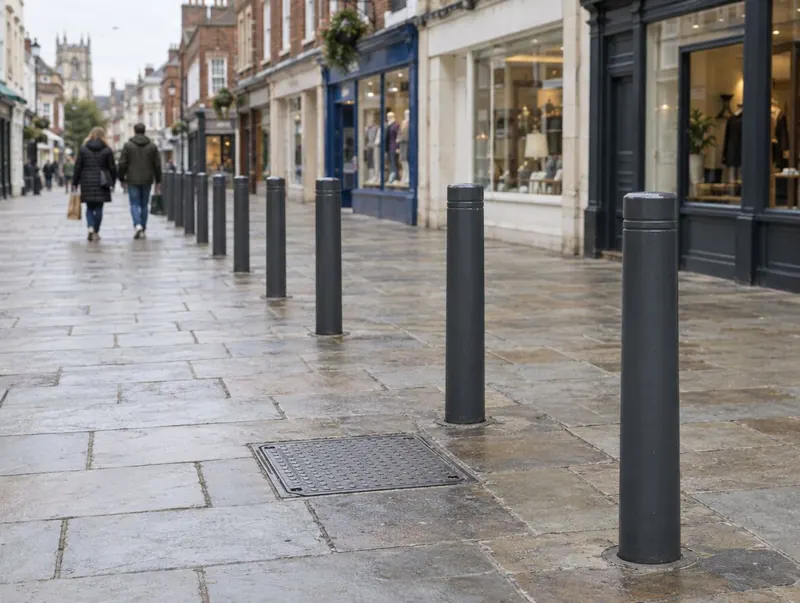 Computer-generated image
Yeovil shallow-mount bollards
Shallow-mount bollards suit plenty of Yeovil sites, small industrial units, filling-station forecourts and community car parks among them. Like any rated product, its performance applies only to the configuration and foundation that were tested.
We work across BA20, BA21, BA22, TA15 and TA14 — Yeovil itself and places including Mudford Sock, Mudford, Coppits Hill and Lower Vagg. We also cover neighbouring Bridgwater (20.7 miles) and Taunton (21.1 miles) — distances are straight-line. It sits roughly 36 miles from Bristol as the crow flies.
Local details
- Area
- Somerset, England
- Highway authority
- Somerset Council (local roads)
- Planning authority
- Somerset Council
- Postcodes
- BA20, BA21, BA22, TA15 and TA14
- Guide price
- Typically £1,995–£8,995 per bollard + VAT; minimum job £4,995
- Survey
- Free, with a fixed written quote
- Nearby
- Bridgwater (20.7 mi), Taunton (21.1 mi)
Shallow-mount bollard prices in Yeovil
| Specification | Guide price | Includes |
|---|---|---|
| Standard | £1,995–£4,945 + VAT | Rated for a 7.5 t vehicle at 30 mph (48 km/h), tested foundation |
| Upgraded | £4,095–£7,045 + VAT | Rated for 7.5 t at 40 mph (64 km/h), tested foundation |
| Premium | £6,195–£8,995 + VAT | Rated for 7.5 t at 50 mph (80 km/h), or a specialist foundation |
Per bollard position, supplied and installed; no regional adjustment. Guide only — the fixed price follows a survey.
Shallow-mount bollards in Yeovil: common uses
Around Yeovil, shallow-mount bollards usually solve one of these:
- Listed or historic streets where deep digging is unwelcome
- Lines that must cross over shallow drainage or ducts
- Sites where service diversions would be slow or impractical
Consents, ground and services in Yeovil
Somerset Council is the highway authority covering Yeovil's local roads. If any post would stand on adopted highway rather than your land, that consent is the first thing we sort out.
If your site in Yeovil is listed or inside a conservation area, check with the local planning authority (Somerset Council) before choosing a finish — heritage settings often favour cast iron or painted steel over stainless.
Paving is often natural stone in the streets where these systems are used, so careful lifting, storage and relaying is part of the job. The trench has to sit over services with enough cover to protect them, but the frame also needs a firm, consistent bearing; soft spots, old backfill around pipe trenches and voids under paving can all need treating first.
- Record the frame's position on as-built drawings so future excavation near the line can be planned safely.
- Keep the test certificate for the exact system and configuration, including the minimum run length and end details.
Installation, step by step
Map what is underground
Utility records, radar scanning and trial holes establish exactly how much depth is available along the line. This is the survey that decides whether a shallow system will fit at all.
Cut and excavate the trench
Paving is lifted and kept for reuse where possible, and a shallow trench is excavated by hand near known services. Where a service sits higher than expected, work stops and the detail is referred back.
Pour, cure and reinstate
Concrete is placed to the specified grade and finish depth, then the surface is rebuilt to match. The line is protected until the specified curing period has passed.
Finishes and options
| Option | Detail |
|---|---|
| Removable posts within a run | Some systems include removable or retractable positions for maintenance or emergency access. Check how these affect the rating. |
| Covers and sleeves | Stainless, cast or powder-coated covers fitted over the cores to match surrounding street furniture, supplied or approved by the manufacturer. |
| Rated planters and street furniture | Benches, planters and cycle stands built around a tested shallow core, used where a line of posts would look out of place. |
What affects the quote
When we price shallow-mount bollards in Yeovil, these make the biggest difference:
- Restricted working hours in busy streets or occupied sites
- Length of run and the system needed to achieve the rating
- Structural engineering checks on slabs or decks
Looking after them
Any later utility work beside the line should be supervised so the frame is not undermined. Pay attention to the surface around the posts, because settlement or loose paving can indicate movement in the bearing layer.
If posts in Yeovil are later hit or damaged, we can repair or replace them — see bollard repairs.
Shallow-mount bollards in Yeovil: FAQs
Which parts of Yeovil do you cover for shallow-mount bollards?
We cover all of Yeovil (BA20, BA21, BA22, TA15 and TA14) and the rest of Somerset. We also work in Bridgwater and Taunton.
Who gives permission for bollards on the pavement in Yeovil?
Somerset Council is the highway authority covering Yeovil's local roads. If any post would stand on adopted highway rather than your land, that consent is the first thing we sort out.
How much do shallow-mount bollards cost in Yeovil?
In Yeovil, typically £1,995–£8,995 per bollard position, supplied and installed, plus VAT, with a minimum job of £4,995 plus VAT, using our South West guide prices. The fixed figure comes in writing after we've seen the site.
How much shallower is a shallow-mount bollard foundation?
Often a fraction of the depth of a conventional rated foundation, commonly a few hundred millimetres. The exact depth depends on the system and rating chosen. What you gain in depth is usually traded for width, because the load is spread along a linked frame.
What if a service turns out to be higher than the records show?
Work stops at that position and the finding goes back to the manufacturer and your adviser. Sometimes the frame can be adjusted within tested limits; sometimes the utility has to be lowered or the line moved. We do not improvise a change to a rated foundation on site.