London · England
Stainless steel bollards and covers in Harrow
Stainless steel bollards for sites across Harrow and the rest of London, from the first measurement to the last relaid paving block.
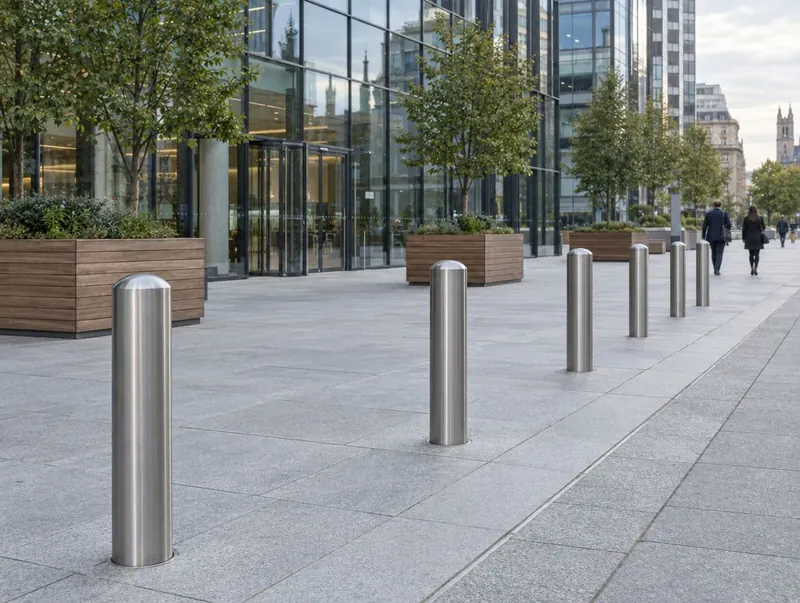 Computer-generated image
About stainless steel bollards in Harrow
In the borough of Harrow, stainless steel bollards tend to go in at estate car parks, station forecourts and hospital approaches. Grade 304 suits most inland sites, while 316 is preferred near the coast, pools or heavy de-icing salt.
We cover Harrow's HA1, HA2, HA3, HA7 and HA5 postcode districts, including places such as Stanmore. Jobs in Harrow can be combined with work in Brent (3.4 miles), Bushey (3.4 miles), Borehamwood (4.8 miles) and Watford (4.8 miles) (straight-line distances).
Harrow at a glance
- Area
- London, England
- Highway authority
- Harrow Council (local roads)
- Planning authority
- Harrow Council
- Postcodes
- HA1, HA2, HA3, HA7 and HA5
- Guide price
- Typically £345–£1,395 per bollard + VAT (£405–£1,645 inc VAT for homes); minimum job £795
- Survey
- Free, with a fixed written quote
- Nearby
- Brent (3.4 mi), Bushey (3.4 mi), Borehamwood (4.8 mi), Watford (4.8 mi)
Harrow: typical stainless steel bollard prices
| Specification | Guide price | Includes |
|---|---|---|
| Standard | £345–£775 + VAT · £405–£925 inc VAT | Standard post, foundation, reinstatement |
| Upgraded | £655–£1,095 + VAT · £785–£1,295 inc VAT | Upgraded finish or fittings, reflective band, matched keys |
| Premium | £965–£1,395 + VAT · £1,145–£1,645 inc VAT | Heavy-duty or architectural spec, premium finish |
Per bollard, supplied and installed; +15% for London. Guide only — the fixed price follows a survey.
Where stainless steel bollards go in around Harrow
Typical reasons Harrow sites choose stainless steel bollards:
- Coastal and poolside sites where paint finishes fail
- Sleeving existing painted steel posts that have become tatty
- Civic squares and pedestrianised plazas
Consents, ground and services in Harrow
Harrow Council is the highway authority covering Harrow's local roads. Red routes are managed by Transport for London. If any post would stand on adopted highway rather than your land, that consent is the first thing we sort out.
Bollards on private land often don't need planning permission, but it depends on the council's view, the height and the location; in a conservation area, next to a listed building or under an Article 4 direction, ask the local planning authority (Harrow Council) first — we flag this at survey.
For solid stainless posts the foundation work is the same as for steel: dig to depth, check for services, set in concrete and reinstate. Paving around new posts is cut before the posts arrive, or the posts are protected while it happens.
- Add a contrasting band near the top, because bare stainless can blend into pale paving for partially sighted people.
- Keep clear gaps of typically at least 1,000–1,200 mm on pedestrian routes, in line with Inclusive Mobility guidance.
Installation, step by step
Prepare the cores
For covers, existing posts are checked for straightness, loose foundations and corrosion. Cores that lean or move are re-bedded first, because a cover will not hide a failing post for long.
Install new posts
New solid stainless posts are set in concrete, bolted down or fitted into sockets, with care taken not to scratch the finish or contaminate it with carbon steel tools.
Fit covers
Sleeves are slid over the cores, packed so they cannot rattle, and fixed with concealed fixings. A gap or drainage detail at the base stops water being trapped inside.
Options to consider
| Option | Detail |
|---|---|
| Brushed or polished finish | Satin brushed finishes hide fingerprints and light scratches; mirror polish is striking but shows every mark. |
| Covers for rated bollards | Manufacturer-supplied or approved covers for crash-tested cores so the security rating is not compromised. |
| Heads and details | Domed, flat, angled or ball tops, grooved bands, engraved logos and inset reflective strips. |
What affects the quote
Our London guide prices are a starting point; the survey in Harrow firms them up. What tends to move them:
- Grade 304 or 316 and the surface finish
- Manufacturer-approved covers for rated bollards
- Diameter and height, and any custom heads or engraving
Keeping them working
Avoid wire wool and steel brushes, which leave particles that rust. Light tea staining can be removed with a stainless cleaner and a non-scratch pad, working with the grain of a brushed finish.
For damaged or loose posts in Harrow, repairs and replacements are priced in writing first.
Common questions
Do you install stainless steel bollards in Harrow?
We cover all of Harrow (HA1, HA2, HA3, HA7 and HA5) and the rest of London. We also work in Brent, Bushey and Borehamwood.
Who gives permission for bollards on the pavement in Harrow?
The highway authority for local roads in Harrow is Harrow Council; motorways and trunk roads sit with National Highways. Red routes are managed by Transport for London. Stainless steel bollards on the adopted footway are a matter for the highway authority, so we only install there with its written agreement.
How much do stainless steel bollards cost in Harrow?
In Harrow, typically £345–£1,395 per bollard, supplied and installed, plus VAT (£405–£1,645 including VAT for homeowners), with a minimum job of £795 plus VAT, using our London guide prices. The fixed figure comes in writing after we've seen the site.
Can stainless covers go over our existing steel bollards?
Yes, if the existing posts are straight, firmly fixed and a size the covers can be made to fit. Leaning or loose posts are re-bedded first. It is often a quicker way to refresh a frontage than replacing every post.
Why has our stainless steel gone brown?
Usually because of tea staining from chlorides, a grade unsuited to the location, a coarse finish that holds dirt, or iron contamination from nearby cutting. Most of it cleans off. If it keeps returning, the grade or finish may be wrong for the site.