Somerset · England
Steel security bollard installation in Yeovil
Steel security bollards for sites across Yeovil and the rest of Somerset, from the first measurement to the last relaid paving block.
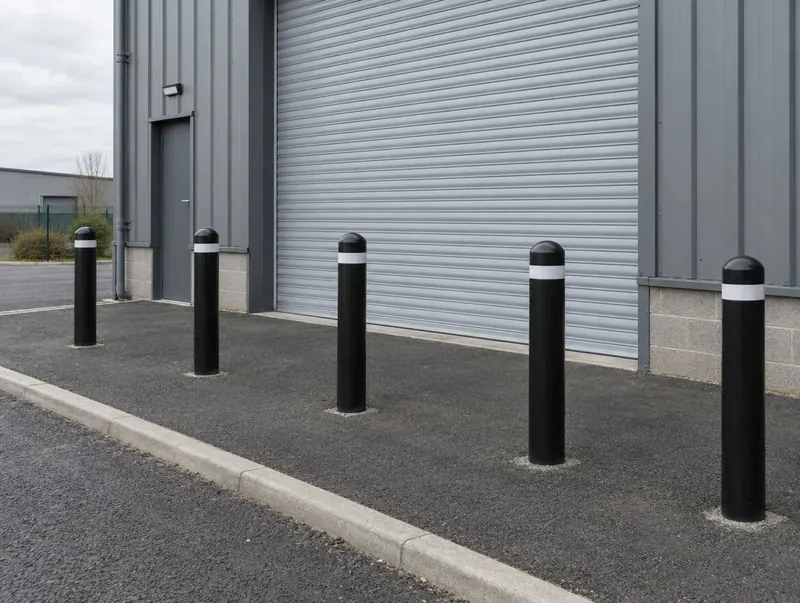 Computer-generated image
Yeovil steel security bollards
Whether it's high street shopfronts, town-centre squares and schools, steel security bollards in Yeovil are planned around who needs to get through and who doesn't. Unrated steel bollards have not been crash-tested, so they deter vehicles and stop low-speed knocks and casual misuse rather than a determined attack.
Coverage in Yeovil takes in the BA20, BA21, BA22, TA15 and TA14 postcode districts and nearby places like Mudford Sock, Mudford, Coppits Hill and Lower Vagg. We also cover neighbouring Bridgwater (20.7 miles) and Taunton (21.1 miles) — distances are straight-line. Yeovil is about 36 miles from Bristol.
Yeovil at a glance
- Area
- Somerset, England
- Highway authority
- Somerset Council (local roads)
- Planning authority
- Somerset Council
- Postcodes
- BA20, BA21, BA22, TA15 and TA14
- Guide price
- Typically £195–£895 per bollard + VAT (£225–£1,045 inc VAT for homes); minimum job £595
- Survey
- Free, with a fixed written quote
- Nearby
- Bridgwater (20.7 mi), Taunton (21.1 mi)
What Yeovil sites use steel security bollards for
Around Yeovil, steel security bollards usually solve one of these:
- Forecourts and building entrances needing a visible boundary
- Stopping cut-through traffic on private roads and estates
- Grass verges and landscaped areas that vans keep driving over
Guide prices for Yeovil
| Specification | Guide price | Includes |
|---|---|---|
| Standard | £195–£485 + VAT · £225–£575 inc VAT | Standard post, foundation, reinstatement |
| Upgraded | £405–£695 + VAT · £485–£825 inc VAT | Upgraded finish or fittings, reflective band, matched keys |
| Premium | £615–£895 + VAT · £735–£1,045 inc VAT | Heavy-duty or architectural spec, premium finish |
Per bollard, supplied and installed; no regional adjustment. Guide only — the fixed price follows a survey.
Consents, ground and services in Yeovil
In Yeovil, work on adopted pavements and verges needs consent from Somerset Council, the local highway authority. Car parks, forecourts and other private land only need the owner's permission.
Many private-land installations in Yeovil need no planning application, but the rules don't clearly cover bollards, so listed buildings, conservation areas and prominent frontages are worth raising with the planning team at Somerset Council before posts go in.
Base plates must sit on a slab thick and sound enough to hold resin anchors; cracked or thin concrete will let the anchors pull out on the first knock. Service runs commonly follow kerb lines and verges, which is exactly where steel posts tend to go, so positions are checked with records and scanning before digging.
- Avoid linking posts with chains across pedestrian routes, which can be a trip hazard for blind and partially sighted people.
- Keep clear gaps of typically at least 1,000–1,200 mm where pedestrians, wheelchair users or buggies pass between posts.
How the job runs
Survey and set out
A free site survey confirms positions, surfaces, buried services and whether root-fixing or base plates suit the ground. You receive a fixed written quote listing post size, finish and fixing.
Set the posts
Posts are set plumb and to a consistent height along the line, and concreted in. Base-plated posts are drilled, anchored with resin and torqued once cured.
Fill and cap
Where specified, posts are filled with concrete and capped so water cannot collect inside the tube.
Choosing the right spec
| Option | Detail |
|---|---|
| Finishes | Hot-dip galvanised, then powder-coated in a RAL colour if wanted. Black, grey, yellow and green are common. |
| Visibility bands | Reflective or contrasting bands near the top for drivers at night and for partially sighted pedestrians. |
| Root-fixed | Cast into a concrete foundation, typically with several hundred millimetres of post below ground. The usual choice where digging is possible. |
What moves the price in Yeovil
Two Yeovil jobs with the same number of posts can price quite differently. The usual reasons:
- Surface reinstatement such as block paving or tarmac
- Tube diameter, wall thickness and concrete infill
- Root-fixed or base-plated installation
Keeping them working
A post that leans after a knock usually means the foundation has moved or cracked; it should be re-bedded or replaced rather than left as a trip or snag hazard. Reflective bands fade and peel and are easy to renew.
For damaged or loose posts in Yeovil, repairs and replacements are priced in writing first.
Questions about steel security bollards in Yeovil
Can you install steel security bollards anywhere in Yeovil?
We cover all of Yeovil (BA20, BA21, BA22, TA15 and TA14) and the rest of Somerset. We also work in Bridgwater and Taunton.
Do I need consent for steel security bollards on a public footway in Yeovil?
The highway authority for local roads in Yeovil is Somerset Council; motorways and trunk roads sit with National Highways. Steel security bollards on the adopted footway are a matter for the highway authority, so we only install there with its written agreement.
What's a typical price for steel security bollards in Yeovil?
In Yeovil, typically £195–£895 per bollard, supplied and installed, plus VAT (£225–£1,045 including VAT for homeowners), with a minimum job of £595 plus VAT, using our South West guide prices. The fixed figure comes in writing after we've seen the site.
Why fill a steel bollard with concrete?
Concrete infill adds weight and stiffness, so the post dents less and is harder to cut. It also stops water collecting inside a hollow tube. It is usual for security and impact positions.
Are unrated steel bollards anti-ram?
No. They have not been crash-tested, so their performance against a deliberate vehicle attack is unknown. They are suited to nuisance parking and low-speed knocks; tested products are needed where an attack is the concern.