England · 7 towns
Telescopic bollard installation in Cambridgeshire
Telescopic bollards for sites across Cambridgeshire: surveyed, quoted in writing and installed by our crews.
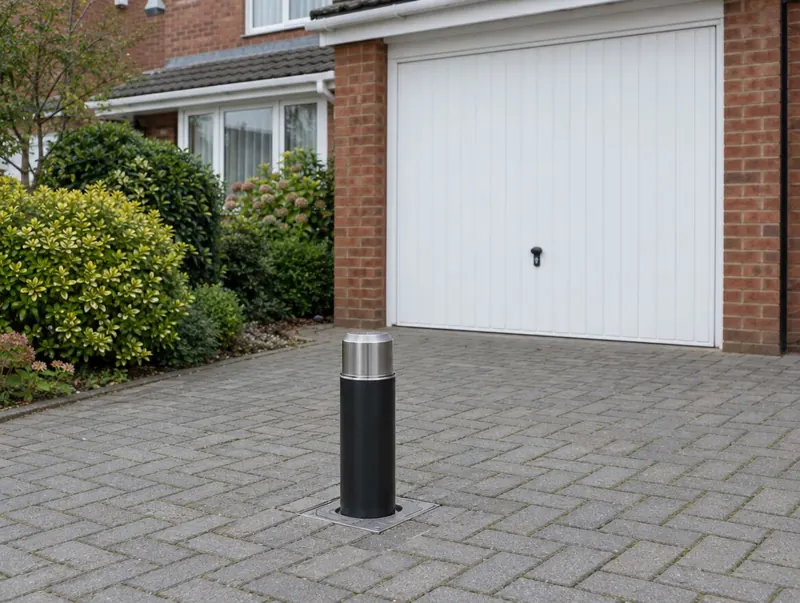 Computer-generated image
Telescopic bollards in Cambridgeshire
Key-locked telescopic bollards that retract into a ground cassette, for driveways, private bays and access roads. We cover Cambridgeshire — Peterborough, Cambridge, Wisbech, St Neots and Huntingdon and more.
Highway authorities for local roads in Cambridgeshire: Cambridgeshire County Council and Peterborough City Council.
Choose your town in Cambridgeshire
Guide prices in Cambridgeshire
| Specification | Guide price | Includes |
|---|---|---|
| Standard | £355–£725 + VAT · £425–£865 inc VAT | Standard post, foundation, reinstatement |
| Upgraded | £615–£985 + VAT · £735–£1,195 inc VAT | Upgraded finish or fittings, reflective band, matched keys |
| Premium | £885–£1,245 + VAT · £1,045–£1,495 inc VAT | Heavy-duty or architectural spec, premium finish |
Per bollard with cassette, supplied and installed; +3% for East of England. Guide only — the fixed price follows a survey.
Local authorities across Cambridgeshire
| Town | Highway / roads authority | Planning authority |
|---|---|---|
| Peterborough | Peterborough City Council | Peterborough City Council |
| Cambridge | Cambridgeshire County Council | Cambridgeshire County Council |
| Wisbech | Cambridgeshire County Council | the council for Fenland |
| St Neots | Cambridgeshire County Council | the council for Huntingdonshire |
| Huntingdon | Cambridgeshire County Council | the council for Huntingdonshire |
| March | Cambridgeshire County Council | the council for Fenland |
| Ely | Cambridgeshire County Council | the council for East Cambridgeshire |
Rules for telescopic bollards in England
Bollards on adopted highway are a matter for the highway authority under the Highways Act 1980, so they need its written agreement. On private land the owner's agreement is what matters; listed buildings and conservation areas need a word with the planning team first. Accessibility guidance asks for posts at least 1,000 mm high with contrasting tops and no chains between them.
Details and sources: bollard rules in England.
How installation works
Cut and excavate
The surface is cut neatly and the hole dug to the cassette's full depth plus a drainage layer, with care near any service that crosses the drive.
Form the drainage
A gravel soakaway is placed beneath the cassette, or a pipe is laid to a surface water drain or new soakaway.
Set the cassette
The cassette is set vertical and its top exactly at finished surface level and fall, then concreted in. A cassette set high or low is a common cause of tyre damage and trip edges.
Reinstate and test
The surface is made good to match. The post is raised, locked, lowered and locked several times to confirm smooth operation, and keys are handed over.
Telescopic bollards in Cambridgeshire: FAQs
Do you cover all of Cambridgeshire for telescopic bollards?
Yes — including Peterborough, Cambridge, Wisbech, St Neots, Huntingdon, March and Ely. Enter your postcode in the price calculator to confirm.
How much do telescopic bollards cost in Cambridgeshire?
In Cambridgeshire, typically £355–£1,245 per bollard with cassette, supplied and installed, plus VAT (£425–£1,495 including VAT for homeowners), with a minimum job of £655 plus VAT, using our East of England guide prices. The fixed figure comes in writing after we've seen the site.
Who do I ask about bollards on public land in Cambridgeshire?
For local roads, Cambridgeshire County Council and Peterborough City Council; National Highways covers motorways and trunk roads. Bollards on adopted highway need the highway authority's written agreement.
Can a telescopic bollard be fitted into a resin or imprinted drive?
Yes, though the cut has to be made cleanly and the surface patched around the lid. Resin and imprinted finishes are hard to match exactly, so we plan positions to keep visible patching small.
How deep does a telescopic bollard go into the ground?
Usually around the exposed height of the post plus the cassette base and drainage layer, which often comes to a metre or more. The exact depth depends on the model. That depth is why we check for services under the drive first.