Cambridgeshire · England
Telescopic bollard installation in Cambridge
Telescopic bollards for sites across Cambridge and the rest of Cambridgeshire, from the first measurement to the last relaid paving block.
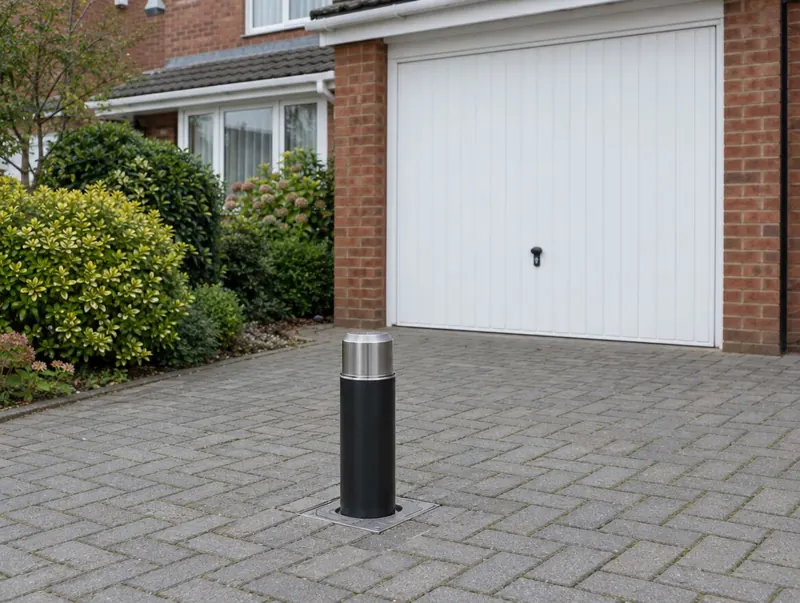 Computer-generated image
Telescopic bollards in Cambridge
From housing association car parks, business parks and high streets, Cambridge has plenty of places where telescopic bollards earn their keep. Because the post stays in its cassette, there is nothing to store and nothing to lose.
We cover Cambridge's CB2, CB1, CB3, CB4 and CB5 postcode districts, including places such as Fen Ditton. Jobs in Cambridge can be combined with work in Newmarket (12.6 miles), Ely (15.1 miles), Huntingdon (15.7 miles) and Haverhill (15.9 miles) (straight-line distances). Cambridge is about 32 miles from Luton.
Cambridge at a glance
- Area
- Cambridgeshire, England
- Highway authority
- Cambridgeshire County Council (local roads)
- Planning authority
- Cambridgeshire County Council
- Postcodes
- CB2, CB1, CB3, CB4 and CB5
- Guide price
- Typically £355–£1,245 per bollard + VAT (£425–£1,495 inc VAT for homes); minimum job £655
- Survey
- Free, with a fixed written quote
- Nearby
- Newmarket (12.6 mi), Ely (15.1 mi), Huntingdon (15.7 mi), Haverhill (15.9 mi)
Where telescopic bollards go in around Cambridge
Common uses in a place like Cambridge:
- Allocated parking bays in flats and private developments
- Domestic driveways where the bollard is used daily
- Access roads closed outside working hours
Cambridge: typical telescopic bollard prices
| Specification | Guide price | Includes |
|---|---|---|
| Standard | £355–£725 + VAT · £425–£865 inc VAT | Standard post, foundation, reinstatement |
| Upgraded | £615–£985 + VAT · £735–£1,195 inc VAT | Upgraded finish or fittings, reflective band, matched keys |
| Premium | £885–£1,245 + VAT · £1,045–£1,495 inc VAT | Heavy-duty or architectural spec, premium finish |
Per bollard with cassette, supplied and installed; +3% for East of England. Guide only — the fixed price follows a survey.
What we check first in Cambridge
Cambridgeshire County Council is the highway authority covering Cambridge's local roads. If any post would stand on adopted highway rather than your land, that consent is the first thing we sort out.
Many private-land installations in Cambridge need no planning application, but the rules don't clearly cover bollards, so listed buildings, conservation areas and prominent frontages are worth raising with the planning team at Cambridgeshire County Council before posts go in.
Reinstatement matches the drive, whether block paving, tarmac, resin-bound or imprinted concrete. Telescopic bollards need a deeper excavation than other manual bollards, so ground and services decide where they can go.
- Confirm the bollard is on your land; bollards on a public footway or dropped kerb need the highway authority's agreement.
- Connect drainage only to surface water systems or a soakaway, never to a foul drain.
Installation, step by step
Check depth and drainage
The free site survey checks how far down we can dig, where services run under the drive and how the ground drains. If water will stand, a drain connection is priced into the fixed written quote.
Cut and excavate
The surface is cut neatly and the hole dug to the cassette's full depth plus a drainage layer, with care near any service that crosses the drive.
Form the drainage
A gravel soakaway is placed beneath the cassette, or a pipe is laid to a surface water drain or new soakaway.
Specification choices
| Option | Detail |
|---|---|
| Standard or lift-assisted | Lift-assisted models use a spring or counterweight so the post rises with little effort, useful for daily domestic use. |
| Diameter and height | Commonly around 90–140 mm diameter and 600–900 mm raised height, with larger posts for commercial use. |
| Finishes | Galvanised, powder-coated in common colours, or stainless steel to suit the frontage. |
What affects the quote
Our East of England guide prices are a starting point; the survey in Cambridge firms them up. What tends to move them:
- Number of posts and keyed-alike locks
- Excavation depth and the presence of services under the drive
- Post size and whether lift assistance is wanted
Keeping them working
Lower and raise the bollard regularly, even if you rarely need to, so the mechanism stays free. Lubricate the lock with a suitable spray, especially before winter.
For damaged or loose posts in Cambridge, repairs and replacements are priced in writing first.
Questions about telescopic bollards in Cambridge
Do you install telescopic bollards in Cambridge?
We cover all of Cambridge (CB2, CB1, CB3, CB4 and CB5) and the rest of Cambridgeshire. We also work in Newmarket, Ely and Huntingdon.
Who gives permission for bollards on the pavement in Cambridge?
The highway authority for local roads in Cambridge is Cambridgeshire County Council; motorways and trunk roads sit with National Highways. Telescopic bollards on the adopted footway are a matter for the highway authority, so we only install there with its written agreement.
How much do telescopic bollards cost in Cambridge?
In Cambridge, typically £355–£1,245 per bollard with cassette, supplied and installed, plus VAT (£425–£1,495 including VAT for homeowners), with a minimum job of £655 plus VAT, using our East of England guide prices. The fixed figure comes in writing after we've seen the site.
Is a telescopic bollard harder to lift than a removable one?
Usually easier, because you only lift it up a short distance within its cassette and many models have lift assistance. You also never carry it or store it anywhere.
Why does my telescopic bollard fill with water?
Because the cassette is not draining, either through a blocked base, clay ground or no drainage provision at installation. Standing water rusts the post and can freeze it in place. Fixing the drainage usually solves the problem.
Telescopic bollards in nearby towns
- Newmarket (12.6 mi)
- Ely (15.1 mi)
- Huntingdon (15.7 mi)
- Haverhill (15.9 mi)
- St Neots (16.3 mi)
- Letchworth Garden City (21.1 mi)