Argyll and Bute · Scotland
Warehouse and loading-bay bollards in Dunoon
Warehouse impact bollards for sites across Dunoon and the rest of Argyll and Bute, from the first measurement to the last relaid paving block.
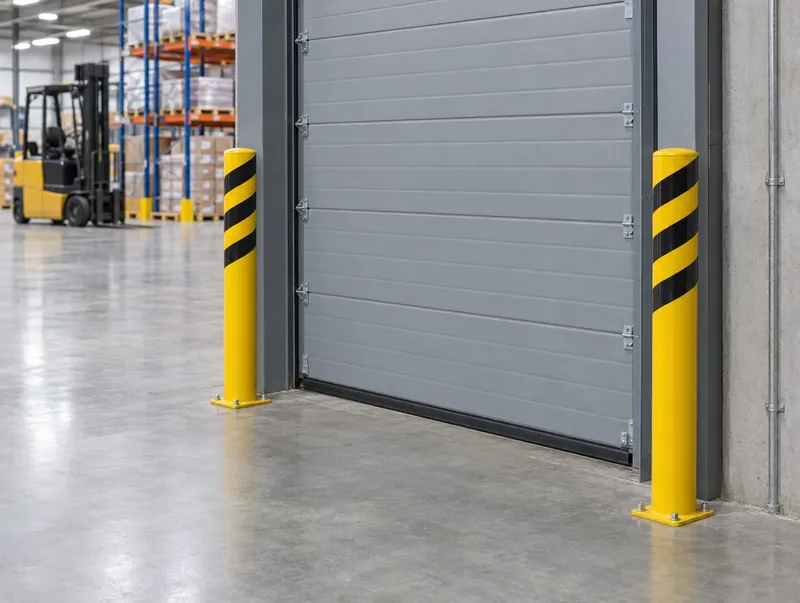 Computer-generated image
Warehouse bollards in Dunoon
Across Dunoon, typical sites for warehouse impact bollards include small industrial units, community buildings and high street shopfronts. Yellow steel and polymer impact bollards for forklift zones, loading bays, doors, columns and racking inside warehouses.
Coverage in Dunoon takes in the PA23 postcode district and nearby places like Sandbank, Innellan, Kilmun and Blairmore. Dunoon is fairly self-contained, with no other large town within about 20 miles.
Key facts for this area
- Area
- Argyll and Bute, Scotland
- Roads authority
- Argyll and Bute Council (local roads)
- Planning authority
- Argyll and Bute Council
- Postcodes
- PA23
- Guide price
- Typically £175–£1,195 per bollard + VAT; minimum job £445
- Survey
- Free, with a fixed written quote
Dunoon: typical warehouse impact bollard prices
| Specification | Guide price | Includes |
|---|---|---|
| Standard | £175–£605 + VAT | Standard post, foundation, reinstatement |
| Upgraded | £485–£905 + VAT | Upgraded finish or fittings, reflective band, matched keys |
| Premium | £785–£1,195 + VAT | Heavy-duty or architectural spec, premium finish |
Per bollard, supplied and fixed; no regional adjustment. Guide only — the fixed price follows a survey.
Typical warehouse impact bollards jobs in Dunoon
Around Dunoon, warehouse impact bollards usually solve one of these:
- Loading dock doors, shutter guides and dock levellers
- Charging stations for forklifts and pallet trucks
- Racking ends and corners in busy aisles
Permissions and groundwork in Dunoon
Dunoon falls under Argyll and Bute Council as roads authority. If the line of posts crosses onto adopted road or pavement, permission comes before excavation; on private land it does not.
Many private-land installations in Dunoon need no planning application, but the rules don't clearly cover bollards, so listed buildings, conservation areas and prominent frontages are worth raising with the planning team at Argyll and Bute Council before posts go in.
Where a slab is too thin or poor, the options include through-bolting, a larger base plate to spread load, a polymer bollard that reduces anchor forces, or breaking out and casting a new local foundation. External yard bollards can be root-fixed in concrete foundations, with the usual checks for buried drainage and cables.
- Use your workplace transport risk assessment to decide where protection is needed, in line with HSE guidance on workplace transport.
- Check with the building owner before drilling into slabs with underfloor heating, guidance wires or post-tensioned reinforcement.
What happens on site
Walk the site with the vehicles running
At the free site survey we watch traffic routes, note the vehicles and loads, and look for existing damage that shows where impacts happen. You receive a fixed written quote with each position and product listed.
Check the slab
Slab thickness, joints, cracks and any underfloor services or heating are checked, and anchors are chosen for the floor rather than taken from a standard list.
Drill and anchor
Holes are drilled, cleaned and anchors installed to the maker's instructions. Chemical anchors are left to cure before the bollard is loaded.
Finishes and options
| Option | Detail |
|---|---|
| Diameters and heights | Commonly 114–273 mm diameter and around 600–1,200 mm high, chosen for vehicle type and mast or fork height. |
| Steel bollards | Yellow-coated steel tube on a base plate, often concrete-filled. Robust and economical, but they pass impact loads straight into the slab. |
| Door frame protection | Bollards or low barriers either side of dock doors and roller shutters to protect frames and guides. |
What affects the quote
Our Scotland guide prices are a starting point; the survey in Dunoon firms them up. What tends to move them:
- Slab condition and the anchors or foundations it needs
- Steel or polymer bollards and the impact performance needed
- Number of positions and types of guard
Looking after them
On steel bollards look for bending, cracked welds, loose or sheared anchors and cracked concrete around the base plate. Persistent strikes in one place often mean the route or turning space needs changing rather than heavier protection.
If posts in Dunoon are later hit or damaged, we can repair or replace them — see bollard repairs.
Common questions
Which parts of Dunoon do you cover for warehouse impact bollards?
We cover all of Dunoon (PA23) and the rest of Argyll and Bute.
Do I need consent for warehouse impact bollards on a public footway in Dunoon?
In Scotland the council is the roads authority for local roads, which in Dunoon means Argyll and Bute Council. Warehouse impact bollards on an adopted footway need its consent; trunk roads sit with Transport Scotland.
How much do warehouse impact bollards cost in Dunoon?
In Dunoon, typically £175–£1,195 per bollard, supplied and fixed, plus VAT, with a minimum job of £445 plus VAT, using our Scotland guide prices. The fixed figure comes in writing after we've seen the site.
What size bollard do we need for forklifts?
That depends on the forklift's weight with load and how fast it travels near the asset, not just the post diameter. Tested products state their impact performance, which can be compared with your fleet. We size from your vehicles at the survey.
How close to a column should a bollard sit?
Close enough that a vehicle cannot reach the column around it, but with enough gap that the bollard does not hit the column when struck. Polymer bollards need more clearance than steel because they deflect. The gap is set from the product data.