Guide
How do bollards stop ram raids on shops and ATMs?
Where to place bollards against ram raids on shopfronts, ATMs and jewellers: approach angles, run-up, rated or unrated posts, highway land and insurers.
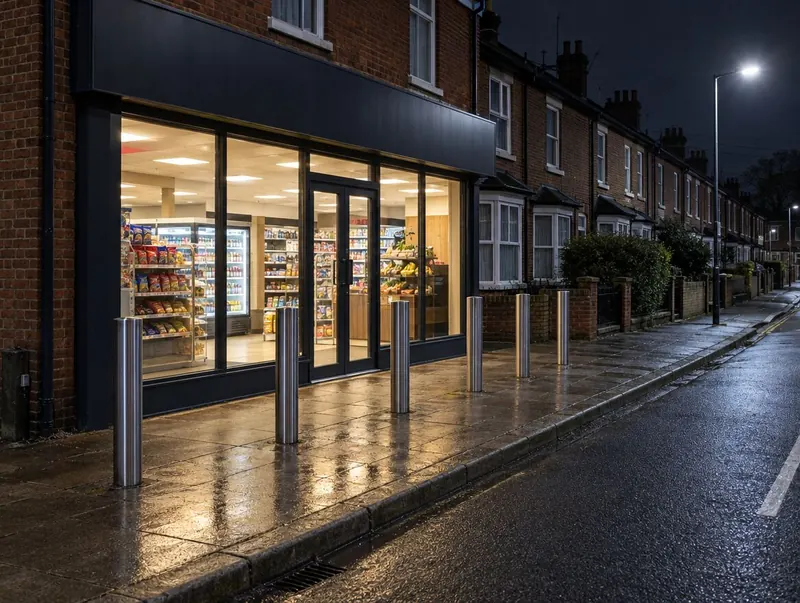 Computer-generated image
Bollards stop a ram raid by putting a fixed obstacle between a vehicle and the glass, cash machine or doorway it would be driven into, with gaps too narrow for a vehicle to pass. Heavy concrete-filled steel posts on deep footings suit many shops, while crash-rated bollards have been tested to stop a stated vehicle at a stated speed, which an unrated post has not. The layout matters as much as the post: cover every approach, limit the run-up and check who owns the ground in front of the shop.
Where should ram-raid bollards go?
Across every line a vehicle could take to the target, not just the obvious one. Stand at the shopfront and look outwards: a vehicle might come straight off the road, diagonally across a forecourt or car park, or along a service road. Each approach needs covering, including the corners and returns of the frontage. The longer the straight run-up, the faster a vehicle arrives, so long, open approaches call for heavier posts or a layout that breaks up the run. Set posts far enough from the glass to keep doors, fire exits and the cash machine usable, and close enough that a vehicle can't fit between the bollards and the front.
How far apart should ram-raid bollards be?
Close enough to stop a vehicle and wide enough for people. Where bollards act as a vehicle security barrier, DfT's Inclusive Mobility and TAL 1/11 put the maximum clear gap at 1200 mm, measured 600 mm above the ground, which still lets wheelchair users and people with prams through. Shopfront layouts commonly use gaps of around 1000 to 1200 mm. Keep the remaining footway usable too, and don't chain posts together, which Inclusive Mobility advises against. See our spacing and accessibility guide.
Do I need crash-rated bollards, or will heavy steel posts do?
Heavy unrated posts on deep reinforced footings suit many shops; jewellers, cash machines and high-value stock may justify tested products, especially if an insurer or adviser asks for them. There are three levels:
- Unrated heavy posts: concrete-filled steel tube, often 140–219 mm in diameter, or heavy-duty telescopic posts. Strong, but with no tested performance.
- Low-speed tested: PAS 170-1 tests a single bollard against a 2,500 kg trolley at 16 or 32 km/h and is aimed at car parks and retail sites. BSI says it is not equivalent to a full-scale vehicle test.
- Full vehicle rating: ISO 22343-1, PAS 68 or IWA 14-1, tested with a real vehicle and valid only on the tested foundation.
ASTM F3016 is a US low-speed test, not an HVM rating, whatever a product listing suggests. More in crash-rated bollards explained.
What if the ground in front of my shop is pavement?
Then it is probably adopted highway, and bollards there need the highway authority's written agreement. In England and Wales, posts on the highway are a matter for the authority under the Highways Act 1980, and obstructing the highway without lawful authority is an offence under section 137. Scotland requires the roads authority's written consent and Northern Ireland the Department for Infrastructure's. Some shop forecourts are private, so check the title plan and the council's adopted highways register; if the forecourt is yours, the job is much simpler. If it isn't, approach the authority early with photos and a plan, and check your lease for restrictions on alterations to the frontage. See bollards on the pavement.
Will my insurer ask for bollards?
It might, particularly for jewellers, cash machines or high-value stock, so ask before you order. If an insurer sets a condition, get the required standard or product in writing, because "anti-ram bollards" can mean anything from a plain steel post to a fully rated system. We install to that specification. Fitting bollards won't necessarily change your premium; that is the insurer's decision, and we can't promise any effect on your cover.
What do ram-raid bollards cost?
Unrated ram-raid bollards typically cost £395–£1,495 per bollard plus VAT, supplied and installed, with a minimum job of around £945. Four posts across a shopfront on a concrete forecourt come to about £3,145–£5,795 plus VAT on the Upgraded specification in our price calculator, or £3,445–£6,745 if the work is done out of hours so the shop can keep trading. Crash-rated bollards start from around £1,995 per position plus VAT, before design and permits.
How do we install ram-raid protection?
We survey first and dig carefully, because shopfronts hide a lot underground. Pavements and forecourts in front of shops can hold cellars, vaults, coal holes and service entries, and filling station forecourts carry fuel lines, tank vents and interceptors. We locate services, hand-dig near them and adjust positions if needed. Footings are excavated and reinforced, posts set plumb and the surface reinstated to match. Telescopic or removable posts can go where deliveries or cash machine servicing need access, and our installation crews, working under our management, can work out of hours. For rated systems we follow the manufacturer's tested foundation and your security adviser's layout; we don't design HVM schemes. Every installation starts with a free survey and a fixed written quote.
Prepared by the Bollard Installers team · Last reviewed 01 November 2026 · Prices and rules change; check the rules pages and your written quote.
Questions
Can telescopic bollards stop a ram raid and still let deliveries in?
Heavy-duty telescopic anti-ram posts are made for this, lowering when a delivery is due and locking up afterwards. Their strength depends on the cassette and footing as much as the post, so they need a deep, well-made foundation.
Will planters or boulders stop a ram raid?
Unless the product has been tested and listed, nobody can say what it will stop. A heavy planter may slow a vehicle, but a purpose-made bollard line is more predictable, and anything on the highway still needs the authority's agreement.
Can the bollards be fitted outside opening hours?
Yes. Out-of-hours working adds £295–£945 per job plus VAT and is shown as its own line in the written quote.
Is ram-raid protection required under Martyn's Law?
No. Martyn's Law doesn't require bollards at any tier, so ram-raid protection is a crime-prevention decision for you and your insurer.
Related services
Ram-raid protection bollards
Bollards fitted in front of shopfronts, ATMs, jewellers and convenience stores to stop vehicles being used to break in.
Learn more →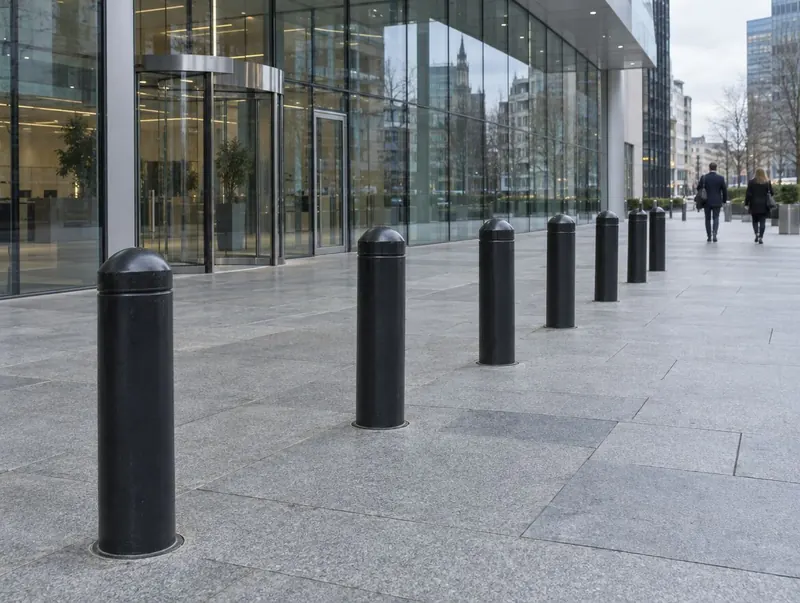
Crash-rated (HVM) bollards
Installation of impact-tested HVM bollards rated to ISO 22343-1 (or the superseded, still-accepted PAS 68 / IWA 14-1) on the tested foundation.
Learn more →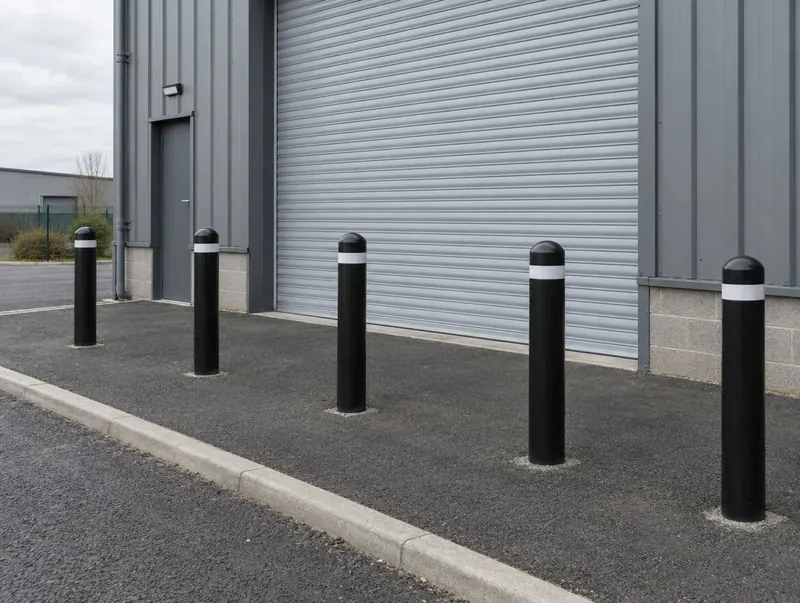
Steel security bollards (unrated)
Concrete-filled steel bollards, root-fixed or base-plated, for car parks, forecourts, boundaries and nuisance vehicle control.
Learn more →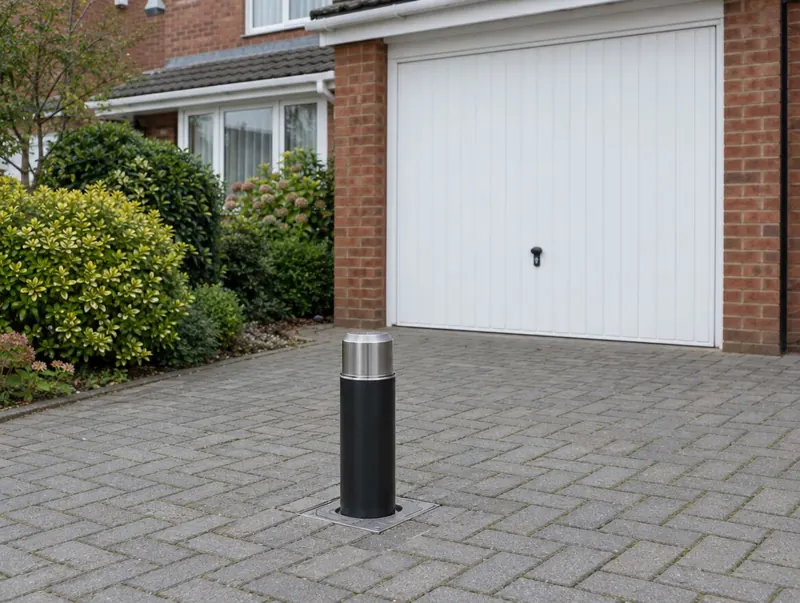
Telescopic bollards
Key-locked telescopic bollards that retract into a ground cassette, for driveways, private bays and access roads.
Learn more →