Flintshire · Wales
Access control for automatic bollards in Mold
Bollard access control systems supplied and fitted in Mold, Flintshire: surveyed, scanned for services, set in proper foundations and finished to match the ground.
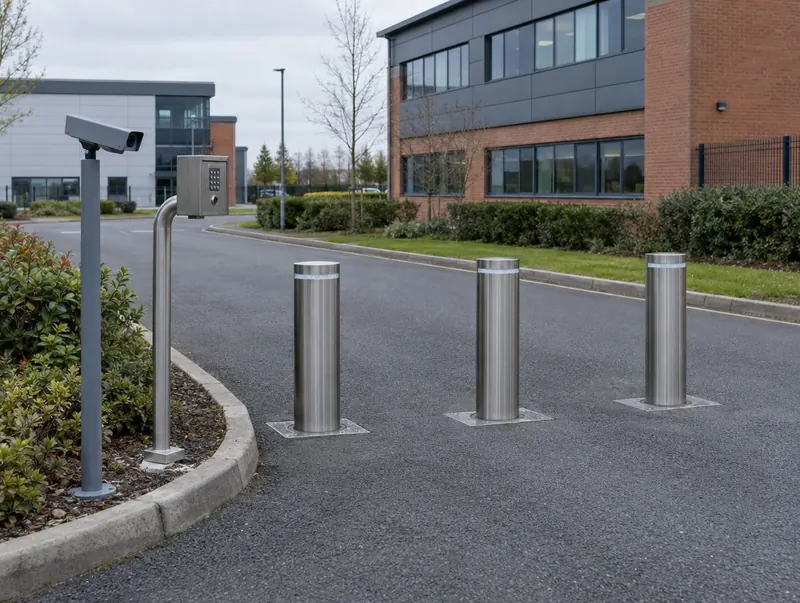 Computer-generated image
Bollard access control in Mold
We supply and fit bollard access control systems throughout Mold, typically for sites such as filling-station forecourts, town-centre squares and small industrial units. A good scheme lets authorised vehicles in without delay while safety devices still decide when the bollard may move.
We work across CH7 — Mold itself and places including Mynydd Isa, Northop Hall, Drury and Treuddyn. Nearby, we also work in Deeside (4.9 miles), Flint (5.4 miles), Coedpoeth (8.5 miles) and Wrexham (10.4 miles), measured as the crow flies.
Key facts for this area
- Area
- Flintshire, Wales
- Highway authority
- Flintshire County Council (local roads)
- Planning authority
- Flintshire County Council
- Postcodes
- CH7
- Guide price
- Typically £575–£11,595 per entrance + VAT
- Survey
- Free, with a fixed written quote
Mold: typical access control prices
| Specification | Guide price | Includes |
|---|---|---|
| Standard | £575–£5,245 + VAT | Remote fobs or a standalone keypad |
| Upgraded | £3,895–£8,545 + VAT | GSM intercom with keypad on a post |
| Premium | £7,195–£11,595 + VAT | ANPR camera, software and integration |
Per entrance, controls supplied, installed and commissioned; -3% for Wales. Guide only — the fixed price follows a survey.
Bollard access control systems in Mold: common uses
Around Mold, bollard access control systems usually solve one of these:
- Residential estates and mews with controlled vehicle access
- Business parks and campuses with large numbers of staff vehicles
- Sites needing a record of vehicle entries and exits
Consents, ground and services in Mold
Local roads and pavements in Mold are the responsibility of Flintshire County Council as highway authority, with the Welsh Government's trunk road agents handling trunk roads. Posts on the public highway need that authority's consent; private land does not.
Bollards on private land often don't need planning permission, but it depends on the council's view, the height and the location; in a conservation area, next to a listed building or under an Article 4 direction, ask the local planning authority (Flintshire County Council) first — we flag this at survey.
Ducts between the controller, readers and cameras usually cross footways and verges where services run, so routes are traced before digging and draw pits are placed where runs change direction. Access control adds duct runs, pedestals and loops to a bollard installation, and each means cutting into the surface.
- Agree emergency access with the fire and ambulance services and test the override.
- If you use ANPR or video, check your obligations for handling personal data, including signage, a privacy notice and how long records are kept.
What happens on site
Understand the users
At the free site survey we ask who uses the entrance, how many, how often they change, and how visitors and deliveries arrive. That decides the entry method, and a fixed written quote follows.
Plan positions
Readers, cameras and intercoms are placed so drivers stop well before the bollard, with queueing space off the public road where possible.
Hand over
You are shown how to add and remove users, read logs and use the emergency override. Credentials and settings are recorded.
Specification choices
| Option | Detail |
|---|---|
| ANPR cameras | Read number plates and compare them with an approved list. Suited to large user groups and hands-free entry; needs careful camera placement and lighting. |
| GSM and video intercoms | Visitors call a person or phone, who opens remotely. Video models let the person answering see who is at the entrance. |
| Exit loops and timers | Loops lower the bollard for vehicles leaving; timers hold it down during set windows. |
Pricing bollard access control systems in Mold
Our Wales guide prices are a starting point; the survey in Mold firms them up. What tends to move them:
- Integration with existing access control or fire systems
- Pedestals, lighting for cameras and signage
- Entry method chosen and number of devices
After installation
Test exit loops and emergency overrides at each service visit. If the bollard opens for people who should not have access, the user list is usually the cause rather than the hardware.
For damaged or loose posts in Mold, repairs and replacements are priced in writing first.
Questions about bollard access control systems in Mold
Which parts of Mold do you cover for bollard access control systems?
We cover all of Mold (CH7) and the rest of Flintshire. We also work in Deeside, Flint and Coedpoeth.
Do I need consent for bollards on a public footway in Mold?
Local roads and pavements in Mold are the responsibility of Flintshire County Council as highway authority, with the Welsh Government's trunk road agents handling trunk roads. Posts on the public highway need that authority's consent; private land does not.
What's a typical price for bollard access control systems in Mold?
In Mold, typically £575–£11,595 per entrance, controls supplied, installed and commissioned, plus VAT, using our Wales guide prices. The fixed figure comes in writing after we've seen the site.
How do visitors and delivery drivers get through?
Usually by intercom to reception or a phone, by a temporary code, or by a timed delivery window. Some systems issue time-limited access to a visitor's number plate. The choice depends on how many visitors arrive and who is there to manage them.
Can new access control be added to our existing bollards?
Often, yes, if the bollard controller can accept the new devices. We check the existing controller and cabling first. Very old controllers sometimes need replacing at the same time.